
Electro-optical device, electronic apparatus, and method of detecting position of directing object
An electro-optical device and detection method technology, which is applied in the directions of optics, nonlinear optics, static indicators, etc., can solve the problems that do not mention the relationship between "polarity inversion drive" and the touch panel, and achieve the reduction of image disordered effect
- Summary
- Abstract
- Description
- Claims
- Application Information
AI Technical Summary
Problems solved by technology
Method used
Image

Examples
no. 1 Embodiment approach
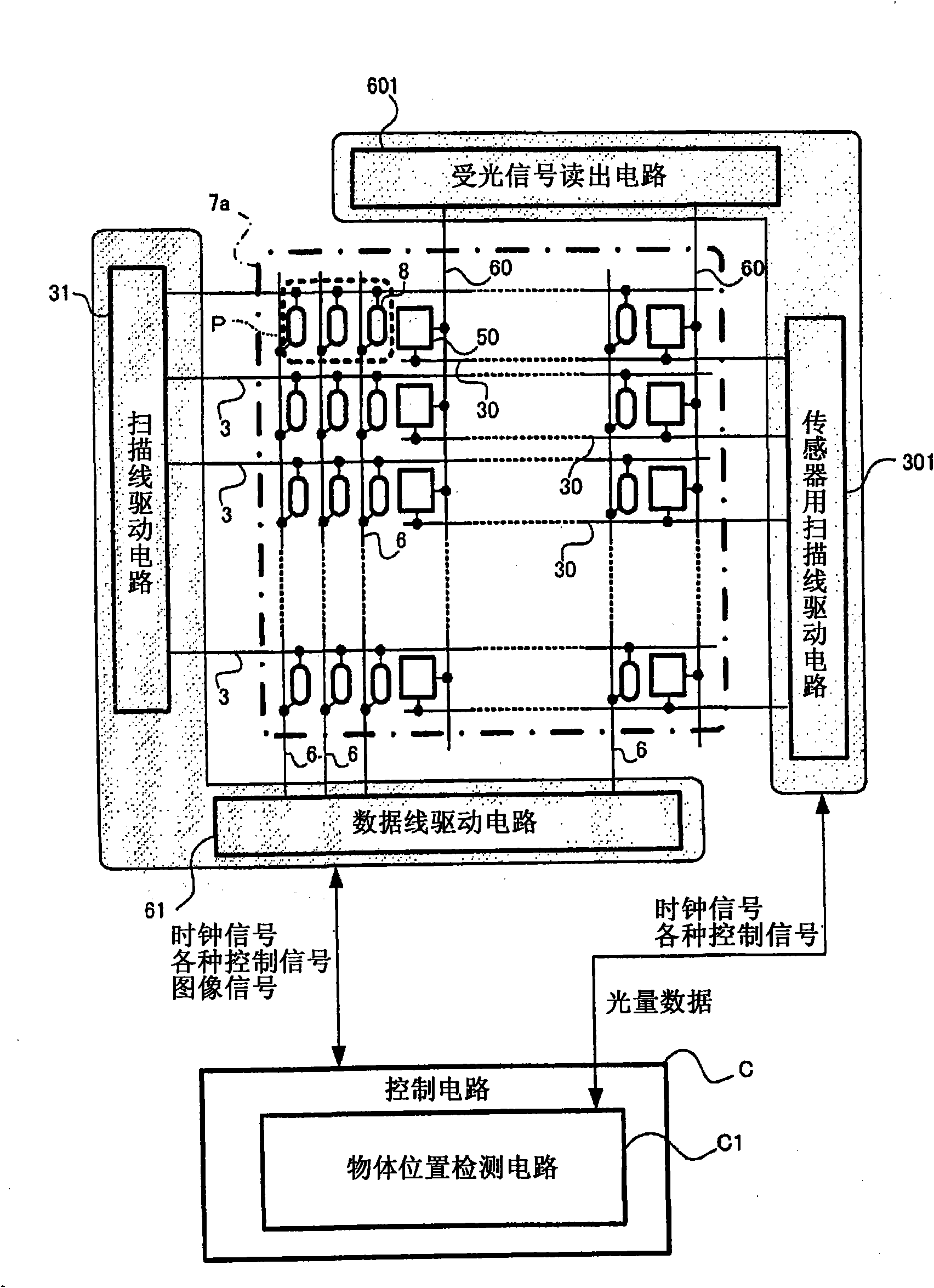
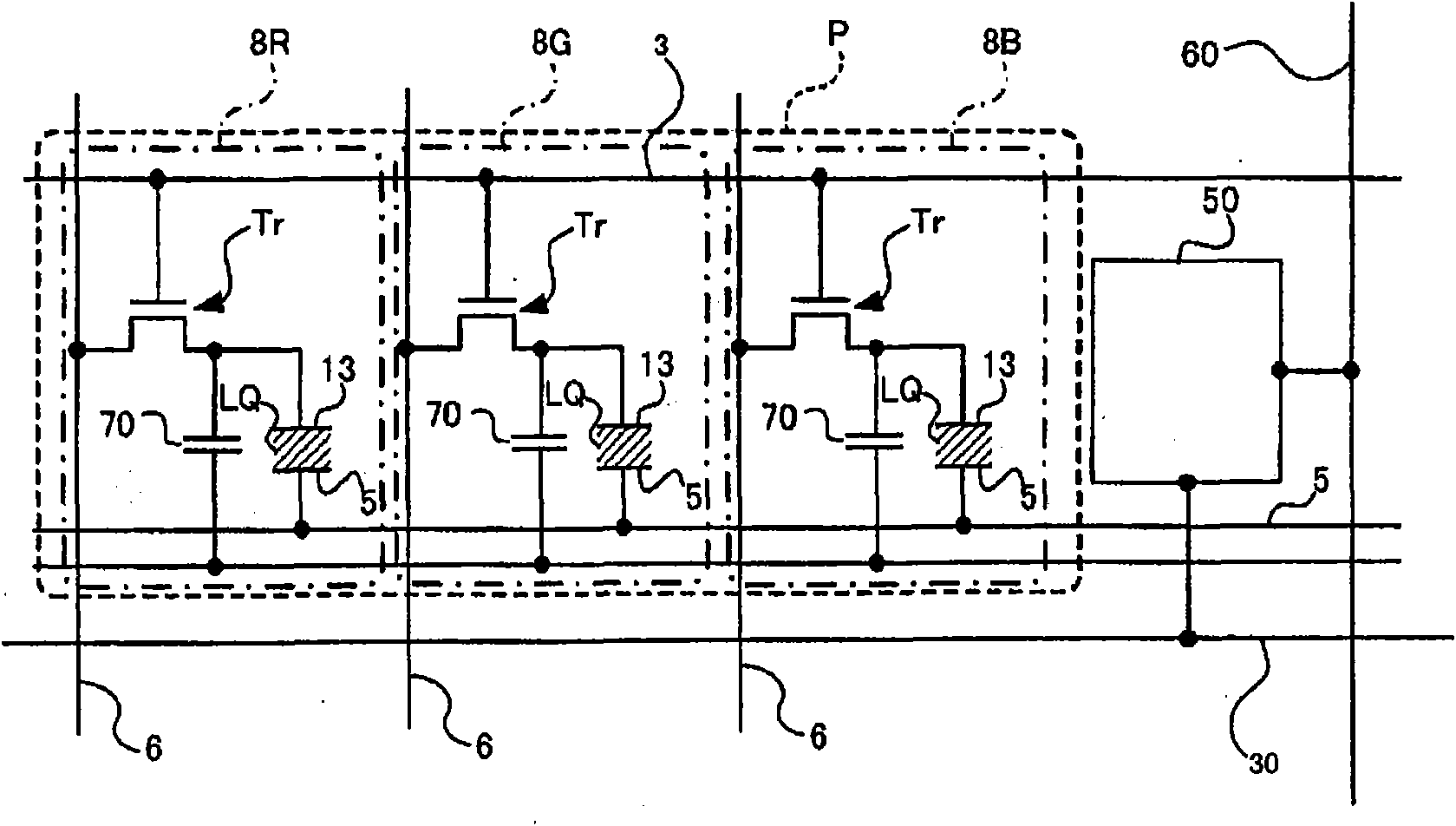
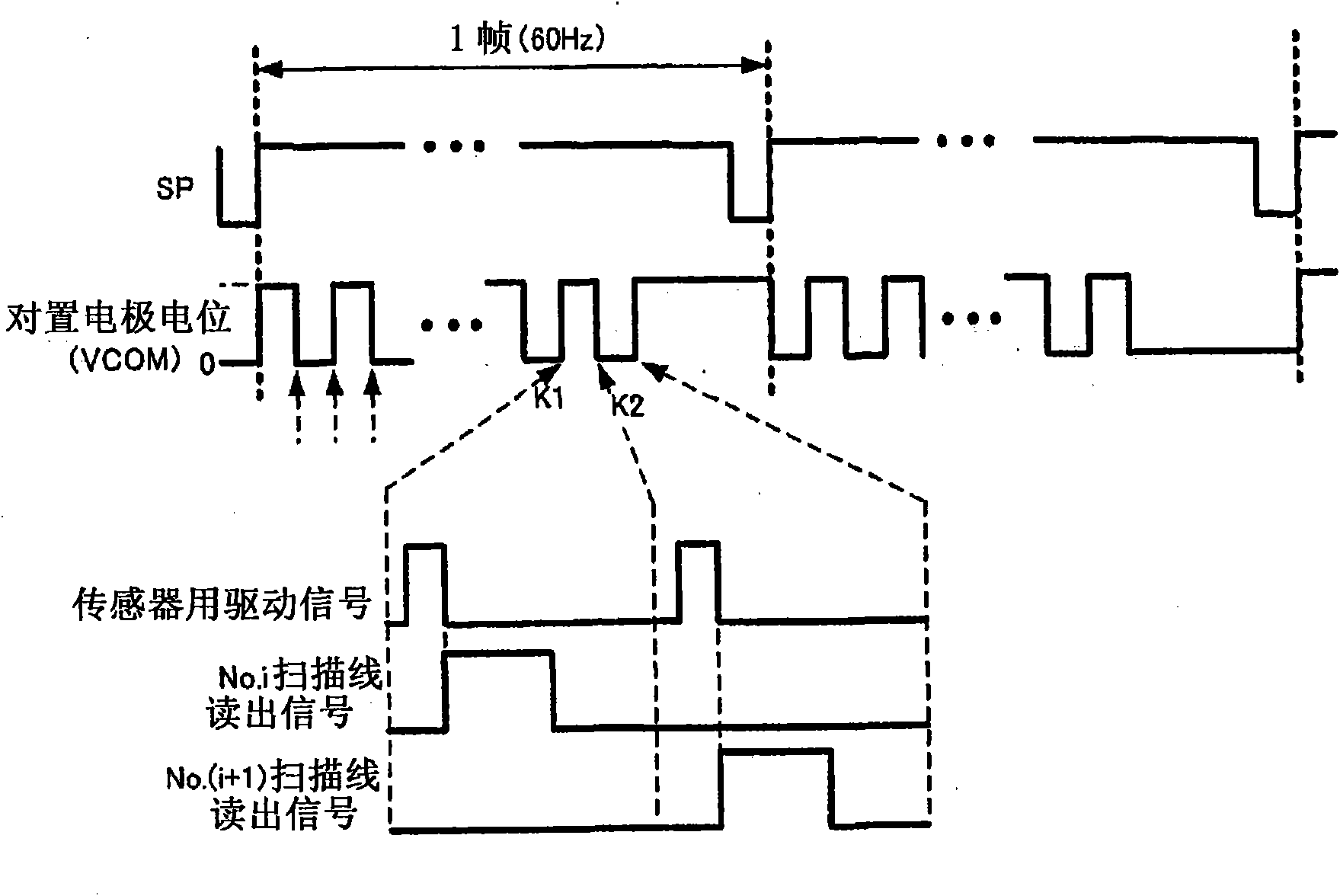
[0071] Below, refer to figure 1 as well as figure 2 A first embodiment of the present invention will be described. Also, in addition to the figure 1 and figure 2 , in the drawings that will be referred to below, also includes image 3 , Figure 11 The size or scale of the curves on the timing chart shown may be slightly different from the actual ratio of the dimensions of each part.
[0072] like figure 1 As shown, the electro-optical device 1 of the first embodiment includes a liquid crystal element (electro-optical element) 8 , scanning lines 3 , data lines 6 , scanning line driving circuit 31 , data line driving circuit 61 , and the like.
[0073] where the liquid crystal element 8, such as figure 2 As shown in detail in , it is composed of the pixel electrode 13, the counter electrode 5, the storage capacitor 70, and the switching transistor Tr.
[0074] The pixel electrodes 13 are arranged in a matrix on an element substrate not shown in the figure (refer to fig...
no. 2 Embodiment approach
[0118] Below, refer to Figure 8 to Figure 11 A second embodiment of the present invention will be described. In addition, since the configuration of the electro-optical device 1 of the second embodiment and the basic processing related to the object position detection processing are the same as those of the first embodiment, descriptions of overlapping parts will be briefly described or appropriately omitted.
[0119] First, in the second embodiment, if Figure 8 As shown, one light quantity detection element 50 is provided for every twelve liquid crystal elements 8 . However, among 12 liquid crystal elements 8, one group is constituted (refer to Figure 8 The arrangement state of the three liquid crystal elements 8 in symbol P) is the same as that of the first embodiment, and the red, green, and blue light emitting liquid crystal elements 8R, 8G, and 8B are arranged in order from the left in the figure. All 12 liquid crystal elements 8 are arranged according to the arrang...
no. 3 Embodiment approach
[0146] Below, refer to Figure 12 A third embodiment of the present invention will be described. In addition, the configuration of the electro-optical device 1 of the third embodiment and the content of the basic processing related to the object position detection processing are the same as those of the first embodiment, so overlapping parts will be briefly described or appropriately omitted.
[0147] In the third embodiment, Figure 5 Object image readout processing ( Figure 5 The content of step S201) is very characteristic. The treatment is as Figure 12 Proceed as shown.
[0148] That is, first, the control circuit C is different from the above-mentioned first and second embodiments in that it can be said that the image readout process for one scanning line is directly started ( Figure 12 step S503). In this regard, it is firstly determined whether or not the polarity inversion of the common potential VCOM has occurred in the two embodiments described above ( Fig...
PUM
 Login to View More
 Abstract
Description
Claims
Application Information
 Login to View More