Check patentability & draft patents in minutes with Patsnap Eureka AI!

Method for increasing sensitivity of latex reagent by crosslinking latex microspheres

A technology for detecting sensitivity and latex, which is applied in the field of medical testing, can solve the problems that the sensitivity cannot reach clinical testing, etc., and achieve the effects of fast detection speed, improved sensitivity, and high sensitivity

Inactive Publication Date: 2011-09-07
JILIN GETEIN BIOTECH CO LTD
View PDF3 Cites 17 Cited by
  • Summary
  • Abstract
  • Description
  • Claims
  • Application Information

AI Technical Summary

Problems solved by technology

[0004] The object of the present invention is to provide a kind of latex microsphere cross-linking method to increase the sensitivity of latex reagents, to solve the problem that the sensitivity of the traditional latex microsphere cross-linking method cannot reach clinical detection in the process of detecting the antigen to be tested

Method used

the structure of the environmentally friendly knitted fabric provided by the present invention; figure 2 Flow chart of the yarn wrapping machine for environmentally friendly knitted fabrics and storage devices; image 3 Is the parameter map of the yarn covering machine
View more

Image

Smart Image Click on the blue labels to locate them in the text.
Viewing Examples
Smart Image
  • Method for increasing sensitivity of latex reagent by crosslinking latex microspheres
  • Method for increasing sensitivity of latex reagent by crosslinking latex microspheres
  • Method for increasing sensitivity of latex reagent by crosslinking latex microspheres

Examples

Experimental program
Comparison scheme
Effect test

Embodiment 1

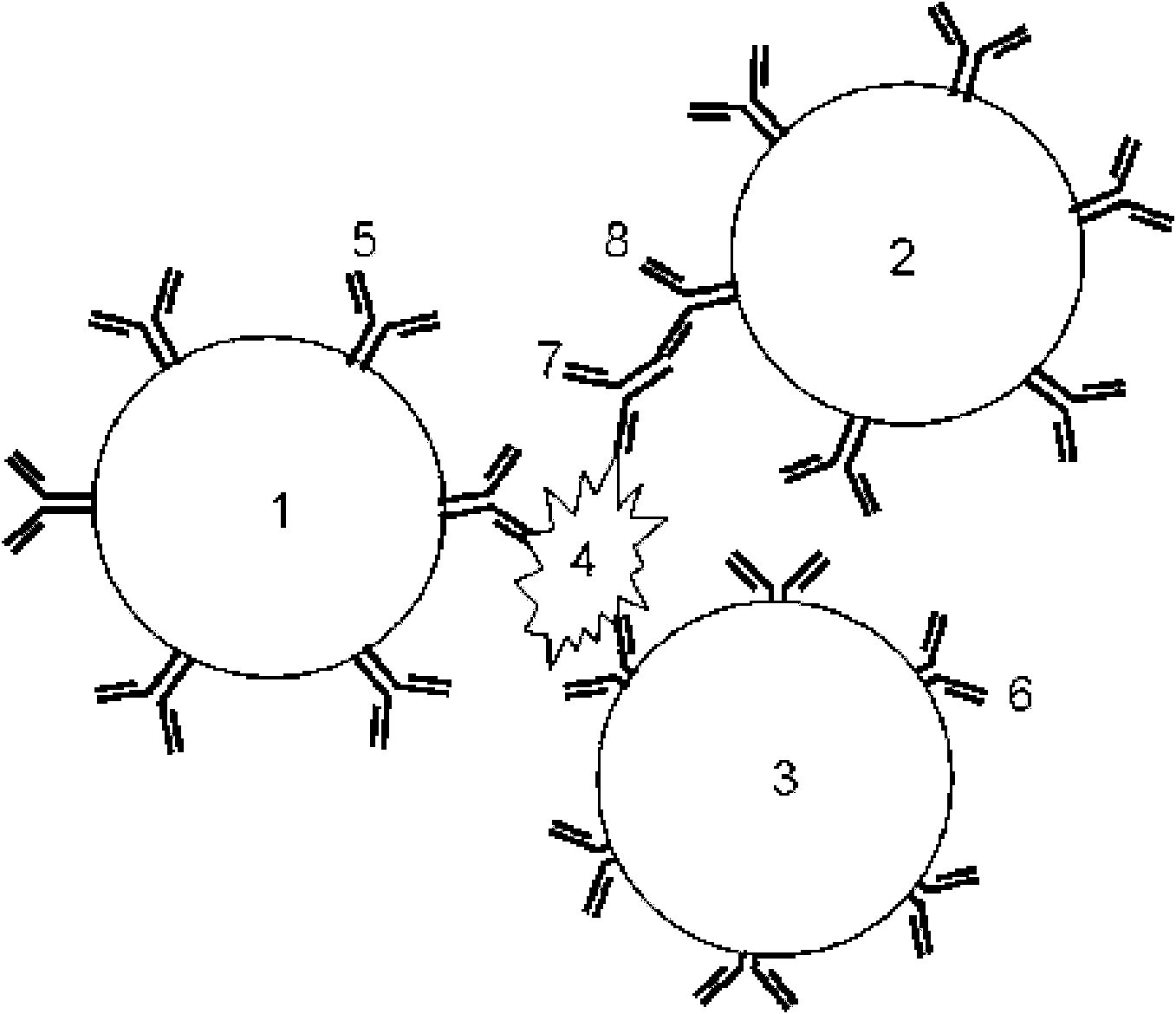
[0030] Such as figure 1As shown, the cTnI latex detection reagent includes the sensitized latex microsphere 1 whose surface is coated with the mouse anti-cTnI monoclonal antibody 5 that specifically recognizes the cTnI amino acid sequence 87-91, and the surface is coated with the mouse anti-cTnI monoclonal antibody 5 that specifically recognizes the cTnI amino acid sequence 88-106. Sensitized latex microspheres 3 of goat anti-cTnI polyclonal antibody F(ab) 2' fragment 6, sensitized latex microspheres 2 of the surface-coated mouse anti-goat Fc' end monoclonal antibody 8; the above three sensitized latex microspheres The balls are mixed according to the ratio of 1:1:1; the reaction buffer containing the goat anti-human cTnI polyclonal antibody 7 that recognizes the cTnI amino acid sequence 27-40 (the formula is 0.2M Tris-HCl, 0.9% NaCl, 0.25% BSA, 0.05% Tween-20, 100ng / ml goat anti-human cTnI polyclonal antibody, 1% PEG6000, pH 8.2).

[0031] Sensitized latex microspheres 1, 2,...

Embodiment 2

[0037] 1. Experimental equipment and reagents:

[0038] Olympus 5400 automatic biochemical analyzer, cTnI standard (BIO-RAD company), TBS-T buffer (0.2M Tris-HCl, 0.9% NaCl, 0.25% BSA, 0.05% Tween-20), EDAC (Sigma Company), Sulfo-NHS (Aladdin Company), the cTnI standard substance diluent is the PBS-T damping fluid containing 20% ​​bovine serum, the cTnI latex kit is the same as Example 1, and the antibody used is the same as Example 1.

[0039] 2. Experimental steps:

[0040] 2.1 Experimental steps of traditional latex reagent cross-linking method

[0041] The monoclonal goat anti-human cTnI polyclonal antibody (purchased from Fitzgerald) was coupled to the latex microspheres according to the method in Example 1, so that the final concentration of the sensitized latex microspheres was 0.25% (W / V). The R1 reaction buffer formula is 0.2M Tris-HCl, 0.9% NaCl, 0.25% BSA, 0.05% Tween-20, 1% PEG6000, pH 8.2. Prepare cTnI standard solution so that the concentrations are 0ng / ml, 30...

the structure of the environmentally friendly knitted fabric provided by the present invention; figure 2 Flow chart of the yarn wrapping machine for environmentally friendly knitted fabrics and storage devices; image 3 Is the parameter map of the yarn covering machine
Login to View More

PUM

No PUM Login to View More

Abstract

The invention discloses a method for increasing sensitivity of a latex reagent by crosslinking latex microspheres and belongs to the field of medical test. The method comprises the following steps of: coating a monoclonal antibody of mouse anti-antigen to be detected, an F(ab)2' fragment of a polyclonal antibody of goat anti-antigen to be detected and a mouse anti-goat Fc' terminal monoclonal antibody on latex microspheres respectively, and adding the polyclonal antibody of the antigen to be detected into a reaction buffer solution, wherein when antigen to be detected exists in the samples, the latex microspheres coated with different antibodies are mutually connected due to specificity binding of antigens and antibodies, and then turbidity is increased, and the higher content of the antigens to be detected results in more obvious changes of absorbancy; and calculating the content of antigens to be detected in samples by detecting the changes of absorbancy of samples and referring to the standard curve. The method has the advantages of strong specificity, high sensibility, rapid detection and the like and can be used together with a full-automatic biochemical analyzer for gaining precious time for timely treatment for diseases.

Description

technical field [0001] The invention belongs to the field of medical inspection, and relates to a method for increasing the sensitivity of latex reagents through latex microsphere crosslinking. Background technique [0002] Cardiac troponin I (cTnI) is one of the subunits of the cardiac troponin complex, which has high myocardial specificity and sensitivity, and has been increasingly used in the diagnosis of myocardial infarction and angina pectoris. And differential diagnosis, and gradually have a tendency to replace myocardial enzymes. Under physiological conditions, the concentration of these proteins cannot be measured by existing immunological methods. During ischemia, the integrity of cell membranes is compromised and these intracellular proteins can be released from damaged muscle cells into the blood. Because the reagents used are different, the lowest detection limit of cTnI reported in different literatures is different, which is about 0.03-0.1 ng / ml. The lower ...

Claims

the structure of the environmentally friendly knitted fabric provided by the present invention; figure 2 Flow chart of the yarn wrapping machine for environmentally friendly knitted fabrics and storage devices; image 3 Is the parameter map of the yarn covering machine
Login to View More

Application Information

Patent Timeline
no application Login to View More
IPC IPC(8): G01N33/577G01N33/546
Inventor 苏恩本叶森颜彬陆严静
Owner JILIN GETEIN BIOTECH CO LTD
Features
  • R&D
  • Intellectual Property
  • Life Sciences
  • Materials
  • Tech Scout
Why Patsnap Eureka
  • Unparalleled Data Quality
  • Higher Quality Content
  • 60% Fewer Hallucinations
Social media
Patsnap Eureka Blog
Learn More