Dual temperature rapid cycling fluorescence quota PCR method for detecting telomerase activity and kit
What is AI technical title?
AI technical title is built by Patsnap AI team. It summarizes the technical point description of the patent document.
A fluorescence quantification, telomerase technology, applied in the determination/inspection of microorganisms, biochemical equipment and methods, etc., can solve the problems of interfering detection results, unavoidable non-specific products, etc.
Inactive Publication Date: 2011-10-19
TIANJIN MEDICAL UNIV
View PDF3 Cites 9 Cited by
Summary
Abstract
Description
Claims
Application Information
AI Technical Summary
This helps you quickly interpret patents by identifying the three key elements:
Problems solved by technology
Method used
Benefits of technology
Problems solved by technology
[0010] However, since the template sequence for PCR amplification in the TRAP method is the substrate sequence and multiple telomere repeat sequences of unequal length, the PCR reaction inevitably introduces non-specific products, which interfere with the detection results.
Method used
the structure of the environmentally friendly knitted fabric provided by the present invention; figure 2 Flow chart of the yarn wrapping machine for environmentally friendly knitted fabrics and storage devices; image 3 Is the parameter map of the yarn covering machine
View more
Image
Smart Image Click on the blue labels to locate them in the text.
Viewing Examples
Smart Image
Click on the blue label to locate the original text in one second.
Reading with bidirectional positioning of images and text.
Smart Image
Examples
Experimental program
Comparison scheme
Effect test
Embodiment 1
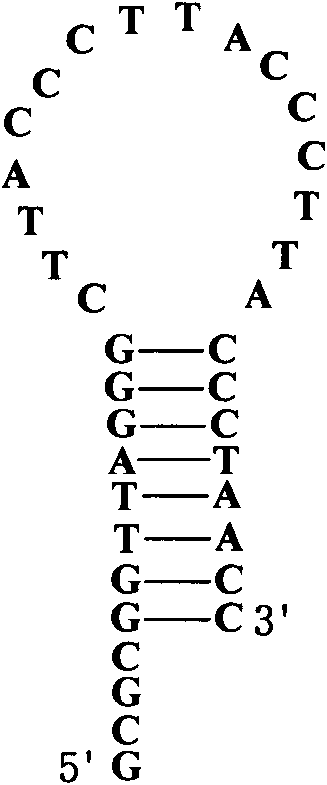
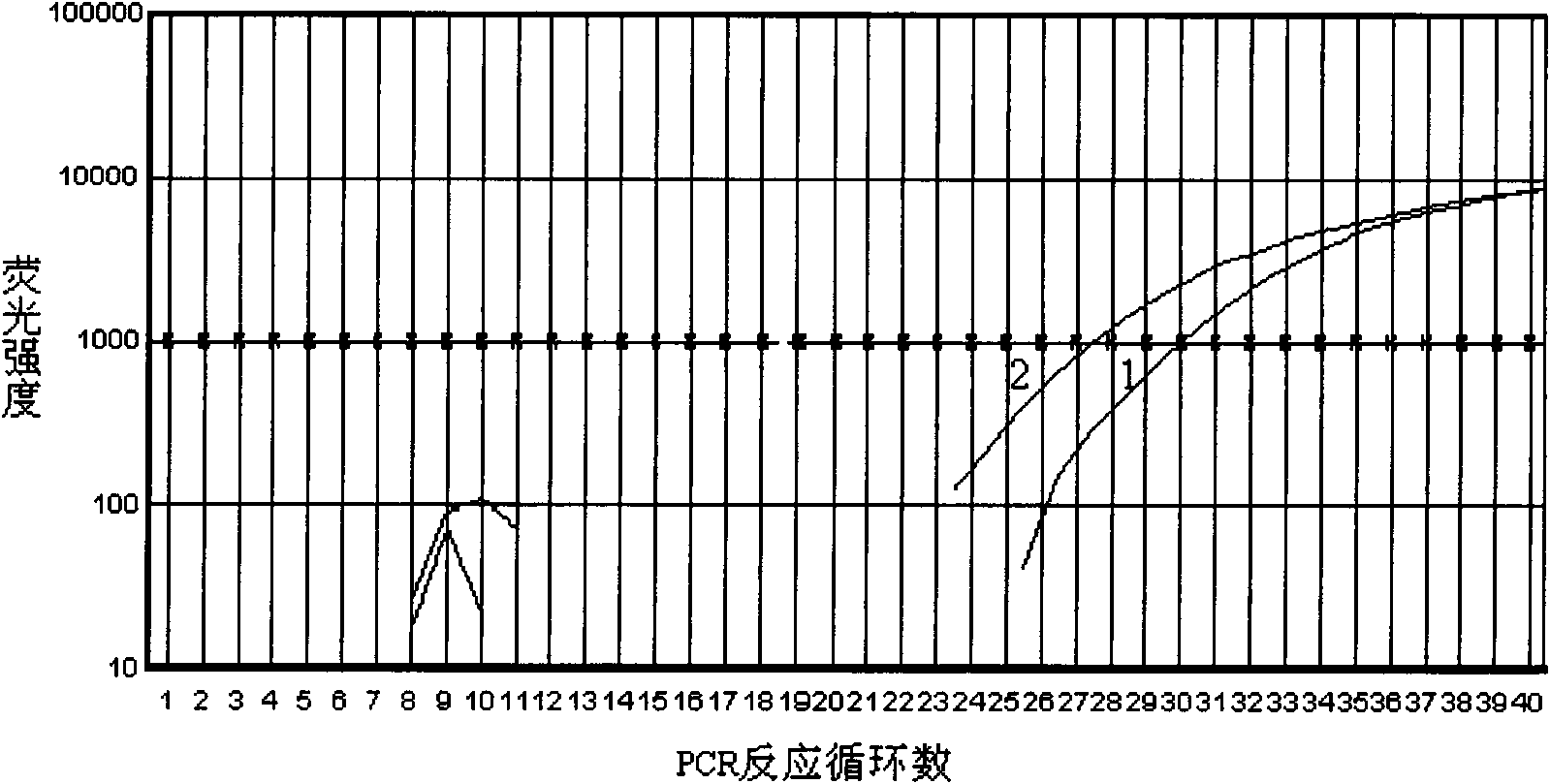
[0044] Effect of anchored hairpin primers on background fluorescent signal for real-time detection
[0045] In this example, the different effects of anchor hairpin primers and hairpin primers on the background fluorescence of real-time quantitative detection were compared.
[0046] In the experiment, the protein extract of immortalized cells that was heat-treated to inactivate telomerase (for the treatment method of immortalized cell samples, see the example below) was used as a negative sample, and the anchored hairpin primer and the hairpin primer were used as downstream primers for fluorescence analysis. Quantitative PCR detection. Under the condition that the cycle number was set to 40, its effect on the background fluorescence detected by real-time quantification was compared. The reaction reagents and conditions are as follows:
[0055] (1) Dissolve 23.83 mg of Hepes in 10 mL of secondary deionized water, adjust the pH to 7.5 with concentrated KOH solution, and prepare a 10 mmol / L Hepes-KOH (PH 7.5) solution.
[0056] (2) MgCl 2 ·6H 2 O 1.52mg, KCl 3.72mg, DTT 0.772mg were dissolved in 5mL 10mmol / L Hepes-KOH (PH 7.5) solution and stored at -20°C.
[0057] Hepes (Free acid): High Pure Grade, Shanghai Sangon Bioengineering Co., Ltd., AMRESCO packaging.
[0058] DTT: High Pure Grade, Shanghai Sangon Bioengineering Co., Ltd., subpackaged by AMRESCO.
the structure of the environmentally friendly knitted fabric provided by the present invention; figure 2 Flow chart of the yarn wrapping machine for environmentally friendly knitted fabrics and storage devices; image 3 Is the parameter map of the yarn covering machine
Login to View More
PUM
Login to View More
Abstract
The invention relates to a dual temperature rapid cyclingfluorescence quota PCR method for detecting telomerase activity and a kit. The method provided by the invention comprises steps of: combining primers, which are the anchored hairpin primers (AHP), with a duplex scorpion primers (DS) to form a DS / AHP-TRAP system; detecting the activity of telomerase in immortalized cellprotein extracts under the condition of dual temperature rapid cycling PCR; taking a telomerase extension product R6 containing 6 telomere repeat sequences as a quantitative standard substance, and drafting a quantitative curve of the extension product of the detected telomerase; comparing the quantitative standard curve of the immortalized cell sample and that of R6 to obtain an anastomosis graph of the detected telomerase activity quantitative curve and the telomerase extension product quantitative curve; supposing that a TPG value is a telomerase extension product generated by an immortalized cell and determining the number of R6 represented by the TPG value. The kit provided by the invention can be used to accomplish a real-time detection of telomerase activity in large quantities on the fluorescence quota PCR instrument in a simpler and faster manner, and has a wide prospect in the early diagnosis of malignant tumor and the screening of anticancer drugs.
Description
technical field [0001] The invention relates to a detection method and kit for double-temperature fast cycle fluorescence quantitative PCR telomerase activity. This method uses Anchored hairpin structural primer (AHP) and compound scorpion primer (Duplex scorpion primer, DS) on a fluorescent quantitative PCR instrument, using dual-temperature fast-cycle PCR amplification conditions to carry out telomeric Detection of enzyme activity. It is a kit for detecting telomerase activity with DS / AHP-TRAP (anchor hairpin primer and composite scorpion primer-telomeric repeat sequence amplification assay). Background technique [0002] Telomerase (Telomerase) is a broad-spectrum tumor marker, which is highly expressed in nearly 90% of cancers, but generally not expressed in benign, precancerous lesions and surrounding tissues. The determination of telomerase activity has directness, high sensitivity and strong specificity, and can be used as an independent indicator for early diagnosi...
Claims
the structure of the environmentally friendly knitted fabric provided by the present invention; figure 2 Flow chart of the yarn wrapping machine for environmentally friendly knitted fabrics and storage devices; image 3 Is the parameter map of the yarn covering machine
Login to View More
Application Information
Patent Timeline
Application Date:The date an application was filed.
Publication Date:The date a patent or application was officially published.
First Publication Date:The earliest publication date of a patent with the same application number.
Issue Date:Publication date of the patent grant document.
PCT Entry Date:The Entry date of PCT National Phase.
Estimated Expiry Date:The statutory expiry date of a patent right according to the Patent Law, and it is the longest term of protection that the patent right can achieve without the termination of the patent right due to other reasons(Term extension factor has been taken into account ).
Invalid Date:Actual expiry date is based on effective date or publication date of legal transaction data of invalid patent.



 Login to View More
  Login to View More