Method for performing stimulation test on stress of glass fiber reinforced plastic (GFRP) pipe steel reinforced high-strength concrete eccentric loading column

A high-strength concrete, simulation test technology, applied in the direction of applying stable tension/pressure to test the strength of materials, can solve problems such as lack, and achieve the effect of improved ductility and good fit of components

CN102305739AInactive Publication Date: 2012-01-04SHENYANG UNIV
0 Cites 7 Cited by

Patent Information

Authority / Receiving Office
CN · China
Current Assignee / Owner
Publication Date
2012-01-04
Estimated Expiration
Not applicable · inactive patent

Smart Images

  • Figure 1
    Figure 1
  • Figure 2
    Figure 2
  • Figure 3
    Figure 3
Patent Text Reader

Abstract

The invention discloses a method for performing stimulation test on the stress of a glass fiber reinforced plastic (GFRP) pipe steel reinforced high-strength concrete eccentric loading column, and relates to a method for testing a building member. The method is characterized by comprising the steps of: analyzing the whole stress process under the action of an eccentric compressive load; establishing a bearing capacity calculation program of the GFRP pipe steel reinforced high-strength concrete eccentric loading column on the basis of a finite strip method with assumed plane sections; and calculating to obtain a load and deformation relation curve and a curve of the influence of the concrete strength, slenderness ratio, eccentricity and steel ratio on load-deformation by using the program, and performing test analysis. The test analysis shows that: the ultimate bearing capacity of a member is decreased along with the increase of the slenderness ratio, the elastic stage of a member curve is gradually shortened, and the rigidity is gradually lost; the ultimate bearing capacity of the member is decreased along with the increase of the eccentricity; the ductility of the member is improved; and the ultimate bearing capacity of the member is improved along with the improvement of the strength of concrete. In the method, a test analysis result and a test result are consistent, and a basis is provided for the actual design.
Need to check novelty before this filing date? Find Prior Art

Description

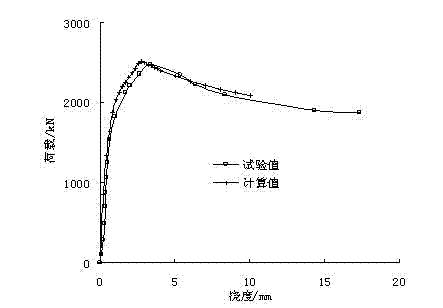
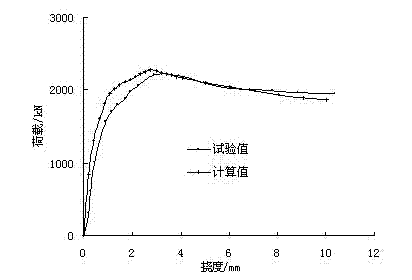
Technical field

[0001] The invention relates to a test method for building components, in particular to a GFRP pipe steel-reinforced high-strength concrete column force simulation test method. Background technique

[0002] GFRP tube steel-reinforced high-strength concrete column is formed by embedding section steel in the wound GFRP tube, and then filling it with concrete to form a composite column. The composite column mainly restrains the concrete through the GFRP pipe, which forces the concrete to be in a three-way stress state, thereby achieving the purpose of improving the strength of the concrete. At the same time, the steel frame shares part of the axial force of the concrete, resulting in an increase in the bearing capacity of the composite column. The outer concrete prevents or alleviates the local buckling of the steel frame, which is a reasonable combined structure. In actual engineering, eccentricity may occur due to the uncertainty of the load position, the unevenne...

Examples

Embodiment Construction

[0021] The present invention will be described in detail below with reference to the drawings.

[0022] In order to further study the force-bearing performance of the GFRP steel-reinforced high-strength concrete column under eccentric compression, the present invention analyzes the entire force process under the action of the eccentric compression load.

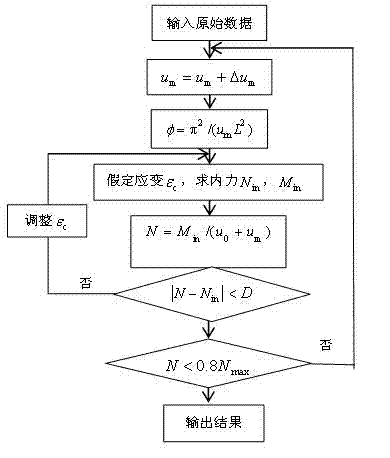
[0023] The invention is based on the finite strip method with the assumption of a flat section, and a calculation program for the bearing capacity of a GFRP pipe steel-reinforced high-strength concrete column under eccentric compression is compiled according to the existing reinforcement theory and related technical regulations.

[0024] The invention uses the program to calculate the relationship curve between load and deformation, and the influence curve of concrete strength, slenderness ratio, eccentricity, and bone content on load-deformation, indicating that the ultimate bearing capacity of the test piece increases with the incr...