
Test paper strip for rapidly detecting traces of chlorothalonil and preparation method thereof
The technology of chlorothalonil and test strips is applied in the field of test strips for rapid detection of trace amounts of chlorothalonil and its preparation, which can solve the problems of tedious and time-consuming, poor timeliness, and inability to detect on-site, and achieves low cost, simple operation, The effect of protecting the health of consumers
- Summary
- Abstract
- Description
- Claims
- Application Information
AI Technical Summary
Problems solved by technology
Method used
Image

Examples
preparation example Construction
[0032](1) Preparation of chlorothalonil carrier protein conjugate antigen
[0033] The carbonyl diimidazole method was used to couple chlorothalonil to carrier protein to prepare artificial conjugated antigen.
[0034] Weigh 10 mg of chlorothalonil and 3 mg of potassium fluoride and dissolve it in 400 μl of ethylene glycol solution (adding potassium fluoride can make ethylene glycol react with chlorothalonil more easily, replace the 6-position chlorine atom on the chlorothalonil molecule, and obtain half Antigen hydroxychlorothalonil (CTN-OH)), heated to 90-100°C, and magnetically stirred for 24-30 hours; after the reaction, the reaction solution was cooled to room temperature, added to 5g of ice water, and the resulting precipitate was separated and air-dried. The white solid is the chlorothalonil derivative CTN-OH (hydroxychlorothalonil); dissolve the chlorothalonil derivative with 400 μL N,N-dimethylformamide (DMF), and add 4 mg N,N-carbonyldiimidazole (CDI), magnetically ...
Embodiment 1
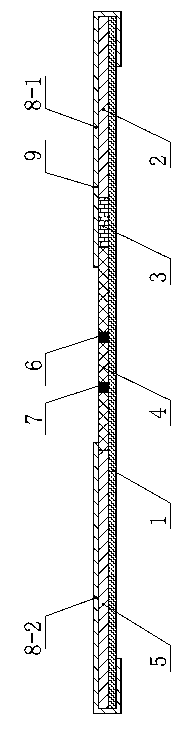
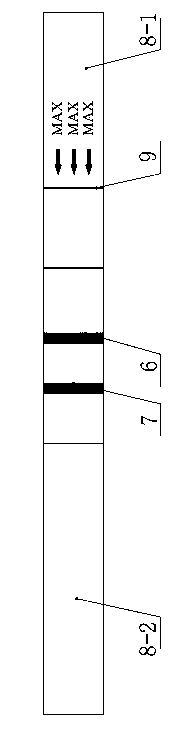
[0049] Example 1: For the test strips for rapid detection of trace amounts of chlorothalonil, see figure 1 , figure 2 . In the figure, the support layer 1 is made of plastic sheet strips, the absorbent fiber layer 2 is made of glass fiber cotton, the cellulose membrane layer 4 is made of nitrocellulose membrane, and the water-absorbing material layer 5 at the handle end is made of water-absorbing filter paper. 2. The gold-labeled antibody fiber layer 3, the cellulose film layer 4, and the water-absorbing material layer 5 at the handle end are pasted and fixed on the plastic sheet strip 1 in sequence from right to left, and the fibers at the junctions between the layers interpenetrate with each other. The cellulose film layer 4 is provided with a stealth detection blot 6 and a stealth control blot 7, the carrier protein coupled with chlorothalonil is bovine serum albumin (BSA), and the stealth control blot 7 is made by blotting with a rabbit anti-mouse IgG antibody. The impr...
Embodiment 2
[0055] Embodiment 2: The structure of the test strip is basically the same as that of Embodiment 1, the difference is that: the gold-labeled antibody fiber layer 3 is adsorbed with anti-chlorothalonil polyclonal antibody, the adsorption fiber layer 2 is made of nylon membrane, and the cellulose membrane Layer 4 adopts pure cellulose film, the invisible detection imprint and the invisible contrast imprint are both "ten", and 8-2 is the blue protective film on the handle end covered on the water-absorbing material layer 5.
[0056]The sample to be tested is tomato, which is cut into pieces, mashed, and then centrifuged at 4000r / min for 5 minutes, and the upper layer of juice is taken as the sample to be tested;
[0057] Result judgment: (a) Positive If there is a brown-red blot on the cellulose membrane " ten ", indicating that the test result is positive, indicating that chlorothalonil is contained in the sample to be tested; (b) negative if there are two brown-red blots on th...
PUM
| Property | Measurement | Unit |
|---|---|---|
| diameter | aaaaa | aaaaa |
Abstract
Description
Claims
Application Information
 Login to View More