Distributed load balancing system and distributed load balancing method based on peer to peer (P2P) technology

A load balancing and distributed technology, applied in the field of computer networks, can solve the problems of no load balancing, overhead affecting the overall performance and stability of the system, and being too light, so as to ensure balance, good promotion and application prospects, and high query efficiency Effect

CN102882973AInactive Publication Date: 2013-01-16BEIJING UNIV OF POSTS & TELECOMM
5 Cites 48 Cited by

Patent Information

Authority / Receiving Office
CN · China
Current Assignee / Owner
Publication Date
2013-01-16
Estimated Expiration
Not applicable · inactive patent

Smart Images

  • Figure 1
    Figure 1
  • Figure 2
    Figure 2
  • Figure 3
    Figure 3
Patent Text Reader

Abstract

Provided are a distributed load balancing system and a distributed load balancing method based on the peer to peer (P2P) technology. The system is composed of a distributed processing cluster with the load balancing function. A plurality of isomorphism or isomerism processing nodes formed by processing layers and communication layers and distributed in different servers are arranged in the cluster. Each processing node can independently bear the distributed arbitral load balancing function, the authority limits and the functions are identical, and only incident processing speeds are different. When a client transmits mass data processing requests in real time to the distributed processing cluster, one processing node packages the generated middle result as the incident and transmits the incident to other processing nodes to be processed after the processing node finishes request processing. The processing nodes adopt the distributed load balancing method to ensure load balancing of incident distribution in the whole incident distribution process till the final results is generated and returned to the client. The system and the method effectively avoid load balancing with single point failure and are capable of achieving load balancing with node dynamic change in a distributed cluster system.
Need to check novelty before this filing date? Find Prior Art

Description

technical field

[0001] The invention relates to a distributed load balancing system and method based on peer-to-peer (Peer-to-Peer) technology, belonging to the technical field of computer networks. Background technique

[0002] With the rapid growth of network traffic, access and data traffic, server cluster technology has been widely used and researched, and load balancing technology, as an important part of server cluster technology, has also been extensively and deeply researched and applied.

[0003] At present, load balancing technology has a lot of research in the fields of business load management of commercial web services, computing task load management in grid computing, computing task load management in parallel computing, and computing resource load management in cloud computing. and practical application.

[0004] According to the arbitration method, load balancing technology is mainly divided into centralized arbitration load balancing and distributed arbitra...

Examples

Embodiment Construction

[0031] In order to make the object, technical solution and advantages of the present invention clearer, the present invention will be further described in detail below in conjunction with the accompanying drawings and embodiments.

[0032] The invention is a distributed load balancing system based on peer-to-peer P2P (Peer-to-Peer) technology, and at the same time, provides a load balancing method based on the system. First introduce the system structure composition:

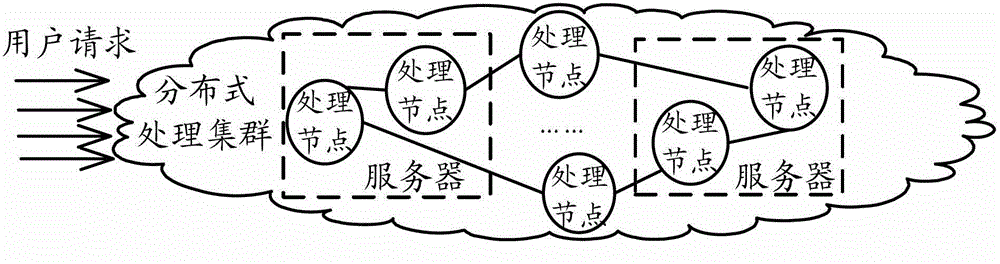
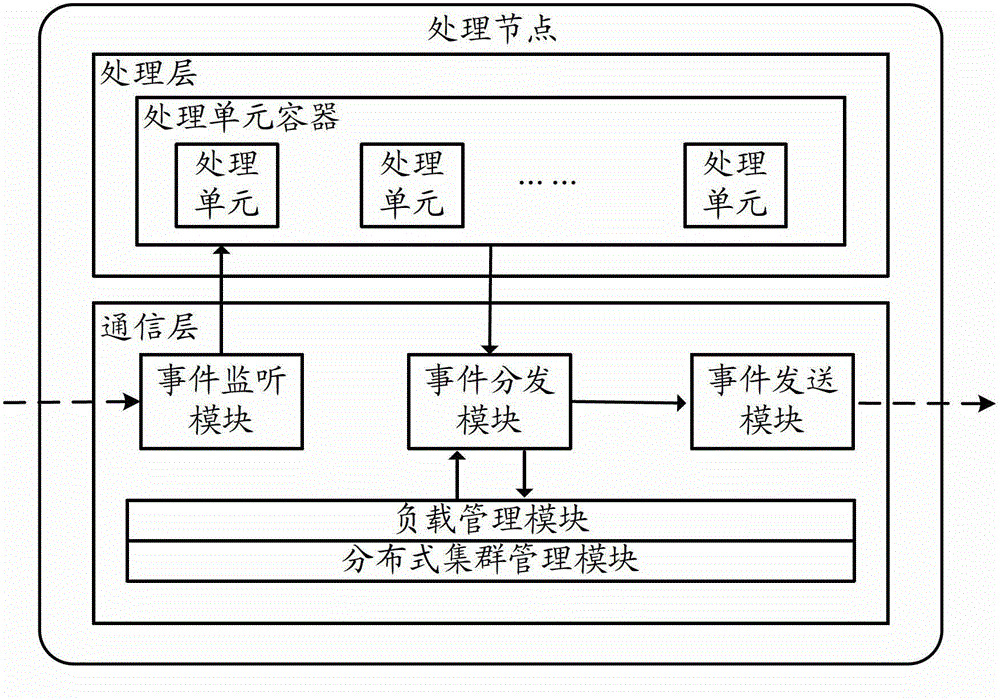
[0033] see figure 1 , the distributed load balancing system based on P2P technology of the present invention is composed of a distributed processing cluster with a load balancing function. Multiple homogeneous or heterogeneous processing nodes in the distributed control core of the system (during actual environment deployment, the same server can also have multiple processing nodes), each processing node can independently provide the load balancing function of distributed arbitration, Moreover, the authority t...