
Method for preparing polyetherketone foaming material by using supercritical CO2
A foaming material, polyether ketone technology, applied in the field of materials, to achieve the effect of high cell density, simple foaming process, and excellent heat resistance
- Summary
- Abstract
- Description
- Claims
- Application Information
AI Technical Summary
Problems solved by technology
Method used
Image

Examples
Embodiment 1
[0023] (1) Add 14g of PPEK fine powder evenly into the mold, put it into a muffle furnace to melt and plasticize for 60 minutes, and then mold a 3mm PPEK sheet on a flat vulcanizing machine;
[0024] (2) Place the sheet obtained in step (1) in an autoclave, and pass through supercritical CO 2 Perform saturation, the saturation pressure is 20MPa, the saturation temperature is 50°C, and a saturated PPEK sheet is obtained after 60 minutes;
[0025] (3) Put the sheet obtained in step (2) into an oil bath at a temperature of 270°C and foam for 90 seconds to obtain a PPEK foam sheet.
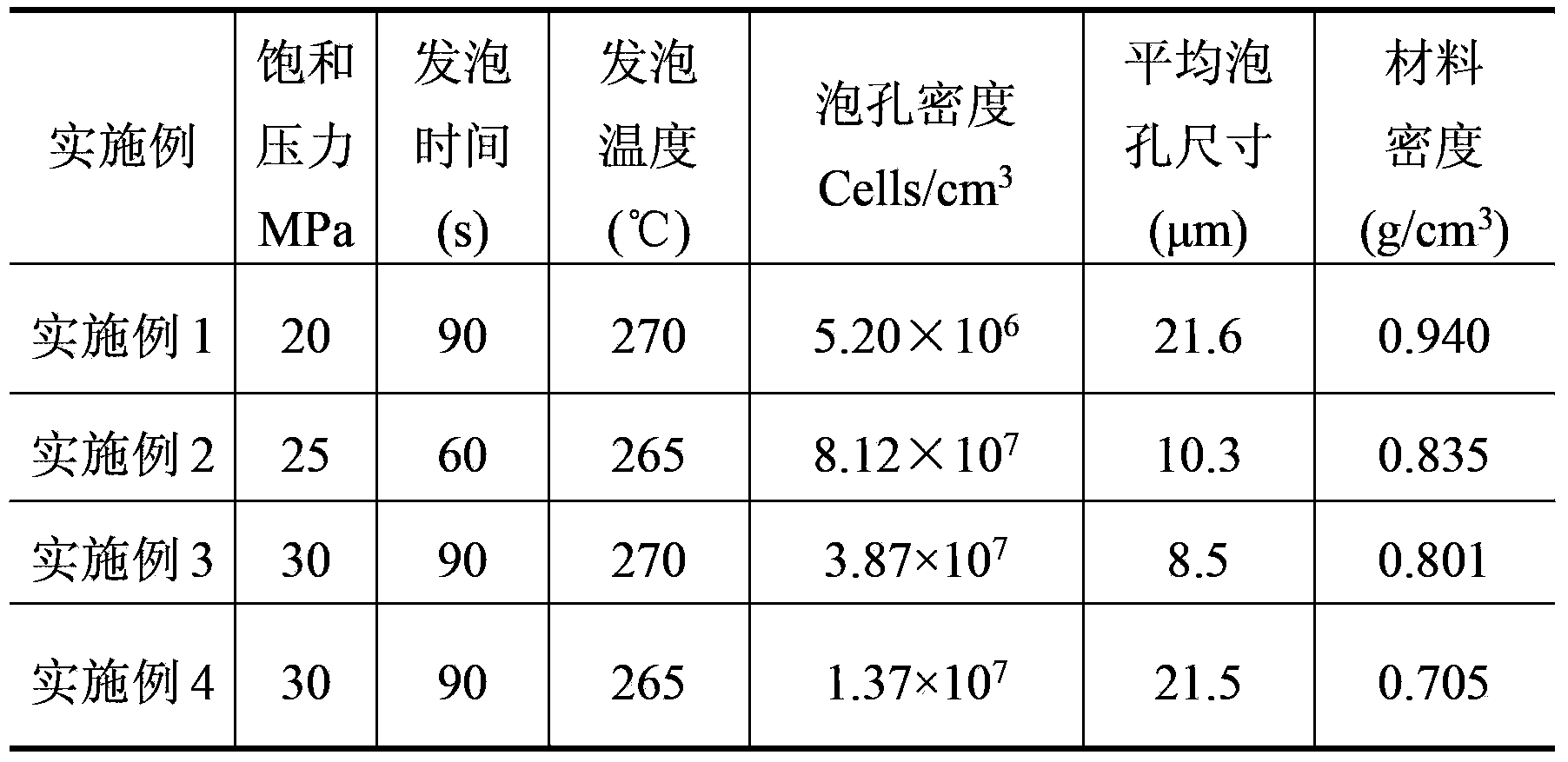
[0026] The density of the PPEK foam sheet prepared above is 0.940g / cm 3 ,
[0027] The average cell size of the PPEK foam sheet can reach 21.6 μm, the cell size distribution is relatively uniform, and the cell density is large, reaching 5.20×10 6 Cells / cm 3 .
Embodiment 2
[0029] (1) Evenly add 12g of PPEK fine powder into the mold, put it into a muffle furnace to melt and plasticize for 60min, and then mold a 2mm PPEK sheet on a flat vulcanizing machine;
[0030] (2) Put the sheet obtained in step (1) into an autoclave, and pass through supercritical CO 2 Perform saturation, the saturation pressure is 25MPa, the saturation temperature is 50°C, and a saturated PPEK sheet is obtained after 60 minutes;
[0031] (3) Put the sheet obtained in step (2) into an oil bath at a temperature of 265°C and foam for 60 seconds to obtain a PPEK foam sheet.
[0032] The density of the PPEK foam sheet prepared above is 0.835g / cm 3 , the average cell size can reach 10.3μm, and the cell density can reach 8.12×10 7 Cells / cm 3 .
Embodiment 3
[0034] (1) Evenly add 12g of PPEK fine powder into the mold, put it into a muffle furnace to melt and plasticize for 60min, and then mold a 2mm PPEK sheet on a flat vulcanizing machine;
[0035] (2) Put the sheet obtained in step (1) into an autoclave, and pass through supercritical CO 2 Carry out saturation, the saturation pressure is 30MPa, the saturation temperature is 50°C, and the saturated PPEK sheet is obtained in 70 minutes;
[0036] (3) Put the sheet obtained in step (2) into an oil bath at a temperature of 270°C and foam for 90 seconds to obtain a PPEK foam sheet.
[0037] The density of the PPEK foam sheet prepared above is 0.801g / cm 3 , the average cell size can reach 8.5μm, and the cell density can reach 3.87×10 7 Cells / cm 3 .
PUM
| Property | Measurement | Unit |
|---|---|---|
| thickness | aaaaa | aaaaa |
| density | aaaaa | aaaaa |
| density | aaaaa | aaaaa |
Abstract
Description
Claims
Application Information
 Login to View More