Integrated rotary cavitating jet nozzle

A jet nozzle, centralized technology, applied in the field of centralized rotating cavitation jet nozzle, can solve the problems of water jet energy concentration, energy non-concentration, low energy concentration of cavitation water jet, etc. Shear action, effect of improving erosion ability

CN104307651AInactive Publication Date: 2015-01-28XIHUA UNIV
7 Cites 14 Cited by

Patent Information

Authority / Receiving Office
CN · China
Patent Type
Applications(China)
Current Assignee / Owner
Publication Date
2015-01-28
Estimated Expiration
Not applicable · inactive patent

Smart Images

  • Figure 1
    Figure 1
  • Figure 2
    Figure 2
  • Figure 3
    Figure 3
Patent Text Reader

Abstract

The invention relates to an integrated rotary cavitating jet nozzle comprising a cylindrical inlet segment, a cylindrical resonant cavity, a cylindrical pore and a cylindrical outlet segment. The cylindrical outlet segment is provided with a plurality of intake tubes; bores of the intake tubes are tangent to a bore of the cylindrical outlet segment. The inner diameter of the intake tubes is half a difference between the inner diameter of the cylindrical outlet segment and the diameter of the cylindrical pore. The section of the bore of each intake tube is round, square, or in any special shape. The intake tubes can be axially distributed in multiple rows at the cylindrical outlet segment of a nozzle body. Compressed air is led into the intake tubes, the compressed air led in from the intake tubes enters in the tangent direction, air swirls surrounding a water jet are formed in the cylindrical outlet segment and drive the water jet to turn into a rotating vortex in the cylindrical outlet segment, and cavitating effect is further enhanced; meanwhile, cavitating bubbles are concentrated to the center of the water jet, energy of the cavitating water jet is more concentrated, the shear action of the jet upon a target is enhanced, and eroding capacity of the cavitating jet is greatly improved accordingly.
Need to check novelty before this filing date? Find Prior Art

Description

technical field

[0001] The invention relates to a cavitation jet nozzle, in particular to a centralized rotating cavitation jet nozzle, which can be used for material surface cleaning, rust removal, degumming, surface strengthening, drilling, cutting, rock breaking and the like. Background technique

[0002] Water jet special processing uses a water jet beam with high kinetic energy to erode materials, thereby realizing material cutting, which belongs to the category of high energy beam processing. Water jet processing belongs to non-contact "cold cutting", without mechanical stress, heat deformation, heat-affected zone, so it becomes the best cutting method for heat-sensitive materials; it has good adaptability, excellent cutting quality, narrow kerf, and less material loss , and the medium cost is low, clean, dust-free, non-toxic, and environmentally friendly during the cutting process, and is widely used in machinery manufacturing, aerospace, automotive, military, and cer...

Examples

Embodiment 1

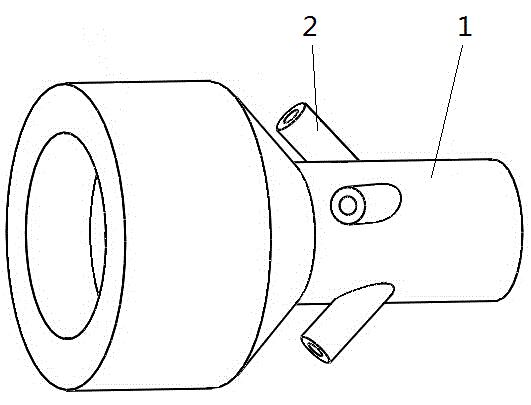
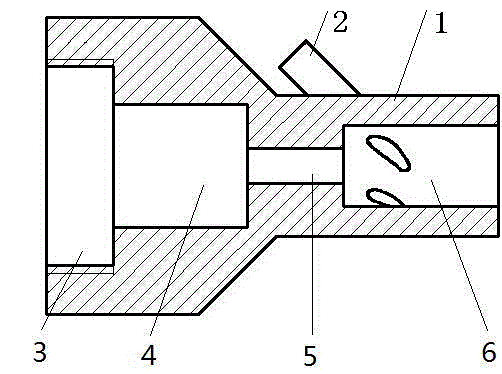
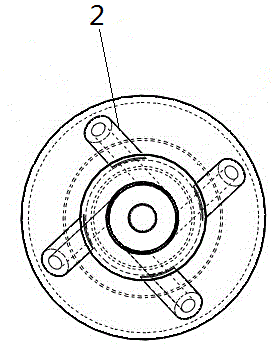
[0019] see figure 1 , figure 2 and image 3 , the centralized rotating cavitation jet nozzle is connected to the high-pressure water pipeline through the thread of the inlet section, and the inner flow channel of the nozzle consists of a cylindrical inlet section (3), a cylindrical resonant cavity (4), a cylindrical small hole (5) and a cylindrical outlet section (6), on the nozzle body (1) there are multiple inlet pipes (2) along the circumference, the inlet pipes (2) lead to compressed air, the inner hole of the inlet pipe (2) and the cylindrical outlet section (6 ) tangent to the inner hole, and the inner diameter of the air inlet pipe (2) is 1 / 2 of the difference between the inner diameter of the cylindrical outlet section (6) and the inner diameter of the cylindrical small hole (5).

[0020] see figure 2 , when water (or other fluid) enters from the cylindrical inlet section (3), it is ejected from the cylindrical hole (5) through the cylindrical resonant cavity (4) ...