AI technical title is built by Patsnap AI team. It summarizes the technical point description of the patent document.
A technology of influenza virus and strain, applied in the field of preparation of influenza virus vaccine strain, can solve the problems of inconvenience and low virus growth titer
Active Publication Date: 2017-02-08
CHINA AGRI UNIV
View PDF5 Cites 0 Cited by
Summary
Abstract
Description
Claims
Application Information
AI Technical Summary
This helps you quickly interpret patents by identifying the three key elements:
Problems solved by technology
Method used
Benefits of technology
Problems solved by technology
Therefore, an ideal vaccine strain should firstly grow well and be safe in chicken embryos. However, most natural influenza virus strains are pathogenic to chicken embryos, and the growth titer of the virus is also low, which is difficult for mass production. Bird flu vaccine brings many inconveniences
Method used
the structure of the environmentally friendly knitted fabric provided by the present invention; figure 2 Flow chart of the yarn wrapping machine for environmentally friendly knitted fabrics and storage devices; image 3 Is the parameter map of the yarn covering machine
View more
Image
Smart Image Click on the blue labels to locate them in the text.
Viewing Examples
Smart Image
Click on the blue label to locate the original text in one second.
Reading with bidirectional positioning of images and text.
Smart Image
Examples
Experimental program
Comparison scheme
Effect test
Embodiment 1
[0058] Embodiment 1, utilize reverse genetic manipulation technology of the present invention to carry out the rescue of influenza virus
[0059] 1. Construction of recombinant influenza virus in 8+7 mode
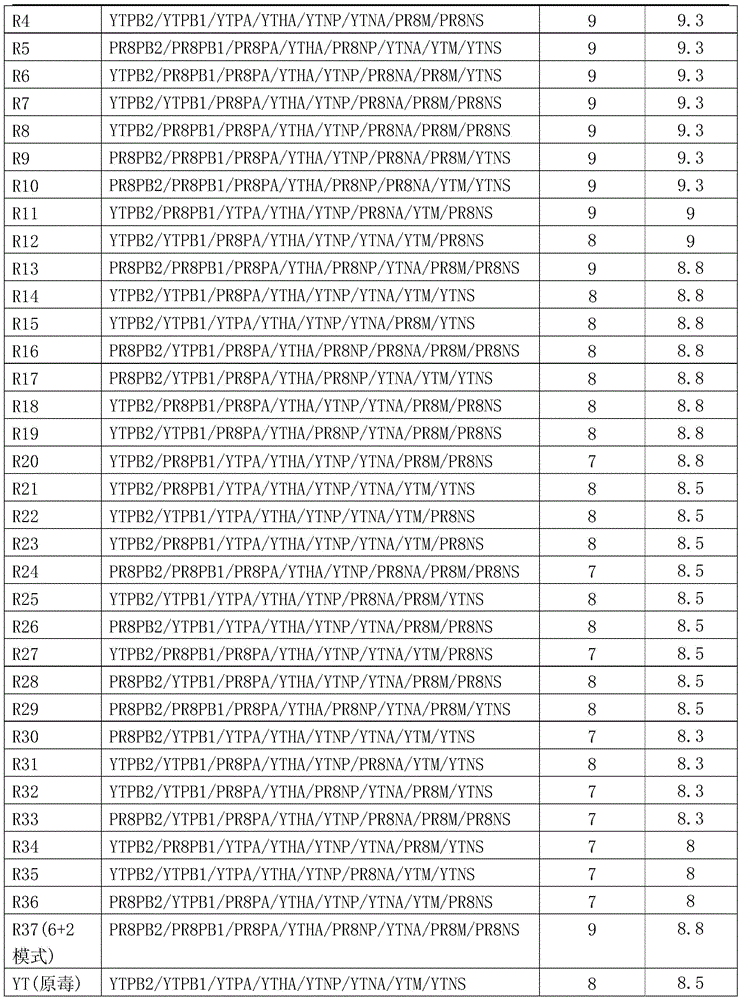
[0060] In this step, the 8+7 mode is used to rescue influenza virus, and the method is as follows: the cDNA molecule encoding PB2 in PR8, the cDNA molecule encoding PB1 in PR8, the cDNA molecule encoding PA in PR8, the cDNA molecule encoding NP in PR8, cDNA molecules encoding NA in PR8, cDNA molecules encoding M1 and M2 in PR8, cDNA molecules encoding NS1 and NS2 in PR8, and cDNA molecules encoding PB2 in YT, cDNA molecules encoding PB1 in YT, cDNA molecules encoding PA in YT 15 cDNA molecules, cDNA molecules encoding HA in YT, cDNA molecules encoding NP in YT, cDNA molecules encoding NA in YT, cDNA molecules encoding M1 and M2 in YT, and cDNA molecules encoding NS1 and NS2 in YT Each molecule is individually inserted into the eukaryotic cell expression vector to obtain 15...
Embodiment 2
[0143] Embodiment 2, vaccine seed virus immunogenicity and protective detection
[0144] 1. Detection of immunogenicity of vaccine seed virus
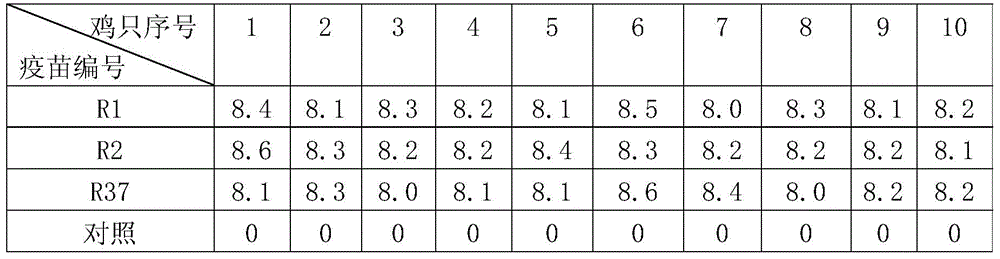
[0145] 10 SPF chickens were immunized with recombinant viruses numbered R1 and R2 with high fecundity in chicken embryos and inactivated vaccines of recombinant virus R37 obtained in 6+2 mode, and the remaining 10 chickens were injected with the same amount of PBS buffer liquid as a control.
[0146] 1. The preparation steps of inactivated vaccine are as follows:
[0147] 1) Add formaldehyde solution with a final concentration of 0.4% (volume percentage) to the recombinant virus solutions numbered R1, R2 and R37, and place them on a shaker at 37° C. for 48 hours to inactivate them.
[0148] 2) Take 96ml of the inactivated virus solution, add 4ml of Tween-80 dropwise as an emulsifier, and mix evenly by inversion.
[0149] 3) Preparation of oil phase: Take 200ml of white oil in a grinding bowl, add 2% aluminum stearate powder into it,...
the structure of the environmentally friendly knitted fabric provided by the present invention; figure 2 Flow chart of the yarn wrapping machine for environmentally friendly knitted fabrics and storage devices; image 3 Is the parameter map of the yarn covering machine
Login to View More
PUM
Login to View More
Abstract
The invention discloses a method for rescuing influenza virus. The method for rescuing the influenza virus comprises the following steps: 1) respectively inserting each of 15 cDNA molecules, namely cDNA molecules used for coding PB2, PB1, PA, NP, NA, M1, M2, NS1 and NS2 in an influenza virus chick embryo adapted strain and cDNA molecules used for coding PB2, PB1, PA, HA, NP, NA, M1, M2, NS1 and NS2 in a to-be-rescued influenza virus strain, into an eukaryotic expression vector, so that 15 recombinant expression vectors are obtained; and 2) introducing the 15 recombinant expression vectors into packaging cells, so that a recombinant influenza virus is obtained. The recombinant influenza virus vaccine strain obtained in the method for rescuing the recombinant influenza virus has high copying capability in chick embryo, growth titer in the chick embryo is also higher compared with the traditional vaccine, and antigenicity detection carried out on a vaccine seed virus finds that antigen property of the vaccine seed virus is not obviously different from a parent virus.
Description
technical field [0001] The invention relates to a method for rescuing influenza virus in the field of virus vaccine production, in particular to a preparation method for influenza virus vaccine strain with high fecundity in chicken embryos. Background technique [0002] H9N2 subtype avian influenza virus is a low-pathogenic avian influenza virus, which mainly infects chickens, ducks, geese, migratory birds and other poultry, but can cause a serious drop in egg production of laying hens, complex respiratory diseases in broilers and young chickens The H9N2 subtype avian influenza virus has become the main influenza virus subtype prevalent in chickens in my country. It is worth noting that the H9N2 subtype avian influenza virus can not only infect birds, but also can break through the interspecies barrier and infect mammals and humans without going through an intermediate host. Cases of human infection with H9N2 subtype avian influenza virus occur from time to time, highlightin...
Claims
the structure of the environmentally friendly knitted fabric provided by the present invention; figure 2 Flow chart of the yarn wrapping machine for environmentally friendly knitted fabrics and storage devices; image 3 Is the parameter map of the yarn covering machine
Login to View More
Application Information
Patent Timeline
Application Date:The date an application was filed.
Publication Date:The date a patent or application was officially published.
First Publication Date:The earliest publication date of a patent with the same application number.
Issue Date:Publication date of the patent grant document.
PCT Entry Date:The Entry date of PCT National Phase.
Estimated Expiry Date:The statutory expiry date of a patent right according to the Patent Law, and it is the longest term of protection that the patent right can achieve without the termination of the patent right due to other reasons(Term extension factor has been taken into account ).
Invalid Date:Actual expiry date is based on effective date or publication date of legal transaction data of invalid patent.



 Login to View More
  Login to View More