Sliding mode control method used for two-stage DC/DC (direct current/direct current) converter

A control method and converter technology, which can be applied in the direction of conversion equipment, output power conversion device, electrical components, etc. with intermediate conversion to AC, and can solve the problems of poor robustness and low stability.

CN104795996AInactive Publication Date: 2015-07-22HUBEI SANJIANG AEROSPACE WANFENG TECH DEV
4 Cites 6 Cited by

Patent Information

Authority / Receiving Office
CN · China
Patent Type
Applications(China)
Current Assignee / Owner
Publication Date
2015-07-22
Estimated Expiration
Not applicable · inactive patent

Smart Images

  • Figure 1
    Figure 1
  • Figure 2
    Figure 2
  • Figure 3
    Figure 3
Patent Text Reader

Abstract

The invention discloses a sliding mode control method used for a two-stage DC / DC (direct current / direct current) converter. A BUCK circuit is the front stage of the two-stage DC / DC converter, and a half-bridge circuit is the back stage of the DC / DC converter. The sliding mode control method includes the steps of establishing a state model of the two-stage DC / DC circuit; constructing a sliding mode surface function S according to the state model; obtaining equivalent control input ueq according to the S; obtaining a control signal vc of a fixed-frequency PWM (pulse-width modulation) controller and a fixed frequency sawtooth signal Vramp according to the ueq so as to achieve sliding mode controlling. The sliding mode control method is used for the two-stage DC / DC converter with the BUCK circuit serving as the front stage and the half-bridge circuit serving as the back stage and is high in controlling stability, the DC / DC converter is good in nonlinear characteristics, and roughness of parameters can be improved in presence of external disturbance; the sliding mode control method is also applicable to constant-frequency two-stage DC / DC converters and good in nonlinear control effect.
Need to check novelty before this filing date? Find Prior Art

Description

technical field

[0001] The invention belongs to the field of DC / DC converters and control methods thereof, and more specifically relates to a fixed-frequency sliding mode control method for two-stage DC / DC converters. Background technique

[0002] The two-stage DC / DC converter with a BUCK converter in the front stage and a half-bridge in the rear stage is used in the DC / DC conversion field of high voltage input, low voltage, and high current output, such as communication power supply, aerospace power supply and vehicle power supply. more and more widely.

[0003] In the existing two-stage DC / DC converter, the transfer function related to the dynamic characteristics is a fourth-order function, which has poor stability; at the same time, the characteristics and parameters of the converter itself are uncertain under nonlinear conditions. The current conventional linear control method must have a detailed understanding of the DC / DC converter and the precise adjustment of the sy...

Examples

Embodiment 1

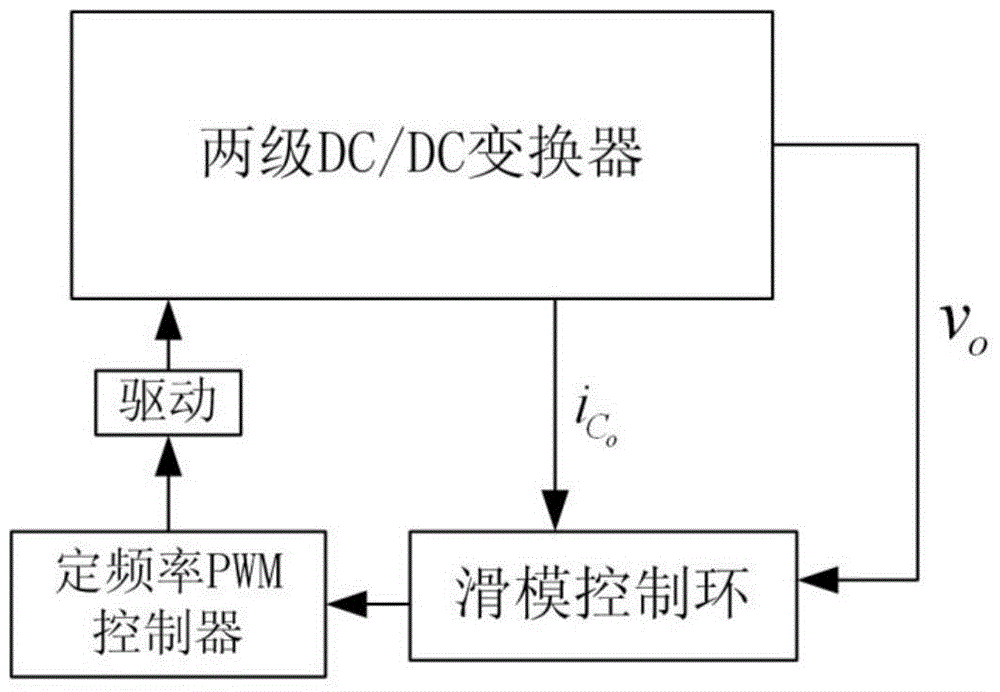
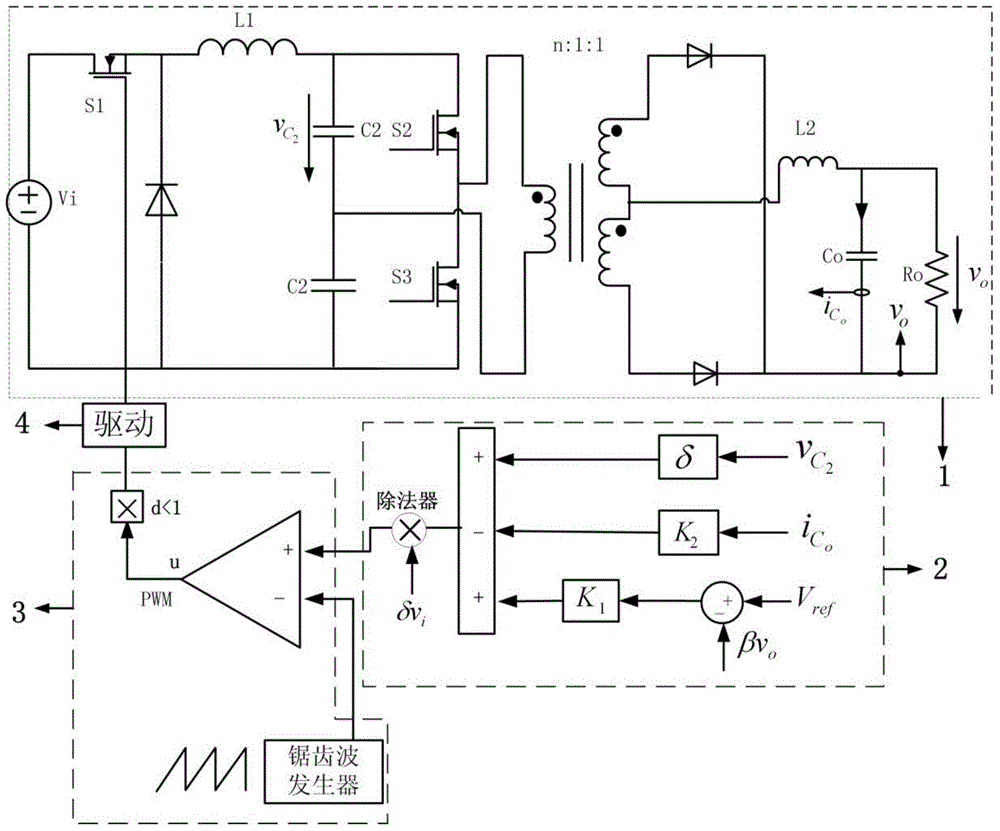
[0058] figure 1 , 2 Shown are the structural block diagram and circuit structural diagram of the sliding mode controller for the two-stage DC / DC converter of the present invention. The front stage of the two-stage DC / DC converter is a BUCK circuit, and the rear stage is a half-bridge circuit. The front-stage circuit and the rear-stage circuit are coupled through a transformer; the voltage input terminal of the two-stage DC / DC converter is on the BUCK circuit, and the input voltage is v i , and controls v through switch S1 i Whether it is connected to the two-stage DC / DC converter; the voltage output terminal is on the half-bridge circuit, and the output voltage is v o . like figure 2 As shown, the sliding mode controller for the two-stage DC / DC converter includes a main circuit 1 of the two-stage DC / DC converter, a sliding mode control loop 2, a PWM generating module 3, and a driving module 4, and its control method Include the following steps:

[0059] In step S201, t...