
PVC battery separation plate production method and PVC battery separation plate
A battery separator and production method technology, applied in battery pack parts, circuits, electrical components, etc., can solve the problems of poor wettability of electrolyte, difficult to manufacture, battery self-discharge, etc., and achieve good penetration resistance and recovery. Elasticity, effect of small pore size distribution
- Summary
- Abstract
- Description
- Claims
- Application Information
AI Technical Summary
Problems solved by technology
Method used
Image

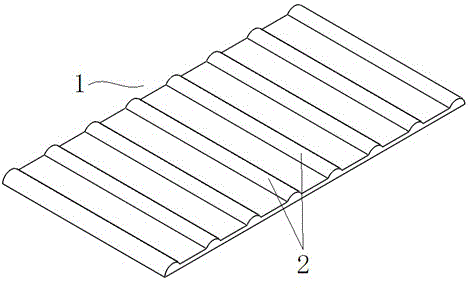
Examples
Embodiment Construction
[0026] The present invention will be further described in detail below through specific embodiments in conjunction with the accompanying drawings.
[0027] The present invention provides a kind of production method of PVC battery separator, and the method step comprises:
[0028] In the first step, polyvinyl chloride resin is mixed with plasticizer and then mixed with silica toner at high speed to form a mixture;
[0029] The second step is to add a solvent to the mixture, so that the solvent material is completely absorbed into the mixture to form a wet powder mixture;
[0030] The third step is to transport the mixture in wet powder state to the extruder for low temperature extrusion;
[0031] The fourth step is to emboss the mud material coming out of the die of the extruder on the calender to form the initial state partition;
[0032] The fifth step is to put the initial state separator into the extraction tank to extract the aforementioned solvent to form a microporous ...
PUM
 Login to View More
 Abstract
Description
Claims
Application Information
 Login to View More