Kalman filtering based method for detecting mechanical property of cell through AFM (Atomic Force Microscope)

A technology of Kalman filtering and mechanical properties, applied in the direction of applying stable tension/pressure to test the strength of materials, etc., can solve problems such as multiple burrs in the offset of the microcantilever, difficult experimental operation, and low accuracy of cell indentation depth

CN106769471AInactive Publication Date: 2017-05-31LESHAN NORMAL UNIV
3 Cites 4 Cited by

Patent Information

Authority / Receiving Office
CN · China
Patent Type
Applications(China)
Current Assignee / Owner
Publication Date
2017-05-31
Estimated Expiration
Not applicable · inactive patent

Smart Images

  • Figure 1
    Figure 1
  • Figure 2
    Figure 2
  • Figure 3
    Figure 3
Patent Text Reader

Abstract

The invention discloses a Kalman filtering based method for detecting the mechanical property of a cell through an AFM (Atomic Force Microscope). The method conducts Kalman filtering on the micro-cantilever offset obtained in a cell indentation experiment to obtain an optimal estimated value for the micro-cantilever offset; an MIIC (modeling-free inversion-based iterative learning control) algorithm is used to iteratively track the optimal estimated value on a hard material, meanwhile, the micro-cantilever offset of the hard material obtained in each iterative process is subjected to Kalman filtering, a z-axis displacement is obtained after the iteration is terminated; and the elasticity modulus of the cell is calculated according to a Hertz model. The micro-cantilever offsets obtained in the cell indentation experiment and the hard material tracking experiment are filtered through a Kalman filtering model to obtain the optimal estimated value of the micro-cantilever offset, the noise and the clutter introduced in the experiment process are reduced, so that the MIIC algorithm effectively tracks the hard material in the tracking experiment, the operation efficiency is improved, meanwhile, the more accurate cell indentation depth value is acquired, and the measurement accuracy of the mechanical property of the cell is improved.
Need to check novelty before this filing date? Find Prior Art

Description

technical field

[0001] The invention relates to the technical field of nano-manipulation, and more specifically relates to a method for detecting cell mechanical properties based on a Kalman filter-based AFM (AtomicForce Microscope, atomic force microscope). Background technique

[0002] The measurement of the mechanical properties of living cells is a hot direction of AFM in biological applications. AFM obtains the mechanical properties of the cell, such as hardness and viscoelasticity, by applying a weak force to the cell, and then obtains information on the internal structure changes of the cell (such as the cytoskeleton). In recent years, the research on the mechanical properties of cells has shown that the mechanical properties of cells are closely related to pathogenesis and pathophysiology. Therefore, the study of mechanical properties of cells will help to better understand the physiological mechanism of diseases, and lay a foundation for the early stages of diseases...

Examples

Embodiment Construction

[0042] The following will clearly and completely describe the technical solutions in the embodiments of the present invention with reference to the accompanying drawings in the embodiments of the present invention. Obviously, the described embodiments are only some, not all, embodiments of the present invention. Based on the embodiments of the present invention, all other embodiments obtained by persons of ordinary skill in the art without creative efforts fall within the protection scope of the present invention.

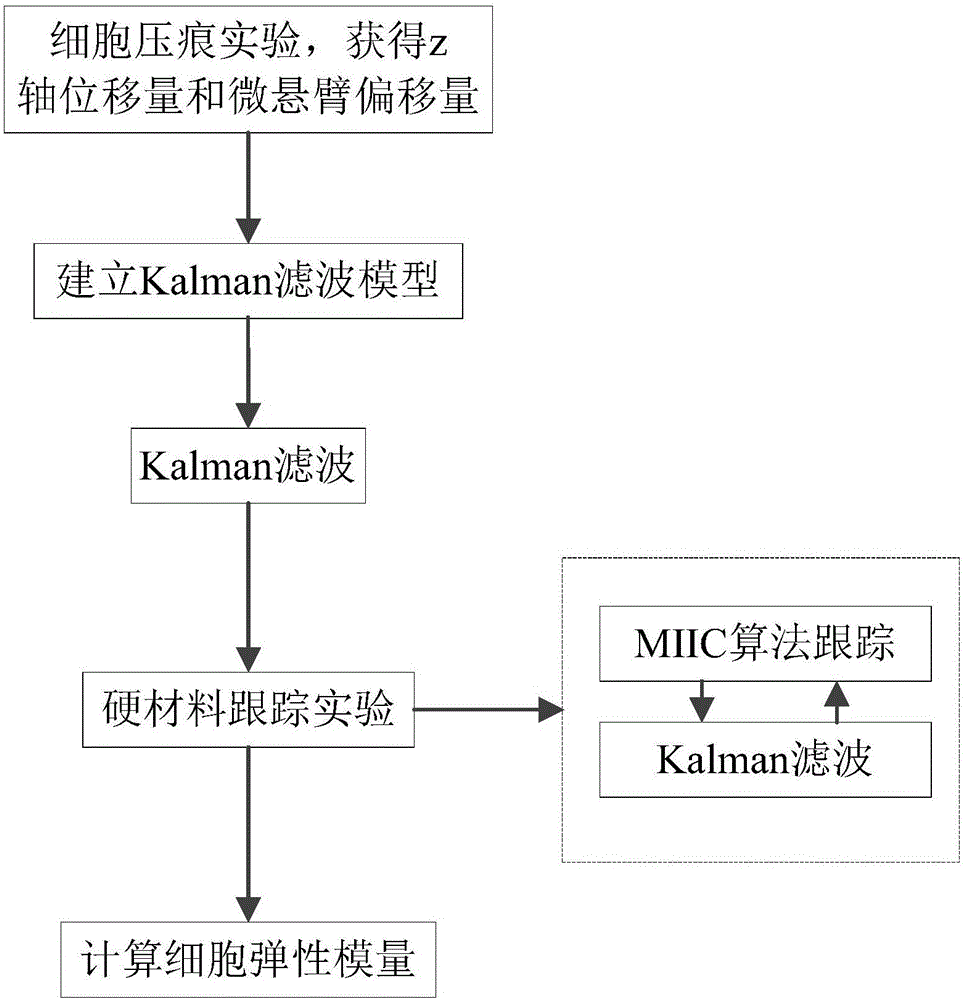
[0043] Such as figure 1 As shown, a method for detecting cell mechanical properties based on Kalman filter AFM includes the following steps:

[0044] 1) Cell indentation experiment:

[0045] 1.1 Experimental preparation: AFM working mode is contact mode in liquid, install AFM probe, place cell sample, probe enters liquid to approach cells, adjust laser point, obtain the whole picture of cell slide in the viewfinder, select a single cell with suitable density for o...