Autonomously group key update method

An update method and group key technology, applied in key distribution, can solve the problems of high computational overhead and long delay, reduce delay, reduce the total amount of calculation, and satisfy the properties of single encryption key and multiple decryption keys. Effect

CN106972923AInactive Publication Date: 2017-07-21ANHUI UNIV OF FINANCE & ECONOMICS
0 Cites 2 Cited by

Patent Information

Authority / Receiving Office
CN · China
Patent Type
Applications(China)
Current Assignee / Owner
Publication Date
2017-07-21
Estimated Expiration
Not applicable · inactive patent

Smart Images

  • Figure 1
    Figure 1
  • Figure 2
    Figure 2
  • Figure 3
    Figure 3
Patent Text Reader

Abstract

The invention discloses an autonomously group key update method comprising the steps as follow: a message sender sends a plaintext m; a key source distributed an initial key Kl' and an update key Kj', wherein a private secrete key is registered when a member joins, and the private secrete key is cancelled when the member quits; encrypting the plaintext m by using the update key Kj' and an encryption algorithm to acquire a ciphertext c which is equal to EKl'(m); sending the ciphertext to a next node; decrypting the ciphertext c by using the update key Kj' and the encryption algorithm to acquire the plaintext m; executing a key interaction protocol; and operating a network. An autonomously group key management scheme is designed via a DH protocol and a polynomial, and has the encryption and decryption characteristics of the single encryption key and the multiple decryption keys, and during an update process, an update member locally and autonomously updates the public encryption key without the support of an only key management center, so that validity of the decryption keys of the non-update members is protected, key update delay and computation overhead of the non-update members are reduced, and thus the method is accordant with an autonomous key update method, and applicable to wireless network scenes with limited delay.
Need to check novelty before this filing date? Find Prior Art

Description

technical field

[0001] The invention relates to the technical field of mobile Internet key management, in particular to an autonomous group key update method capable of reducing key update delay. Background technique

[0002] Group key management is one of the basic technologies of wireless network security. With the widespread application of distributed wireless networks, distributed group key management (DGKM) has become a security research hotspot. DGKM has the advantages of not needing the support of the key management center KMC, open channel negotiation and tolerance to failed nodes, but because all nodes share the key negotiation task, it has the disadvantages of long delay, large computational overhead and all members participating in the update.

[0003] With the continuous improvement of high-performance processors and energy levels, deep space networks, DTN networks, and opportunistic networks have put forward more stringent requirements for key management delays....

Examples

Embodiment Construction

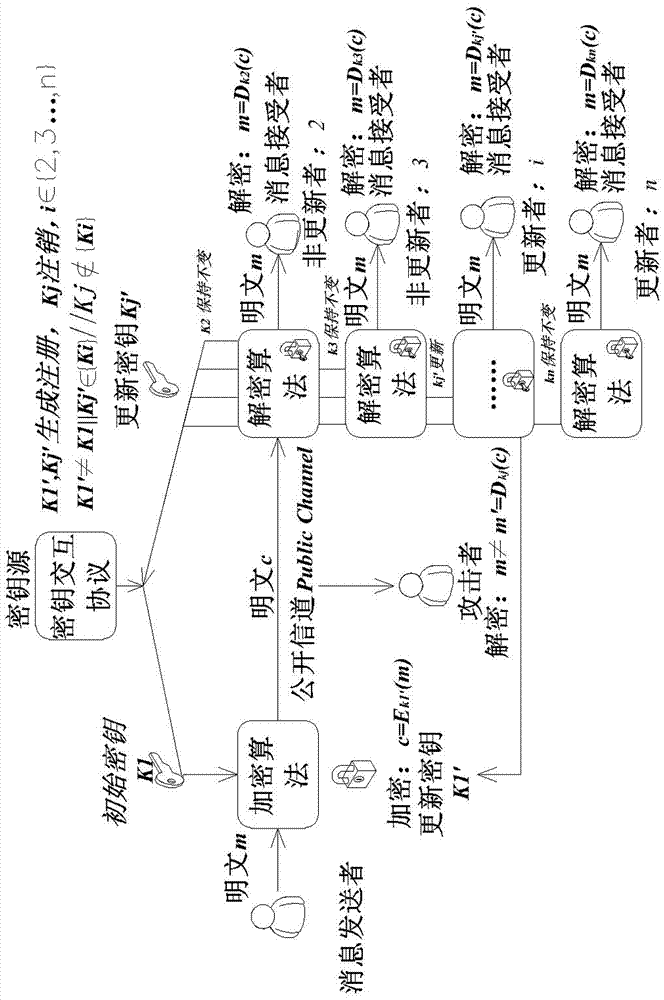
[0054] Such as figure 1As shown, the present invention provides an autonomous group key update method, comprising the following steps:

[0055] S1. The message sender sends plaintext m;

[0056] S2. The key source distributes the initial key Kl' and the updated key Kj', joins the member to register the private secret key, and withdraws the member to cancel the private secret key;

[0057] S3, update the key Kl' and the encryption algorithm to encrypt the plaintext m to obtain the ciphertext c=EKl'(m);

[0058] S4. Send the ciphertext c to the next node;

[0059] S5. Update the key Kj' and the decryption algorithm to decrypt the ciphertext c to obtain the plaintext m;

[0060] S6. Execute the key exchange protocol;

[0061] S7, network operation;

[0062] The key exchange protocol in step S6 is an autonomous key management scheme based on the Diffie-Hellman protocol, and there is a legal entity u i i∈{1,2,...,n}, bulletin board B and offline management server C three typ...