
Function test method for server UIDLED lamp with fool-proof function
A functional testing and server technology, applied in functional testing, instrumentation, error detection/correction, etc., can solve the problems of relying on the accuracy of the operator's actions, lack of fool-proof means, and easy to produce false tests, etc., to achieve a simple and fast test process To optimize, promote the use value, and avoid the effect of false measurement
- Summary
- Abstract
- Description
- Claims
- Application Information
AI Technical Summary
Problems solved by technology
Method used
Image

Examples
Embodiment
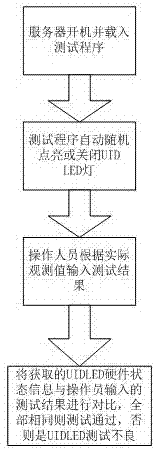
[0024] as attached figure 1 As shown, the server UID LED lamp function test method with foolproof function of the present invention, the method includes the following steps:
[0025] (1) Put the UID LED test program image on the PXE boot server, power on the server and start it up, and boot into the test program;
[0026] (2) The test program starts to be automatically executed, and the UID LED is automatically turned on or off at random. The test program directly reads the UIDLED hardware status information; among them, the test program uses the IPMI protocol to automatically turn on or off the UID LED. Some code examples are as follows:
[0027] IPMIComm *opIpmi = IPMIComm::getInstance();
[0028] if (NULL==opIpmi)
[0029] {
[0030] cerr<<"Cannot get the object of IPMI command class" <
[0031] return 1;
[0032]}
[0033] ret=opIpmi->initKCS(0x20);
[0034] if(0!=ret)
[0035] {
[0036] cerr << "Initialize BMC error, ret:" << ret << endl;
[0037] return re...
PUM
 Login to View More
 Abstract
Description
Claims
Application Information
 Login to View More