Unlock instant, AI-driven research and patent intelligence for your innovation.

Hyperspectral Image Target Detection Method Based on Tensor Linear Discriminant Analysis Dimensionality Reduction

A linear discriminant analysis, hyperspectral image technology, applied in the field of hyperspectral image target detection, can solve the problems of inability to mine three-dimensional data information, low detection accuracy, etc., to achieve effective detection, improve detection accuracy, and good results.

Active Publication Date: 2020-08-28
HARBIN INST OF TECH
View PDF6 Cites 0 Cited by
  • Summary
  • Abstract
  • Description
  • Claims
  • Application Information

AI Technical Summary

Problems solved by technology

[0006] The purpose of the present invention is to solve the problem that the existing hyperspectral image target detection method does not fully consider the characteristics of spatial constraint enhancement under high-resolution conditions, and cannot carry out information mining from the whole 3D data, and the detection accuracy is low. Hyperspectral Image Target Detection Method Based on Tensor Linear Discriminant Analysis Dimensionality Reduction

Method used

the structure of the environmentally friendly knitted fabric provided by the present invention; figure 2 Flow chart of the yarn wrapping machine for environmentally friendly knitted fabrics and storage devices; image 3 Is the parameter map of the yarn covering machine
View more

Image

Smart Image Click on the blue labels to locate them in the text.
Viewing Examples
Smart Image
  • Hyperspectral Image Target Detection Method Based on Tensor Linear Discriminant Analysis Dimensionality Reduction
  • Hyperspectral Image Target Detection Method Based on Tensor Linear Discriminant Analysis Dimensionality Reduction
  • Hyperspectral Image Target Detection Method Based on Tensor Linear Discriminant Analysis Dimensionality Reduction

Examples

Experimental program
Comparison scheme
Effect test

specific Embodiment approach 1

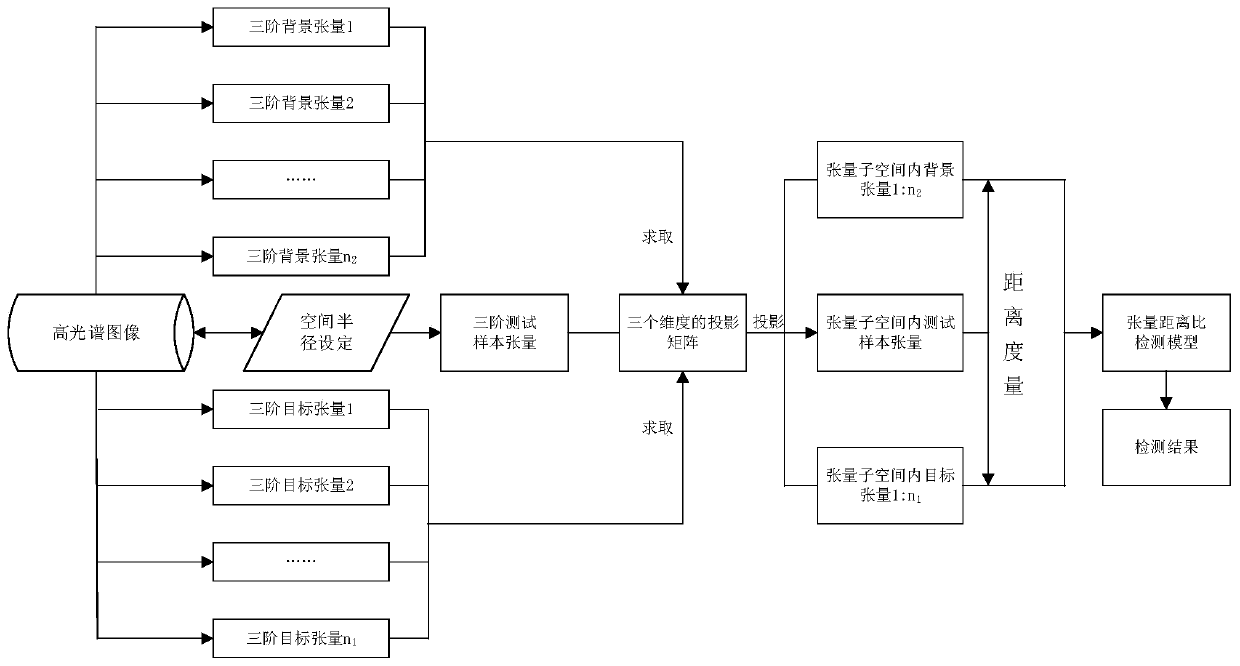
[0030] Specific implementation mode one: combine figure 1 To illustrate this embodiment, the specific process of the hyperspectral image target detection method based on tensor linear discriminant analysis dimensionality reduction in this embodiment is as follows:

[0031] Step 1: Select and divide the tensor block of the hyperspectral image to be detected, and obtain the empty X-empty Y-spectrum third-order target tensor block, empty X-empty Y-spectrum third-order background tensor block and empty X- Empty Y-spectrum third-order test sample tensor block to be detected;

[0032] Step 2: Set the size of the target tensor block, background tensor block and test sample tensor block to be tested in each dimension after projection, and use the target tensor block and background tensor block obtained in step 1 to train and obtain the target The three-dimensional projection matrix of the tensor block, the background tensor block and the test sample tensor block to make the target t...

specific Embodiment approach 2

[0036] Specific embodiment 2: The difference between this embodiment and specific embodiment 1 is that in the first step, the hyperspectral image to be detected is selected and divided into tensor blocks, and the third-order target tensor of empty X-empty Y-spectrum is obtained Block, empty X-empty Y-spectrum third-order background tensor block and empty X-empty Y-spectrum third-order test sample tensor block to be detected; the specific process is:

[0037] Given a 3×3 window, convert the hyperspectral image to be detected into a third-order tensor form, slide the sampling window, and determine it as empty X-empty when the value of the truth map corresponding to the center point of the sampling window is 1 Block of Y-spectral third-order target tensors from which n is arbitrarily sampled 1 get an empty X-empty-Y-spectrum third-order target tensor block 1≤j≤n 1 ; When the values ​​of all points in the window corresponding to the truth map are 0, it is determined to be an em...

specific Embodiment approach 3

[0039] Specific embodiment three: the difference between this embodiment and specific embodiment one or two is that in the step two, the target tensor block, the background tensor block and the test sample tensor block to be detected are set in each dimension after projection The size of the target tensor block and the background tensor block obtained in step 1 are trained to obtain the projection matrix in the three dimensions of the target tensor block, the background tensor block and the test sample tensor block to be detected, so that the target tensor Blocks and background tensor blocks have maximum separability in the projected subspace; the specific process is:

[0040] Step 21, the target tensor block obtained in step 1 1≤j≤n 1 and the background tensor block 1≤j≤n 2 As two-class training tensor samples 1≤j≤n i , 1≤i≤2, set the target tensor block, the background tensor block and the test sample tensor block to be tested. The size of the projected dimension of...

the structure of the environmentally friendly knitted fabric provided by the present invention; figure 2 Flow chart of the yarn wrapping machine for environmentally friendly knitted fabrics and storage devices; image 3 Is the parameter map of the yarn covering machine
Login to View More

PUM

No PUM Login to View More

Abstract

A hyperspectral image target detection method based on tensor linear discriminant analysis dimensionality reduction, the invention relates to a hyperspectral image target detection method. The purpose of the present invention is to solve the problem that the existing hyperspectral image target detection method does not fully consider the characteristics of spatial constraint enhancement under high-resolution conditions, cannot carry out information mining from the whole 3D data, and has low detection accuracy. The process is: 1: Obtain the third-order target, third-order background and third-order test sample tensor blocks to be detected; 2: Make the target and background tensor blocks have the greatest separability in the projected subspace; 3: Project the tensor block of the target, background and test samples to be detected into the tensor subspace with maximum separability; four: calculate the total distance from each test sample to the background and target; five: set the threshold, if If the gray value is greater than the threshold, the pixel at the center point is determined to be the target, otherwise the pixel at the center point is considered to be the background. The invention is used in the field of image processing.

Description

technical field [0001] The invention relates to a hyperspectral image target detection method. Background technique [0002] The hyperspectral image sensor can obtain the reflected radiation information of ground objects through hundreds of spectral channels, and its band range covers from visible light to near infrared and even long wave infrared. Hyperspectral images contain spatial information, reflection or radiation information, and spectral information of ground objects at the same time, and its characteristic is usually called "map-spectrum integration". Moreover, hyperspectral image data provides nearly continuous spectral sampling information, which can record small reflection differences of ground objects in the spectrum, which can be used as the basis for classification and detection of ground objects. It has important theoretical significance and application value to study the new technology of hyperspectral image target detection. In the military aspect, it ca...

Claims

the structure of the environmentally friendly knitted fabric provided by the present invention; figure 2 Flow chart of the yarn wrapping machine for environmentally friendly knitted fabrics and storage devices; image 3 Is the parameter map of the yarn covering machine
Login to View More

Application Information

Patent Timeline
no application Login to View More
Patent Type & Authority Patents(China)
IPC IPC(8): G06K9/00G06K9/62G06T7/00
CPCG06T7/0002G06T2207/20068G06T2207/20021G06T2207/10032G06V20/194G06V20/13G06V10/757G06V2201/07G06F18/22
Inventor 谷延锋谭苏灵
Owner HARBIN INST OF TECH