
A kind of preparation method of methanol system p-xylene catalyst
A xylene catalyst and methanol technology, applied in the direction of catalyst activation/preparation, catalyst, carbon compound catalyst, etc., can solve the problems of uneven bed temperature, poor catalyst stability, high cost, etc., to improve surface characteristics and stability, The effect of increasing the adsorption capacity and improving the reaction effect
- Summary
- Abstract
- Description
- Claims
- Application Information
AI Technical Summary
Problems solved by technology
Method used
Image

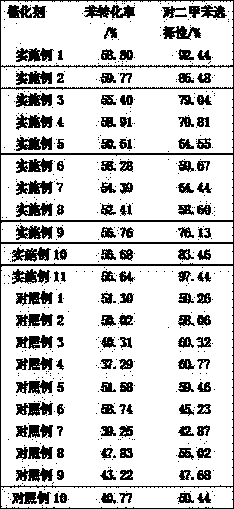
Examples
Embodiment 1
[0016] A method for preparing a catalyst for producing p-xylene from methanol, comprising the following steps:
[0017] Step 1. Freeze-dry 100g of COF-1 nanomaterials and pulverize them, place them in a tube furnace, blow nitrogen gas for 10min, flow rate is 0.5L / min, and rapidly raise the temperature to 350°C and keep the constant temperature for 5h to obtain a thermally expandable porous material;
[0018] Step 2, put the above COF-1 nanomaterials in 1mol / L dilute hydrochloric acid, stir at constant temperature, and filter to obtain a solid; take 100g of the solid, add a mixed solution of 50ml concentrated sulfuric acid and 50ml concentrated nitric acid in a volume ratio, and then mechanically stir for 4 hours , suction filtration,
[0019] wash and dry;
[0020] Step 3. Add the above-mentioned dried product into 25ml of ammonia water, mechanically stir for 15 minutes, add 25g of sodium dithionite, stir at a constant speed for 24 hours, filter with suction, wash and dry to ...
Embodiment 2
[0027] Step 4. Take 20g of amino-modified COF-1 nanomaterials, add 160ml of alcohol-water mixed system containing 15gFeSO4•7H2O and 5g of PEG-4000, wherein the volume ratio of water and absolute ethanol is 1:2, and inject high-purity nitrogen, While stirring at a constant speed, 30 ml of KBH4 solution with a concentration of 0.5 mol / L was added dropwise, then continued to stir for 20 min, and vacuum freeze-dried to obtain nano-iron-loaded amino-modified COF-1 catalyst. All the other steps are the same as in Example 1.
Embodiment 3
[0029] Step 4. Take 10g of amino-modified COF-1 nanomaterials, add 160ml of alcohol-water mixed system containing 15gFeSO4•7H2O and 5g of PEG-4000, wherein the volume ratio of water and absolute ethanol is 1:2, and inject high-purity nitrogen, While stirring at a constant speed, 30 ml of KBH4 solution with a concentration of 0.5 mol / L was added dropwise, then continued to stir for 20 min, and vacuum freeze-dried to obtain nano-iron-loaded amino-modified COF-1 catalyst. All the other steps are the same as in Example 1.
PUM
| Property | Measurement | Unit |
|---|---|---|
| particle diameter | aaaaa | aaaaa |
Abstract
Description
Claims
Application Information
 Login to View More