Unlock instant, AI-driven research and patent intelligence for your innovation.
Application of FXR expression interference reagent in preparation of anti-hepatic fibrosis drugs
What is Al technical title?
Al technical title is built by PatSnap Al team. It summarizes the technical point description of the patent document.
An anti-liver fibrosis, reagent technology, applied in the field of biomedicine to achieve the effect of maintaining integrity
Inactive Publication Date: 2018-05-29
CHINA PHARM UNIV
View PDF13 Cites 5 Cited by
Summary
Abstract
Description
Claims
Application Information
AI Technical Summary
This helps you quickly interpret patents by identifying the three key elements:
Problems solved by technology
Method used
Benefits of technology
Problems solved by technology
However, the current research is still limited to the role of FXR transcriptional activity in diseases, ignoring the role of FXR expression in the physiological and pathological process of the liver; therefore, it is also limited to the development of reagents that regulate FXR transcriptional activity, while ignoring the intervention of FXR expression Reagents, including drugs and genes (viral and non-viral vectors) and other reagents
Method used
the structure of the environmentally friendly knitted fabric provided by the present invention; figure 2 Flow chart of the yarn wrapping machine for environmentally friendly knitted fabrics and storage devices; image 3 Is the parameter map of the yarn covering machine
View more
Image
Smart Image Click on the blue labels to locate them in the text.
Viewing Examples
Smart Image
Click on the blue label to locate the original text in one second.
Reading with bidirectional positioning of images and text.
Smart Image
Examples
Experimental program
Comparison scheme
Effect test
Embodiment 1
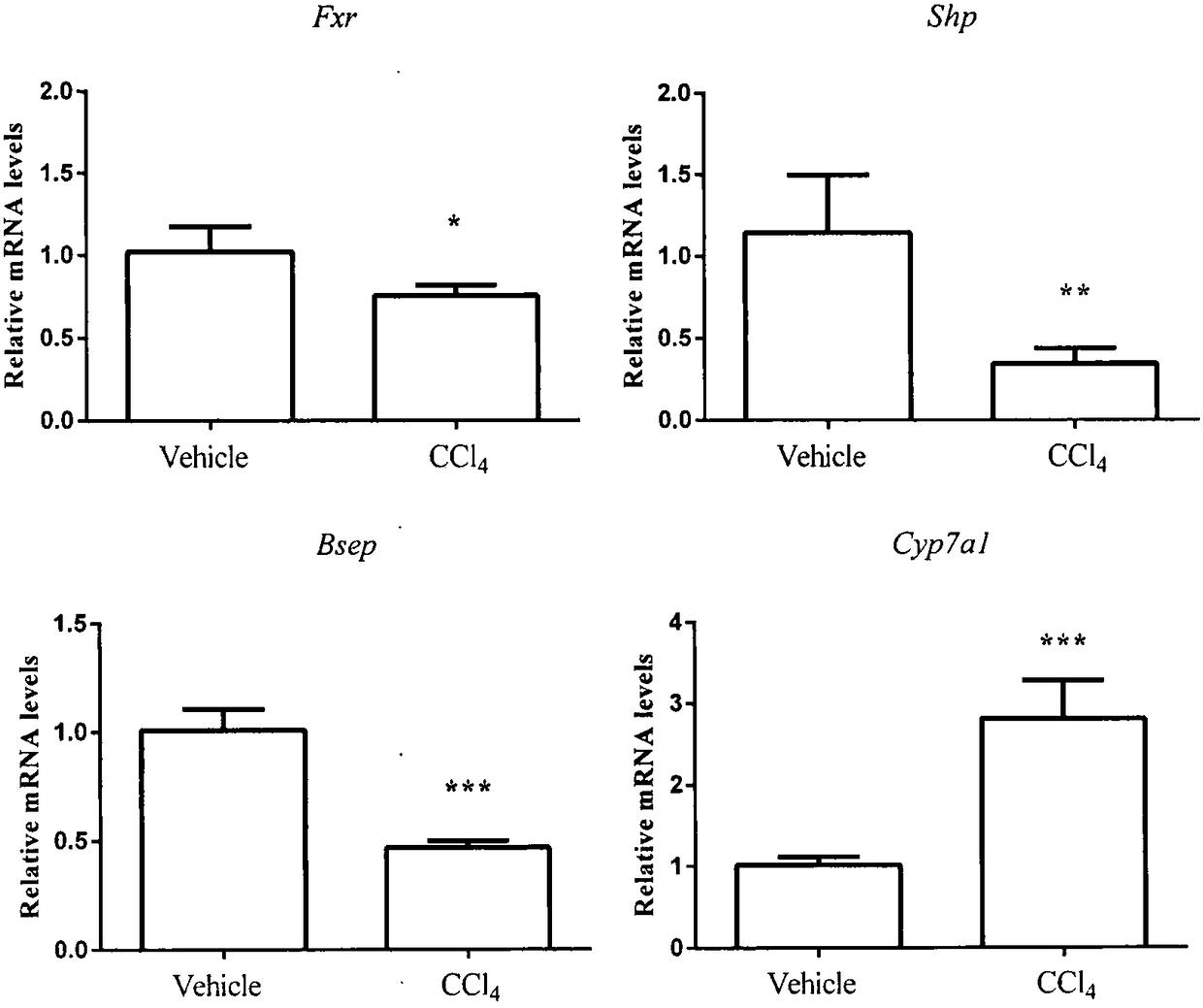
[0023] Example 1 The levels of FXR and its downstream signaling molecules are significantly down-regulated in the state of liver fibrosis
[0024] 1 Experimental materials
[0025] Experimental mice (C57BL / 6) were purchased from the Comparative Medicine Center of Yangzhou University;
[0026] CCl 4 Purchased from Shanghai Lingfeng Chemical Reagent Company, mineral oil was purchased from Sigma-Aldrich Company, TrizolRNAiso plus was purchased from Takara Company, reverse transcription kit and SYBR Green were purchased from Applied Biosystems Company, and the primers used were synthesized by Life Company.
[0027] All other biological materials / reagents can be obtained from commercial sources.
[0029] 2.1 Establishment of mouse liver fibrosis model
[0030] After the animals were adaptively fed for one week, the mice were randomly divided into 2 groups, 8 in each group, 16 in total. The control group and the model group were respectively, and...
Embodiment 2
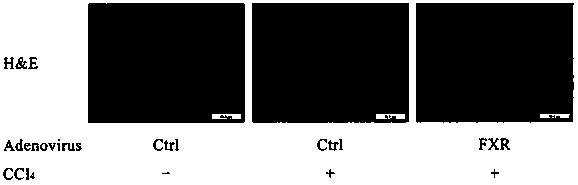
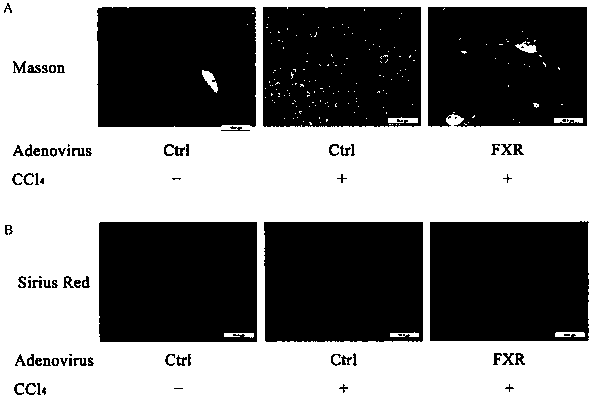
[0049] Example 2 Injecting mice with FXR adenovirus can significantly improve the symptoms of liver fibrosis
[0050] 1 Experimental materials
[0051] The adenovirus carrying FXR (Ad-FXR) was donated by Professor Frank J Gonzalez of the NIH Center in the United States and amplified by Bailingwei Biotechnology Co., Ltd. The control adenovirus (Ad-Ctrl) was designed, synthesized and amplified by the company;
[0052] Experimental mice were purchased from the Comparative Medicine Center of Yangzhou University;
[0053] Anti-FXR antibody was purchased from Abcam Company, and anti-GAPDH antibody was purchased from Bioworld Company.
[0054] All the other experimental materials are the same as in Example 1.
[0057] After the animals were adaptively fed for one week, the mice were randomly divided into 4 groups, 10 in each group, 40 in total. They were blank control group, FXR Adenovirus group, model ...
the structure of the environmentally friendly knitted fabric provided by the present invention; figure 2 Flow chart of the yarn wrapping machine for environmentally friendly knitted fabrics and storage devices; image 3 Is the parameter map of the yarn covering machine
Login to View More
PUM
Login to View More
Abstract
The present invention relates to the field of biomedicine. The present invention provides application of a farnesoid X receptor (FXR) expression interference reagent in preparation of anti-hepatic fibrosis drugs. Specifically, the present invention relates to application of FXR for treatment of hepatic fibrosis, by tail intravenous injection of the farnesoid X receptor (FXR) expression interference reagent (namely, an adenovirus carrying FXR plasmid) to mice, the expression level of the FXR in hepatocytes is significantly increased, CCl4-induced hepatic fibrosis can be significantly countered,hepatocyte morphology and structural integrity can be maintained, and serum transaminase level can be reduced. A new approach for clinical treatment of liver diseases especially hepatic fibrosis is provided.
Description
technical field [0001] The present invention relates to the field of biomedicine. Specifically, the present invention belongs to genemedicine in the field of biopharmaceuticals, and in particular relates to a gene therapy drug against liver fibrosis, that is, using a recombinant adenovirus carrying farnesoid X receptor (FXR) in the preparation of liver Application in drugs for the prevention and treatment of fibrotic diseases. technical background [0002] The incidence of liver diseases, especially viral hepatitis, fatty liverdisease, liver fibrosis and liver cancer, remains high worldwide. For example, the incidence rate of NAFLD among ordinary adults in Europe and America is 20-33%, and the incidence rate among obese people reaches 60-90%; the prevalence rate of ordinary adults in China is about 15% (Fan J G, Farrell G C. non-alcoholic fatty liverdisease in China. Journal of Hepatology, 2009, 50(1): 204-10.). Liver fibrosis (Fibrosis) is a pathological state, which ...
Claims
the structure of the environmentally friendly knitted fabric provided by the present invention; figure 2 Flow chart of the yarn wrapping machine for environmentally friendly knitted fabrics and storage devices; image 3 Is the parameter map of the yarn covering machine
Login to View More
Application Information
Patent Timeline
Application Date:The date an application was filed.
Publication Date:The date a patent or application was officially published.
First Publication Date:The earliest publication date of a patent with the same application number.
Issue Date:Publication date of the patent grant document.
PCT Entry Date:The Entry date of PCT National Phase.
Estimated Expiry Date:The statutory expiry date of a patent right according to the Patent Law, and it is the longest term of protection that the patent right can achieve without the termination of the patent right due to other reasons(Term extension factor has been taken into account ).
Invalid Date:Actual expiry date is based on effective date or publication date of legal transaction data of invalid patent.



 Login to View More
  Login to View More