
Laser radar and working method thereof
A laser radar and laser beam technology, applied in the direction of radio wave measurement systems, instruments, etc., can solve the problems of large galvanometer rotation angle and small field of view, so as to improve accuracy, increase angular resolution and field of view, and reduce impact Effect
- Summary
- Abstract
- Description
- Claims
- Application Information
AI Technical Summary
Problems solved by technology
Method used
Image

Examples
Embodiment Construction
[0026] LiDAR has many problems, such as: the rotation angle of the galvanometer is large or the field of view of the LiDAR is small.
[0027] Combining with a kind of laser radar, analyze the reasons why the lidar field of view angle is small or the rotation angle of the galvanometer is large:
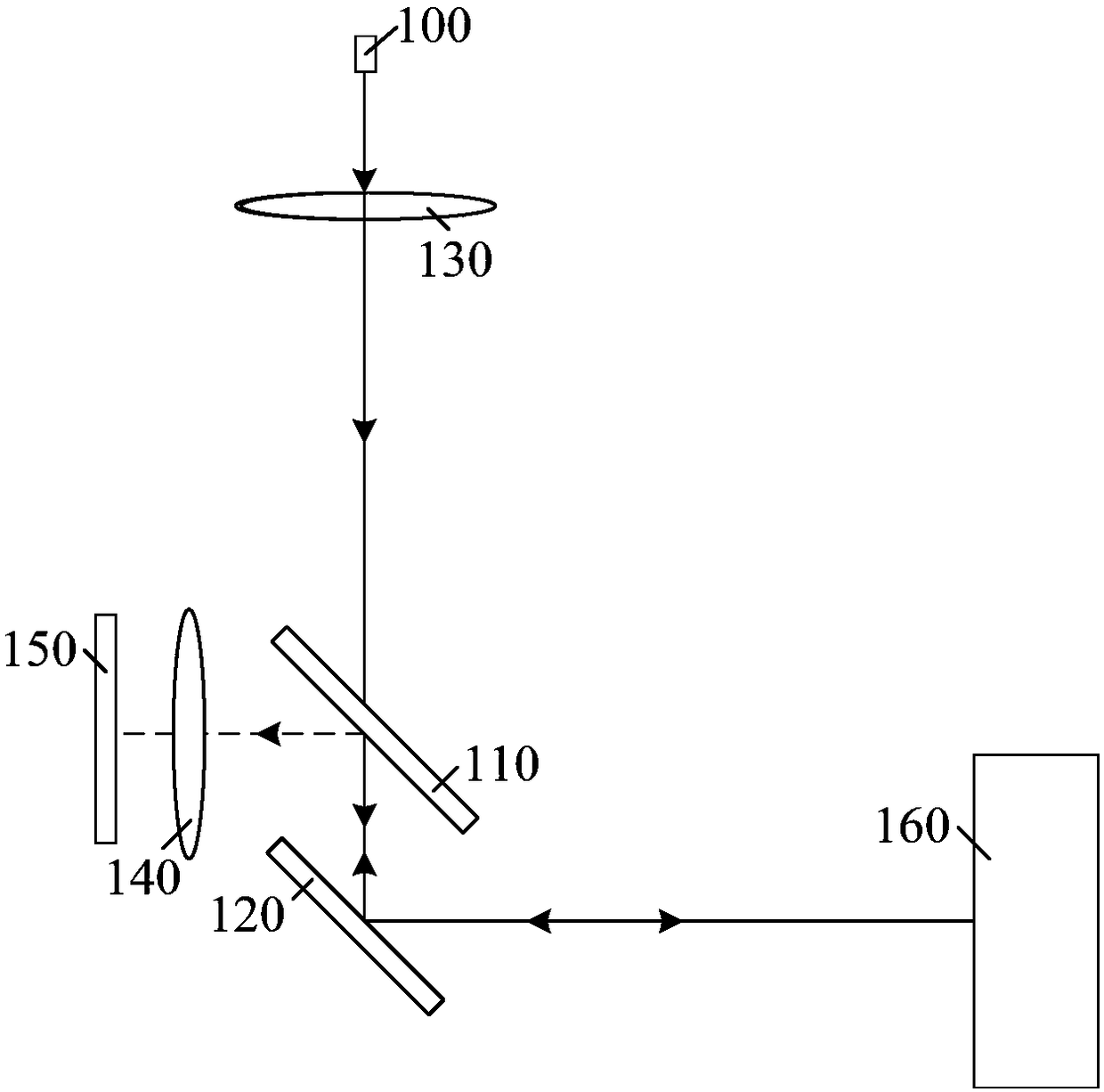
[0028] figure 1 It is a schematic diagram of the working principle of a laser radar.
[0029] The lidar includes: a laser 100, which is used to emit a laser beam; a collimating lens 130, which is used to collimate the laser beam 100 emitted by the laser 100; a vibrating mirror 120, which is used to change the Propagation direction; photoelectric detection array 150, used to receive the echo beam reflected by the target 160 to be detected; half-transparent mirror 110, used to transmit the laser beam 100 to the surface of the vibrating mirror 120, and enable the target to be detected The echo beam reflected by 160 is reflected into the photoelectric detection array 150 ;
[0030] Its ...
PUM
 Login to View More
 Abstract
Description
Claims
Application Information
 Login to View More