
Battery pack and power management
A technology of power management system and power management module, which is applied in the direction of battery circuit device, charge equalization circuit, arrangement of multiple synchronous batteries, etc. It can solve the problems that other batteries cannot be discharged, batteries cannot be charged, and cannot be fully discharged, etc. The effect of voltage difference, high balance efficiency, and simple structure
- Summary
- Abstract
- Description
- Claims
- Application Information
AI Technical Summary
Problems solved by technology
Method used
Image

Examples
Embodiment 1
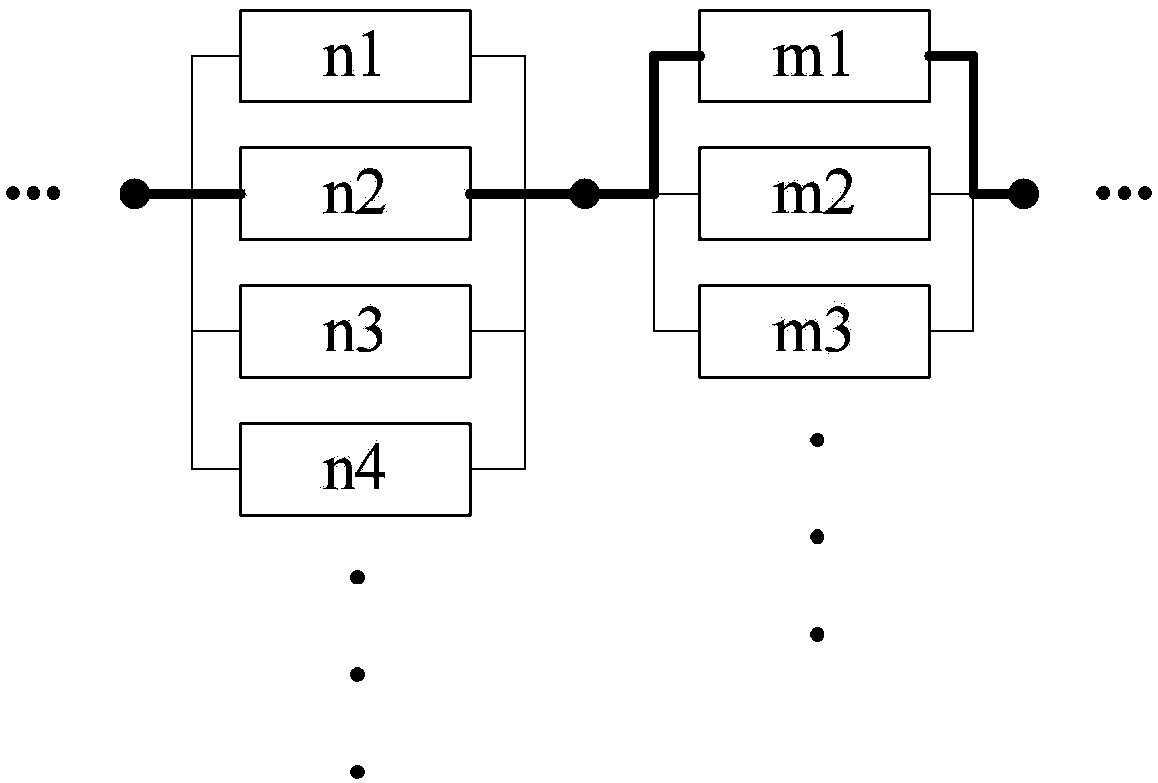
[0049] Such as figure 1 As shown, this embodiment provides a power management system, including a battery pack and a power management module,
[0050] The battery pack includes a plurality of battery cells connected in series, each battery cell includes a plurality of batteries connected in parallel, and a control unit for collecting the voltage of each battery;
[0051] When the battery pack is charged and discharged by the power management module, only a few batteries are selected from each battery unit to be connected to the circuit.
[0052] In the figure, the nth battery unit includes batteries n1, n2, n3, n4...;
[0053] The adjacent mth battery cells include batteries m1, m2, m3....
[0054] The figure shows that only one battery is selected for each battery unit, namely n2 and m1, and connected to the circuit.
[0055] The principle of selecting batteries for the power management module is that the voltages between the batteries connected to the circuit are closer a...
Embodiment 2
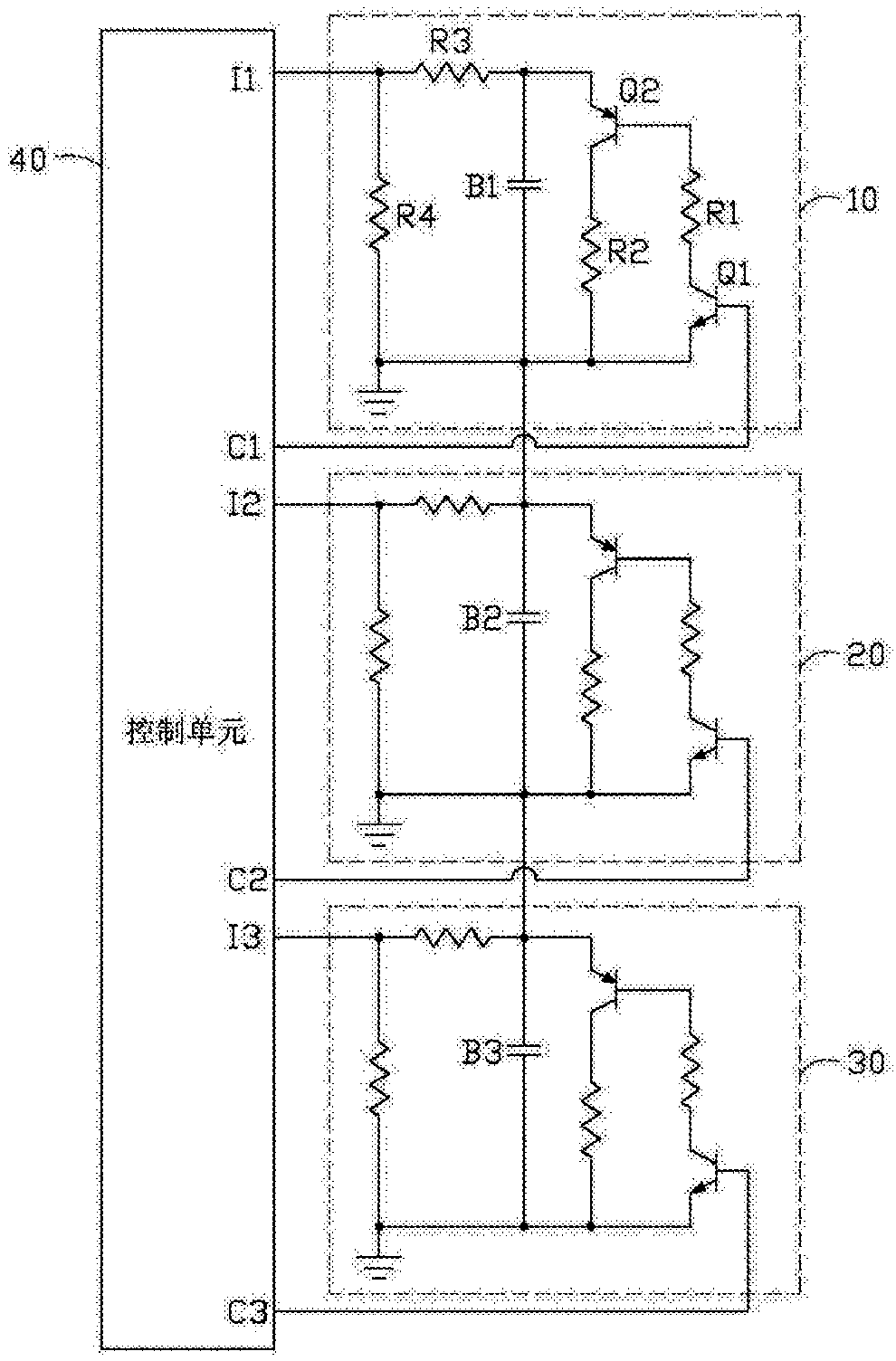
[0060] Please refer to figure 2 , figure 2 It is a circuit schematic diagram of a battery device according to an embodiment of the present invention, taking one battery connected to the circuit as an example for each battery unit, that is, the batteries are connected in series.
[0061] The battery device includes a control unit 40, a plurality of batteries B1-B3 connected in series, and an equalizing circuit 10-30 connected in parallel at both ends of each battery B1-B3. This embodiment is described by taking the battery device including three batteries connected in series as an example.
[0062] The batteries referred to in this application may be lithium batteries, nickel-cadmium batteries, nickel-metal hydride batteries and the like.
[0063] A plurality of batteries B1-B3 connected in series can be connected in series at both ends of the power supply device, so as to be powered by the power supply device when needed.
[0064] The control unit 40 includes three collec...
Embodiment 3
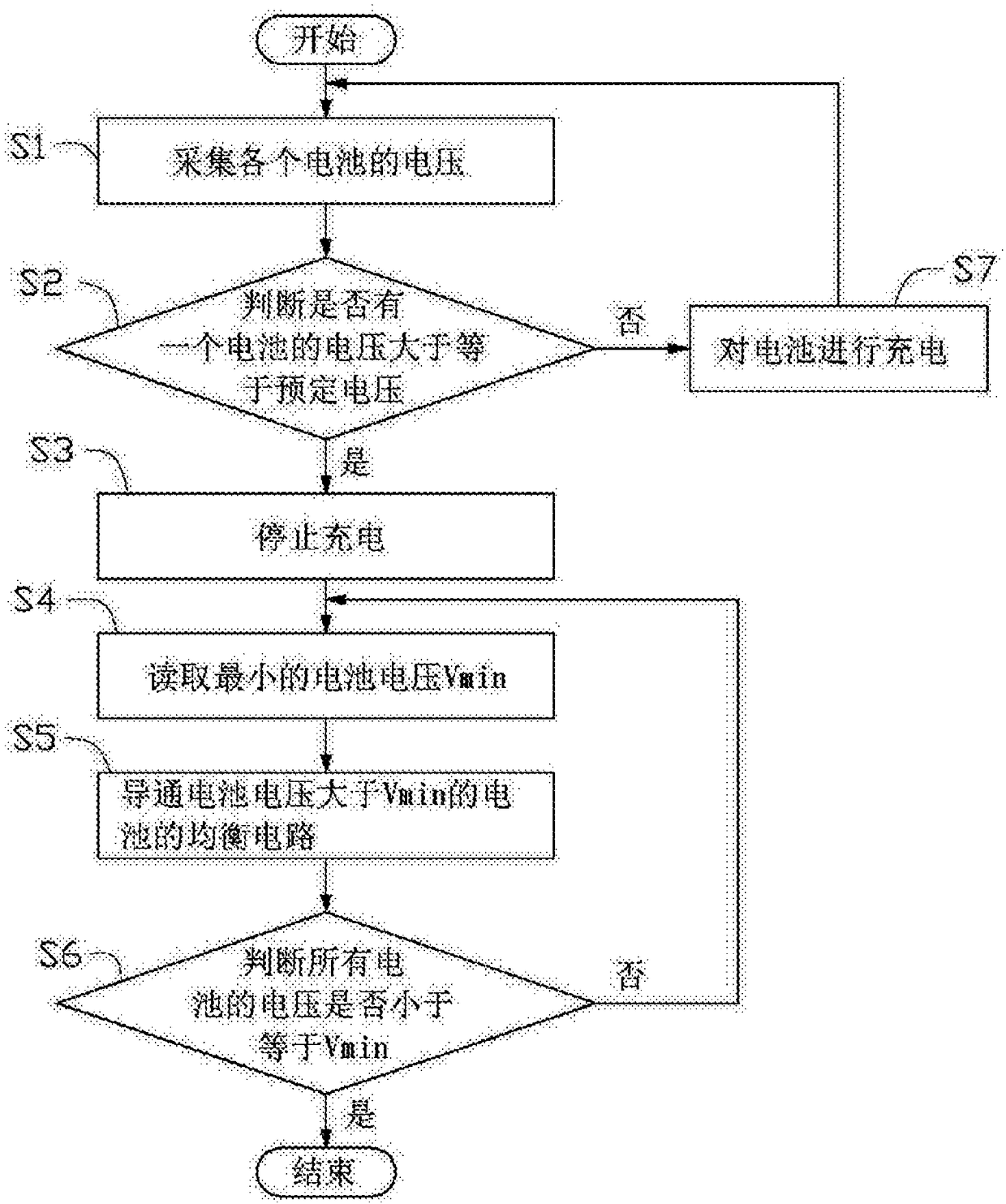
[0072] Please refer to image 3 , the present embodiment provides a battery balancing method adopted by a battery device, the method includes the following steps:
[0073] S1: The control unit 40 collects the voltage of each battery.
[0074] S2: Determine whether there is a battery whose voltage is greater than or equal to a predetermined voltage of 4.2V; if there is a battery with a voltage greater than or equal to 4.2V, perform step S3; if no battery has a voltage greater than or equal to 4.2V, perform step S7.
[0075] S3: The control unit 40 stops charging all batteries.
[0076] S4: The control unit 40 reads the voltage value of the battery with the lowest voltage, and records it as Vmin.
[0077] S5: Turn on the balancing circuit of the battery whose battery voltage is greater than Vmin, so that the battery is discharged. This step needs to last long enough to ensure that all cells are in equilibrium. The duration can be pre-stored in the control unit 40, and the co...
PUM
 Login to View More
 Abstract
Description
Claims
Application Information
 Login to View More