
Plasmid carrying green fluorescent protein gene and indicator bacteria with plasmid
A green fluorescent protein and plasmid technology, applied in the field of microorganisms, can solve the problems of low virulence Salmonella, unable to accurately track Salmonella, etc., and achieve the effect of low virulence
- Summary
- Abstract
- Description
- Claims
- Application Information
AI Technical Summary
Problems solved by technology
Method used
Image



Examples
Embodiment 1
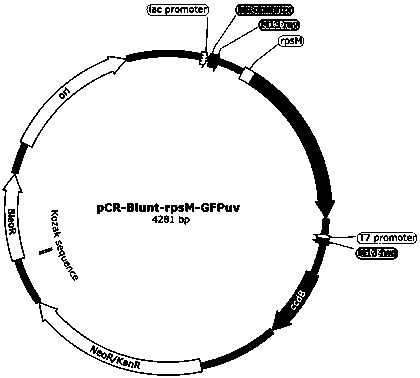
[0043] Example 1 Construction of pCR-rpsM-GFPuv plasmid
[0044] Take the pGFPuv plasmid (purchased from Clontech, see https: / / www.takarabio.com / products / gene-function / fluorescent-proteins / fluorescent-protein-plasmids / cyan-and-green-fluorescent-proteins / gfp for plasmid information -and-gfpuv-fluorescent-proteins website) as template DNA, with PrpsM-gfp-fwd and Pgfp-rev as upstream and downstream primers, and using PrimeSTAR HS DNA polymerase (purchased from TaKaRa Company) to establish a PCR gene amplification reaction, Amplification of the GFPuv coding sequence. At the same time, the PCR reaction also introduces the promoter sequence of the rpsM gene of Salmonella typhimurium at the 5' end of the GFPuv gene by PCR method. Concrete reaction system is as follows:
[0045]
[0046] The PCR reaction conditions were preheated at 95°C for 2 min, followed by 30 cycles of 98°C for 10 s, 55°C for 5 s, and 72°C for 1 min, followed by an extension at 72°C for 5 min. The amplified ...
Embodiment 2
[0050] Example 2 Preparation of Salmonella Competent Cells
[0051] The activated Salmonella SE17 bacteria liquid was inoculated in 100 mL LB liquid medium at a volume ratio of 1:100, and cultured at 37°C with shaking at 180 rpm until the OD600 reached 0.6. Ice bath for 30 minutes to fully cool the bacterial solution; harvest bacterial cells by centrifugation at 4000×g at 4°C for 20 minutes; Resuspend and wash with glycerol; finally resuspend the pellet with 0.2 mL of ice-cold 10% glycerol; aliquot 40 μL / tube to obtain competent cells for Salmonella electric shock transformation.
Embodiment 3
[0052] Example 3 Electric Shock Transformation
[0053] The specific operation steps are:
[0054] (1) Carefully pipette 40 μL of freshly prepared or frozen-thawed Salmonella electric shock transformation competent cells into a 0.5 mL ice-cold micro-sterile centrifuge tube, and pre-cool on ice with the electric shock transformation cup;
[0055] (2) Add 10pg-25ng of plasmid DNA to be transformed (i.e., pCR-rpsM-GFPuv plasmid) in a volume of 1-2μL, and place on ice for 1 min;
[0056] (3) Adjust the electroporator so that the electric pulse is 25μF, the voltage is 25kV, and the resistance is 200Ω; add the mixture of competent cells and plasmid DNA into the ice-cold electric shock cup, put the electric shock cup into the electroporator, and start the electric pulse;
[0057] (4) After the pulse is over, quickly take out the electroshock transformation cup, add 1ml of SOC medium at room temperature, and shake at 37°C at 180 rpm for 2 hours to recover the bacteria;
[0058] (5) ...
PUM
 Login to View More
 Abstract
Description
Claims
Application Information
 Login to View More