
Threonine fermentation medium prepared by using bacterial protein as raw material
A technology for fermentation medium and bacterial protein, applied in the directions of fermentation, microorganism-based methods, biochemical equipment and methods, etc., can solve the problem of low degree of hydrolysis, improve the degree of hydrolysis, speed up the mass transfer process, and mild reaction conditions Effect
- Summary
- Abstract
- Description
- Claims
- Application Information
AI Technical Summary
Problems solved by technology
Method used
Image

Examples
Embodiment 1
[0031] A process for combining hydrolyzed bacterial protein and soybean protein, comprising the steps of:
[0032] The method of obtaining bacterial protein: use a high-speed disk separator to separate the bacterial protein in the threonine fermentation broth, recover the bacterial protein, and dry it.
[0033] Take bacterial protein and soybean protein according to the weight ratio of 2:1, then add citric acid aqueous solution with a concentration of 0.6M according to the ratio of 1g:10ml, stir evenly, and then place it in a high-speed shearing machine at a speed of 10000rpm for 90s, Stand still for 60min, then ultrasonic treatment for 60s, the ultrasonic frequency is 25kHz, and then stand still for 2h, then adjust the pH to 3.0, the temperature is 40°C, then add acid protease, the addition amount is 2000U / g dry matter, and the enzymatic hydrolysis time is 5h , and then adjust the pH to 7.0 and the temperature to 50°C, then add serrapeptase in an amount of 1000U / g dry matter,...
Embodiment 2
[0035] A process for combining hydrolyzed bacterial protein and soybean protein, comprising the steps of:
[0036] Take bacterial protein and soybean protein according to the weight ratio of 3:1, then add a citric acid aqueous solution with a concentration of 0.6M according to the ratio of 1g:8ml, stir evenly, and then place it in a high-speed shearing machine at a speed of 8000rpm for 120s, Stand still for 90 minutes, then ultrasonically treat for 45s, the ultrasonic frequency is 25kHz, and then stand still for 2h, then adjust the pH to 3.0, the temperature is 40°C, then add acid protease, the addition amount is 2000U / g dry matter, and the enzymatic hydrolysis time is 6h , and then adjust the pH to 7.0 and the temperature to 50°C, then add serrapeptase in an amount of 1000U / g dry matter, enzymatic hydrolysis time is 4h, and finally inactivate the enzyme at 100°C for 5min to obtain a hydrolyzate.
Embodiment 3
[0044] Index detection method: Kjeldahl method for determination of total protein; SDS-PAGE for differential determination of protein molecular weight; proteolysis degree determination method uses ninhydrin chromogenic method to determine the degree of hydrolysis.
[0045] 1. The influence of different concentrations of citric acid solution and hydrochloric acid solution on the degree of hydrolysis.
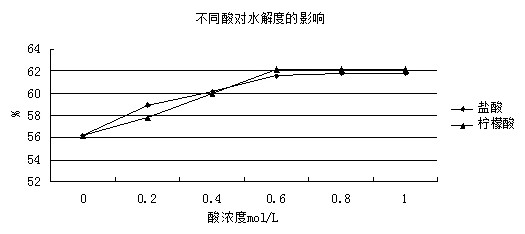
[0046] Set the acid concentration gradient to 0, 0.2, 0.4, 0.6, 0.8, 1.0, the unit is mol / L; for example figure 1 As shown, horizontal observation shows that with the increase of acid concentration, the degree of hydrolysis is also increasing. When the acid concentration reaches 0.6ml / L, the degree of hydrolysis is close to the peak value, and continuing to increase the concentration of acid has no significant impact on the degree of hydrolysis. Considering the There is a certain damage to amino acids, therefore, it is most appropriate to choose a lower concentration of acid. Lon...
PUM
 Login to View More
 Abstract
Description
Claims
Application Information
 Login to View More