Double-acceleration distributed asynchronous optimization method based on Nesterov gradient method and heavy ball method
An optimization method and distributed technology, applied in digital transmission systems, electrical components, transmission systems, etc., can solve problems such as insufficient data processing capabilities, algorithms that cannot meet requirements, and low fault tolerance
Active Publication Date: 2020-11-17
SOUTHWEST UNIVERSITY
View PDF7 Cites 3 Cited by
- Summary
- Abstract
- Description
- Claims
- Application Information
AI Technical Summary
Problems solved by technology
[0008] (1) In the actual environment of large-scale problems and networks, the distributed synchronization algorithm has defects such as insufficient data processing capacity, poor robustness, low utilization of network links, and low fault tolerance due to the requirement of a global clock.
[0009] (2) The existing asynchronous algorithm cannot effectively solve the delay problem, and data packet loss cannot be avoided in an asynchronous communication network
At the same time, most asynchronous algorithms can only converge to the optimal solution at a sublinear speed
[0010] (3) Although synchronous algorithms analyze individual acceleration technologies, existing asynchronous algorithms ignore the discussion of acceleration technologies
In addition, neither the synchronous algorithm nor the asynchronous algorithm discusses whether the two acceleration technologies can be effectively combined to achieve double acceleration.
[0011] It can be seen that the conventionally used algorithms in the prior art can no longer meet people's requirements
Method used
the structure of the environmentally friendly knitted fabric provided by the present invention; figure 2 Flow chart of the yarn wrapping machine for environmentally friendly knitted fabrics and storage devices; image 3 Is the parameter map of the yarn covering machine
View moreImage
Smart Image Click on the blue labels to locate them in the text.
Smart ImageViewing Examples



Examples
Experimental program
Comparison scheme
Effect test
Embodiment 1
[0183] Adopt algorithm of the present invention to calculate, wherein parameter is set to: α=0.4, β=0.08;
the structure of the environmentally friendly knitted fabric provided by the present invention; figure 2 Flow chart of the yarn wrapping machine for environmentally friendly knitted fabrics and storage devices; image 3 Is the parameter map of the yarn covering machine
Login to View More PUM
 Login to View More
 Abstract
The invention discloses a double-acceleration distributed asynchronous optimization method based on a Nesterov gradient method and a heavy ball method. The double-acceleration distributed asynchronousoptimization method comprises the following steps of initializing variables, determining a time delay value and an activation node, clearing out outdated information, building a network, determiningparameters and updating the variables. In the invention, a very universal asynchronous model is adopted. In the model, 1) all agents can communicate with their neighbors at any time and without any coordination control; and 2) by using the time delay information, all the agents can locally process their own sub-problems. Therefore, the asynchronous algorithm can greatly reduce idle time of a communication link, relieve network and memory access congestion and save power, and has higher robustness and fault tolerance for an actual network system. The method is widely applied to large-scale machine learning and network information processing.
Description
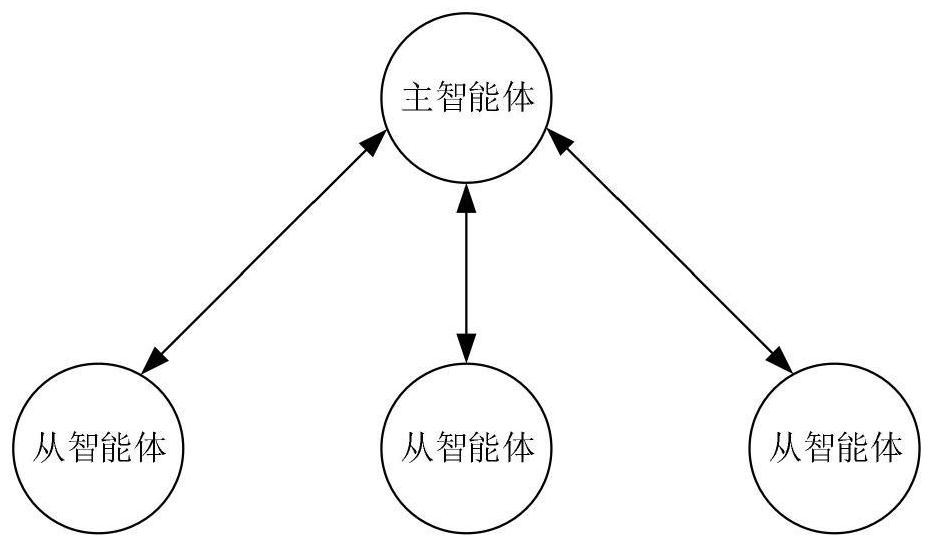
technical field [0001] The invention relates to the technical field of distributed optimization of communication data, in particular to a dual-acceleration distributed asynchronous optimization method based on the Nesterov gradient method and the weighted ball method. Background technique [0002] In the early days, industrial data was mostly small in size and low in dimensionality, and the data was often stored in an intelligent body system, which could effectively process these simple data only by relying on centralized algorithms. However, as the types of industrial data increase, the data is often stored in multiple agent systems, and the data becomes complex and difficult to process. Centralized algorithms have been difficult to apply to process industrial data. Researchers began to work on the study of distributed algorithms. There are two classic architectures in current systems: master-slave computing architecture and distributed computing architecture. We take fou...
Claims
the structure of the environmentally friendly knitted fabric provided by the present invention; figure 2 Flow chart of the yarn wrapping machine for environmentally friendly knitted fabrics and storage devices; image 3 Is the parameter map of the yarn covering machine
Login to View More Application Information
Patent Timeline
 Login to View More
 IPC IPC(8): H04L12/24
CPCH04L41/083H04L41/142H04L41/145
Inventor 李华青程胡强夏大文吴国成王政吕庆国王慧维纪良浩郭靖
Owner SOUTHWEST UNIVERSITY