Check patentability & draft patents in minutes with Patsnap Eureka AI!

Channel estimation method of novel narrowband Internet of Things uplink shared channel

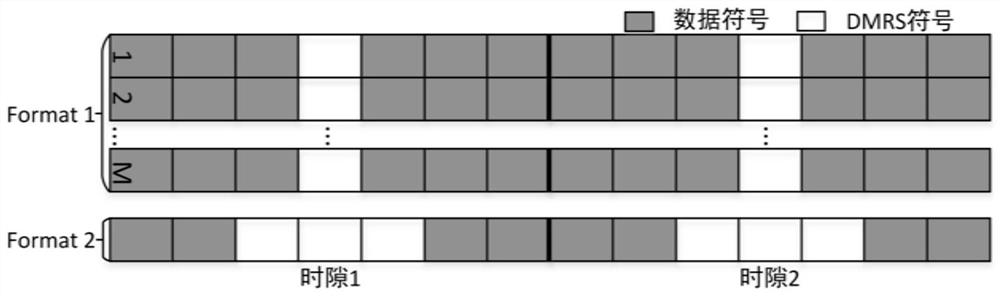
A narrowband Internet of Things and channel estimation technology, applied in the field of channel estimation of uplink shared channels at the physical layer, can solve the problems of low estimation accuracy, computational complexity, low estimation accuracy, and large noise pollution, and achieve high estimation accuracy and improve estimation accuracy. , the effect of reducing noise pollution

Active Publication Date: 2020-12-04
CHINA ELECTRONICS TECH GRP NO 7 RES INST
View PDF5 Cites 0 Cited by
  • Summary
  • Abstract
  • Description
  • Claims
  • Application Information

AI Technical Summary

Problems solved by technology

[0007] In order to solve the problems of high noise pollution and low estimation accuracy in channel estimation in the prior art, the present invention provides a new channel estimation method for uplink shared channels of the narrowband Internet of Things, which has the characteristics of high estimation accuracy and low computational complexity , while greatly reducing noise pollution

Method used

the structure of the environmentally friendly knitted fabric provided by the present invention; figure 2 Flow chart of the yarn wrapping machine for environmentally friendly knitted fabrics and storage devices; image 3 Is the parameter map of the yarn covering machine
View more

Image

Smart Image Click on the blue labels to locate them in the text.
Viewing Examples
Smart Image
  • Channel estimation method of novel narrowband Internet of Things uplink shared channel
  • Channel estimation method of novel narrowband Internet of Things uplink shared channel
  • Channel estimation method of novel narrowband Internet of Things uplink shared channel

Examples

Experimental program
Comparison scheme
Effect test

Embodiment 1

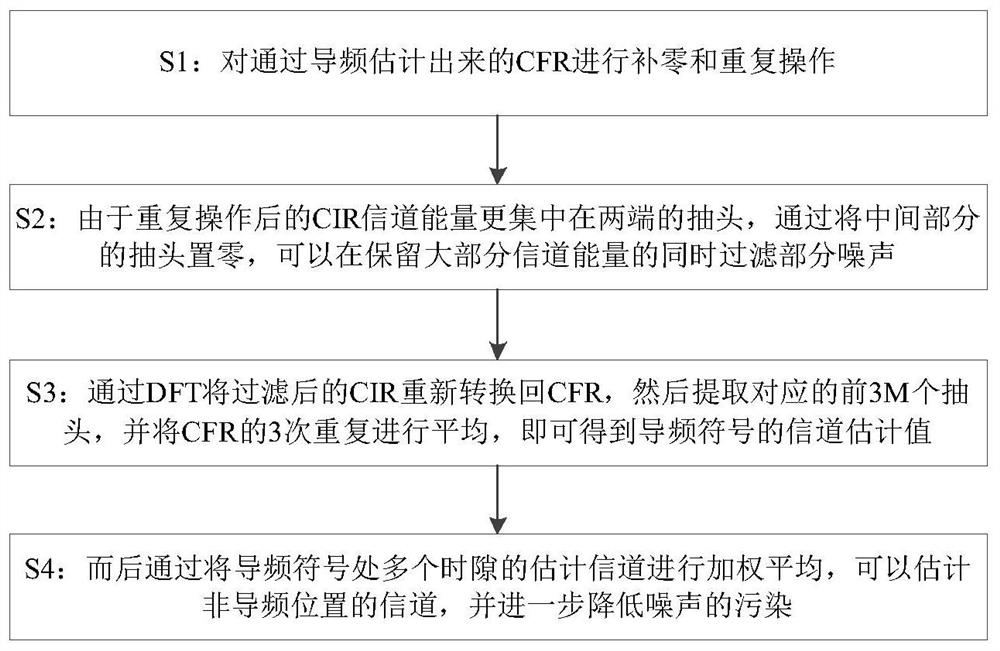
[0038] Such as image 3 Shown, a kind of channel estimation method of uplink shared channel of novel narrowband Internet of things, described method carries out the following steps:

[0039] S1: Carry out zero padding and repeat operations on the CFR estimated from the pilot;

[0040] S2: Since the energy of the CIR channel after repeated operations is more concentrated on the taps at both ends, by setting the taps in the middle part to zero, part of the noise can be filtered while retaining most of the channel energy;

[0041] S3: Convert the filtered CIR back to CFR by DFT, then extract the corresponding first 3M taps, and average the 3 repetitions of CFR to obtain the channel estimation value of the pilot symbol;

[0042]S4: Then, by weighting and averaging the estimated channels of multiple time slots at the pilot symbol, the channel at the non-pilot position can be estimated, and the noise pollution can be further reduced.

Embodiment 2

[0044] Based on the channel estimation method of the new narrowband Internet of Things uplink shared channel described in Embodiment 1, this embodiment also provides a specific embodiment, as follows:

[0045] Step S1: Assumption respectively represent the received signal in the frequency domain, the transmitted signal in the frequency domain, CFR, and the noise in the frequency domain, X=diag(x), then y=Xh+w;

[0046] Carry out zero padding and repeat operations on CFR, and we can get

[0047]

[0048] in, I M is the M-dimensional identity matrix.

[0049] Step S2, such as Figure 4 As shown, it can be seen that the energy of the CIR channel after repeated operations is more concentrated in the taps at both ends, and the noise energy is more concentrated in the taps in the middle, so the taps in the middle can be set to zero, thereby retaining most of the channel energy. while filtering noise. Specifically, the tap of the middle part is set to zero, and the formula...

the structure of the environmentally friendly knitted fabric provided by the present invention; figure 2 Flow chart of the yarn wrapping machine for environmentally friendly knitted fabrics and storage devices; image 3 Is the parameter map of the yarn covering machine
Login to View More

PUM

No PUM Login to View More

Abstract

The invention discloses a channel estimation method of a novel narrowband Internet of Things uplink shared channel. The method comprises the following steps: performing zero padding and repeated operation on a CFR estimated through a pilot frequency; in the repeatedly operated CIR, enabling channel energy to be more concentrated at taps at two ends, and through a condition that the tap at the middle part is set to be zero, filtering parts of a noise while reserving most of the channel energy; converting the filtered CIR back to the CFR again through DFT, then extracting the corresponding first3M taps, and averaging three repetitions of the CFR to obtain a channel estimation value of a pilot symbol; and then carrying out weighted averaging on estimated channels of a plurality of time slotsat the pilot symbol so that a channel at a non-pilot position can be estimated, and further reducing noise pollution. The method has the characteristics of high estimation precision and low calculation complexity, and meanwhile, the noise pollution is greatly reduced.

Description

technical field [0001] The present invention relates to the technical field of wireless communication, and more specifically, relates to a channel estimation method for a physical layer uplink shared channel in a novel narrowband Internet of Things communication system. Background technique [0002] In the narrowband Internet of Things (NB-IoT) communication system, the terminal (user equipment, UE) transmits data to the base station (E-NodeB, eNB) through the physical layer uplink shared channel (narrowband physical uplink shared channel, NPUSCH) information (Format 1) or feedback uplink control information (Format 2). [0003] Due to the noise pollution in the wireless propagation environment, we need to perform channel equalization at the receiving end to correctly recover the information transmitted by the terminal. To perform channel equalization, we first need to estimate the channel at the pilot position through the pilot-based channel estimation technique, and then ...

Claims

the structure of the environmentally friendly knitted fabric provided by the present invention; figure 2 Flow chart of the yarn wrapping machine for environmentally friendly knitted fabrics and storage devices; image 3 Is the parameter map of the yarn covering machine
Login to View More

Application Information

Patent Timeline
no application Login to View More
Patent Type & Authority Applications(China)
IPC IPC(8): H04L25/02
CPCH04L25/0202H04L25/024H04L25/0242H04L25/025Y02D30/70
Inventor 腾潢龙陈海波容琪龙刘为
Owner CHINA ELECTRONICS TECH GRP NO 7 RES INST
Features
  • R&D
  • Intellectual Property
  • Life Sciences
  • Materials
  • Tech Scout
Why Patsnap Eureka
  • Unparalleled Data Quality
  • Higher Quality Content
  • 60% Fewer Hallucinations
Social media
Patsnap Eureka Blog
Learn More