Fluorescent biosensor for detecting DNA methylation, and detection method and application thereof

A biosensor, methylation technology, applied in biochemical equipment and methods, recombinant DNA technology, microbial assay/inspection, etc., can solve the problems of complex reaction steps, limited wide application, time-consuming and labor-intensive pretreatment process, etc. The method is simple, the experimental scheme is simplified, and the sensitivity is improved.

CN112852922AActive Publication Date: 2021-05-28SHANDONG NORMAL UNIV
3 Cites 0 Cited by

Patent Information

Authority / Receiving Office
CN · China
Current Assignee / Owner
Publication Date
2021-05-28

Smart Images

  • Figure 1
    Figure 1
  • Figure 2
    Figure 2
  • Figure 3
    Figure 3
Patent Text Reader

Abstract

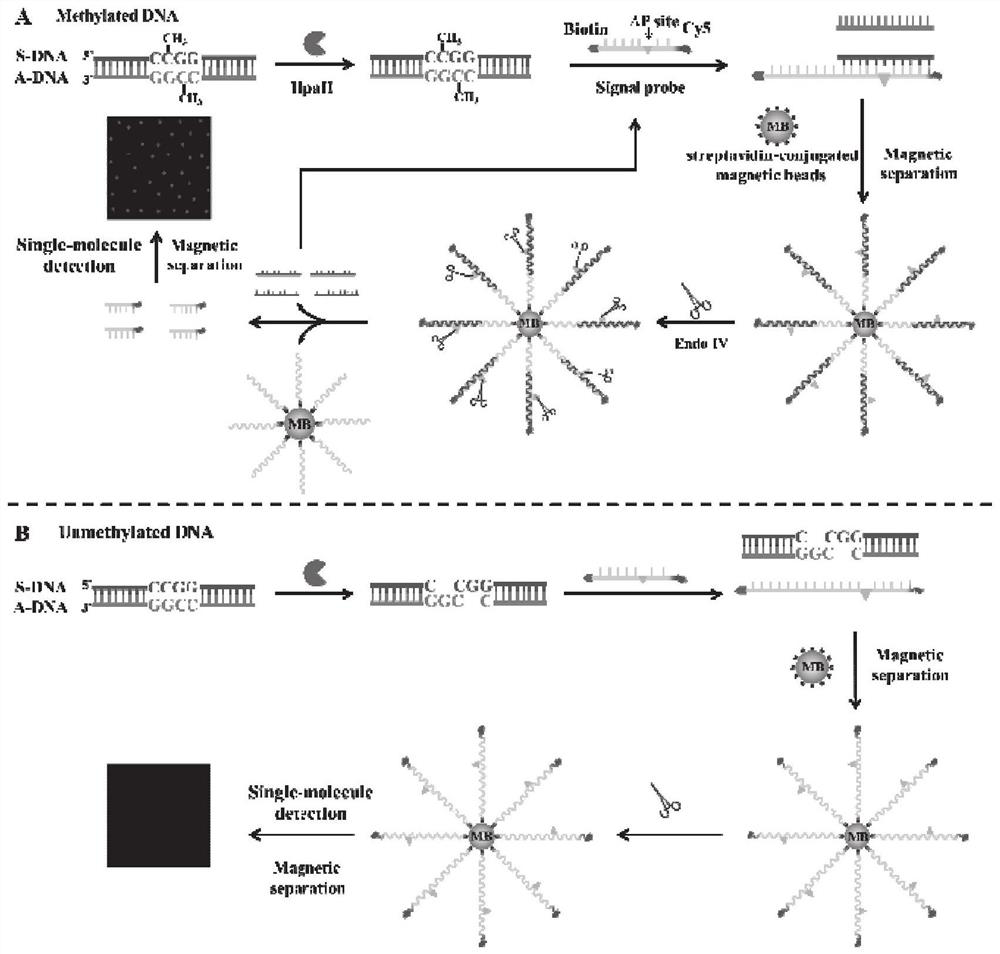
The invention relates to the technical field of DNA methylation detection, and in particular, relates to a fluorescent biosensor for detecting DNA methylation, and a detection method and application thereof. The fluorescent biosensor comprises restriction endonuclease HpaII, a signal probe containing AP sites, endonuclease IV and streptavidin modified magnetic beads; and the probe is modified by biotin and Cy5 together. Endonuclease IV (Endo IV) auxiliary signal amplification is combined with single-molecule fluorescence detection, and the fluorescent biosensor is used for ultrasensitive detection of DNA methylation. The method is simple to operate, high in sensitivity and good in specificity, can even quantify the DNA methylation level in a single cancer cell, and has huge potential in disease diagnosis and clinical medical research.
Need to check novelty before this filing date? Find Prior Art

Description

technical field

[0001] The invention relates to the technical field of DNA methylation detection, in particular to a fluorescent biosensor for detecting DNA methylation, a detection method and an application. Background technique

[0002] The information disclosed in this background section is only intended to increase the understanding of the general background of the present invention, and is not necessarily taken as an acknowledgment or any form of suggestion that the information constitutes the prior art already known to those skilled in the art.

[0003] DNA methylation is one of the most common epigenetic modifications in mammalian genomes, mainly occurring at the fifth carbon atom of cytosine residues in cytosine / guanine dinucleotide (CpG) pairs. By covalently adding methyl groups to cytosines, DNA methylation affects the heritable state of gene expression without altering the DNA sequence. Normal DNA methylation status plays a crucial role in various physiological p...

Examples

Embodiment 1

[0059] Detection of DNA methylation:

[0060] Drugs and materials: All oligonucleotides were synthesized and purified by HPLC at Sangon Bioengineering Co., Ltd. (Shanghai, China). Restriction enzyme HpaII (HpaII), 10×Cutsmart buffer (500 mmol potassium acetate (KAc), 200 mmol tris(hydroxymethyl)aminomethane-acetic acid (Tris-Ac), 100 mmol magnesium acetate ( Mg(Ac) 2 ), 100 micrograms per milliliter bovine serum albumin (BSA), pH 7.9), endonuclease IV (Endo IV), 10×NEB buffer 3 (1 mole sodium chloride (NaCl), 500 mmol tris(hydroxy Methyl)aminomethane-hydrochloric acid (Tris-HCl), 100 mmol magnesium chloride (MgCl 2 ), 10 mmol dithiothreitol (DTT, pH 7.9) and NEBNext DNA double-strand fragmentation enzyme (NEBNext dsDNA Fragmentase) were purchased from New England Bio (Ipswich, MA, USA). Streptavidin-coupled superparamagnetic beads ( M-280 Streptavidin) was purchased from Thermo Fisher Corporation (Carlsbad, CA, USA). All other reagents were of analytical grade and used w...