A method for measuring residual magnetism in shielded barrels based on in-situ magnetometer

A measurement method and magnetometer technology, which is applied in the field of atomic sensors, can solve the problems of not reflecting the shielding effect of the shielding barrel on the residual magnetic field of the environment, complicated operation, etc., and achieve the effect of convenient design and testing, and simple and convenient measurement operation

CN112924910BActive Publication Date: 2022-07-26BEIHANG UNIV
7 Cites 0 Cited by

Patent Information

Authority / Receiving Office
CN · China
Patent Type
Patents(China)
Current Assignee / Owner
Publication Date
2022-07-26

Smart Images

  • Figure 1
    Figure 1
  • Figure 2
    Figure 2
  • Figure 3
    Figure 3
Patent Text Reader

Abstract

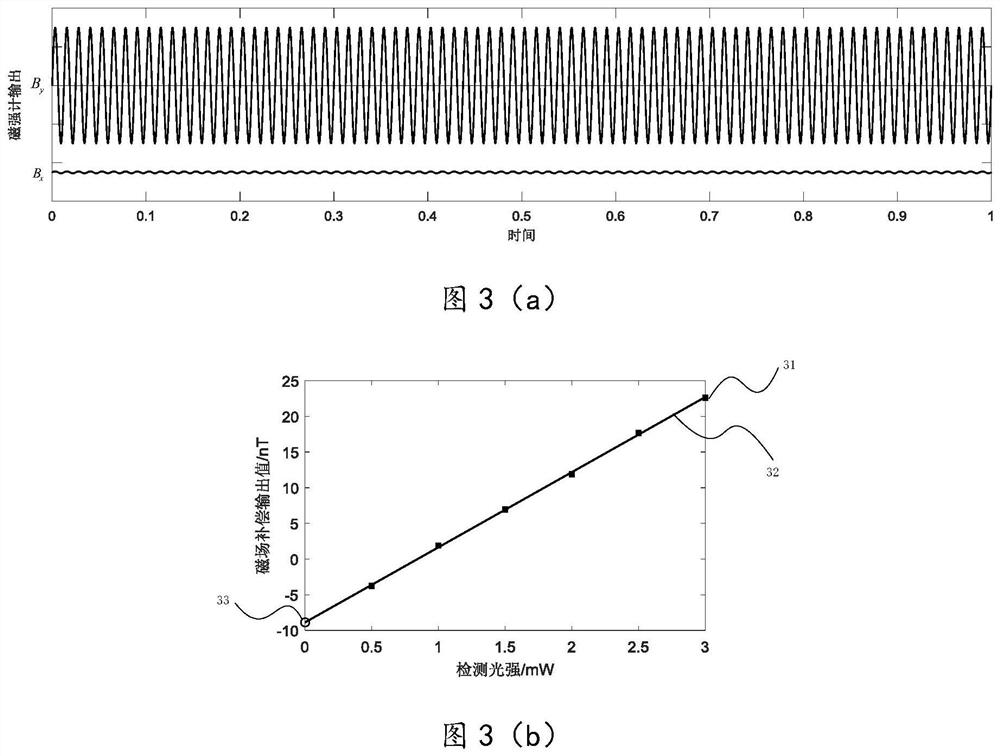
A method for measuring residual magnetism in shielded barrels based on an in-situ magnetometer is suitable for testing the residual magnetism in shielded barrels of atomic sensors. First, apply a static magnetic field, modulate the magnetic field, pump light, and detect light to make the atomic magnetometer work in the magnetic resonance state; demodulate the magnetometer signal, extract its DC component with a low-pass filter, and obtain the horizontal or vertical static For the remanence in the magnetic field direction, apply a DC compensation magnetic field in the transverse direction to compensate the remanence to zero; carry out the remanence measurement and compensation under different detection light intensities, and find that the output value of the compensation magnetic field changes linearly with the detection light intensity, and the straight line is on the vertical axis. The intercept above is the value of the actual lateral remanence after excluding the optical frequency shift; the electronic resonance frequency is measured by the method of magnetic field sweep, and the change of the resonance frequency after the direction of the static magnetic field and the left-right rotation of the pump light are simultaneously reversed, divided by Twice the alkali metal gyromagnetic ratio can get the actual longitudinal remanence. The invention does not need to use an external sensor, which greatly facilitates the design of the atomic sensor.
Need to check novelty before this filing date? Find Prior Art

Description

technical field

[0001] The invention relates to the field of atomic sensors, in particular to a method for measuring residual magnetism in a shielded barrel based on an in-situ magnetometer. Background technique

[0002] In recent years, with the rapid development of atomic physics, breakthroughs in theories such as quantum optics and cold atoms, and advances in technologies such as lasers and quantum manipulation, atomic sensors have gradually attracted attention and attention. High-precision and high-sensitivity atomic sensors are widely used in time measurement, inertial measurement, magnetic field measurement and other fields, some of which have achieved engineering applications and brought about major technological changes. Since the atomic energy level is very sensitive to the magnetic field, magnetic shielding is generally required in the atomic sensor to reduce the interference of the ambient magnetic field on the atoms. Good shielding effect.

[0003] In order to ...

Examples

Embodiment Construction

[0016] The present invention will be further described below with reference to the accompanying drawings and specific embodiments.

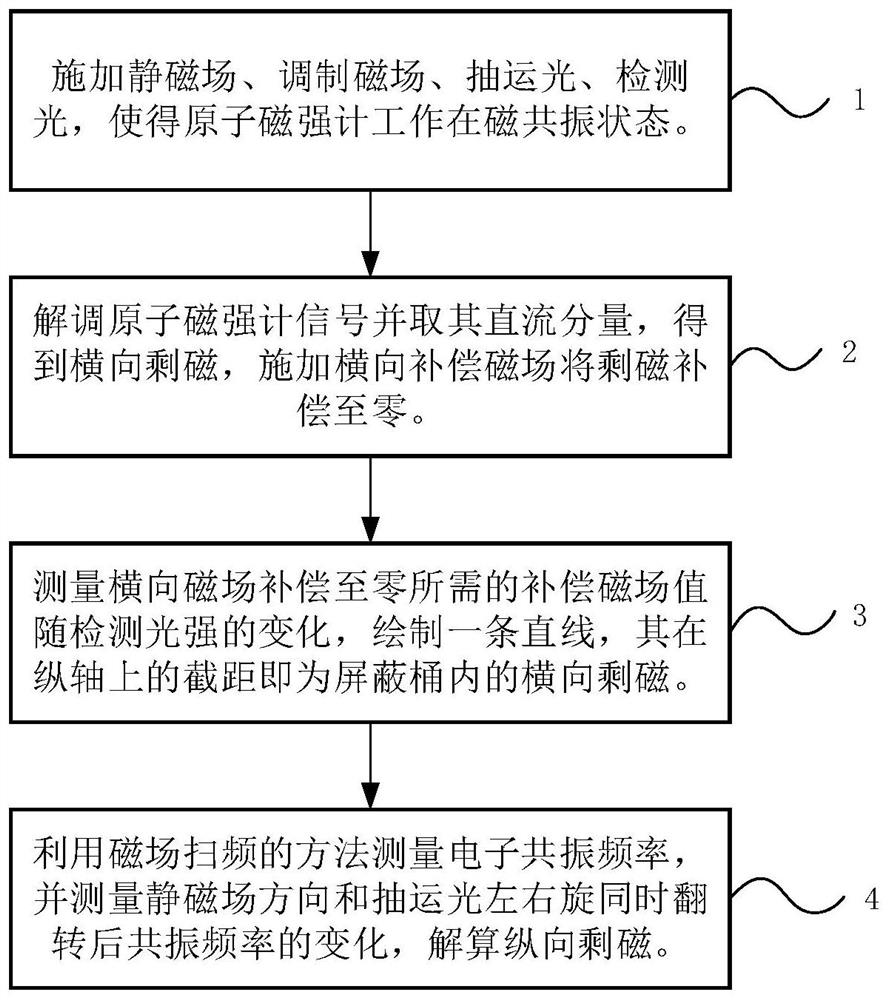
[0017] The specific implementation steps of the present invention are as follows: figure 1 As shown, it includes 4 steps in total, and the specific steps are as follows:

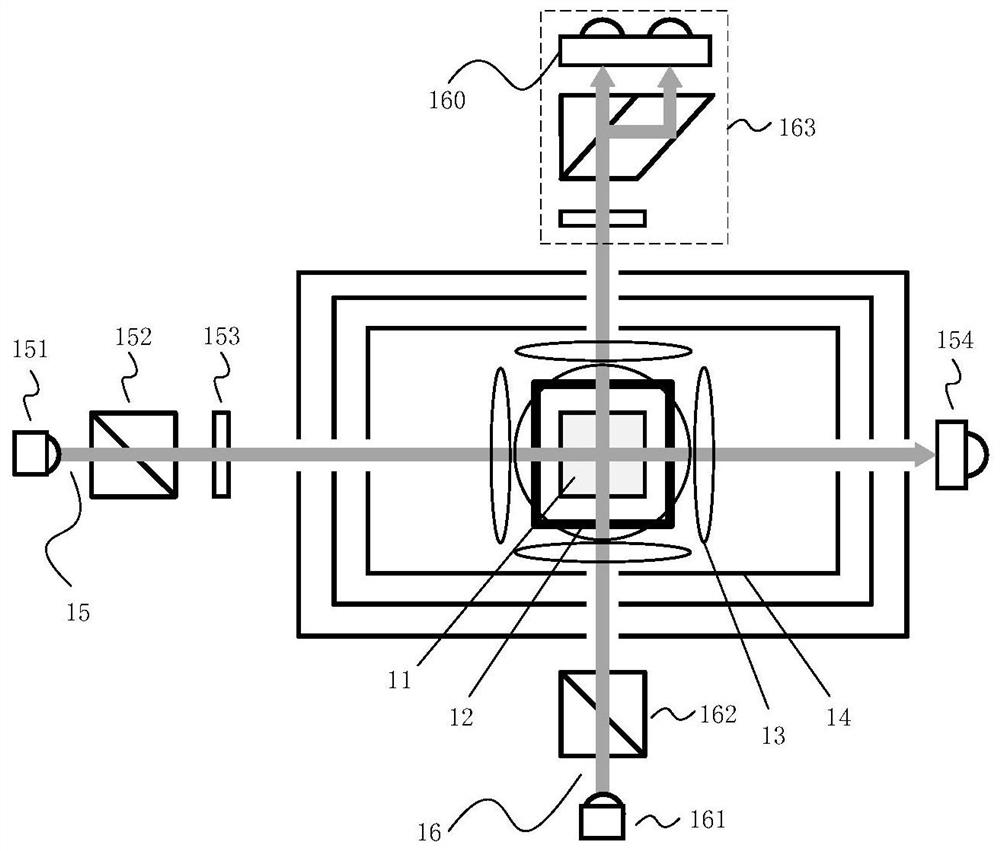
[0018] Step 1. Build an atomic sensor system, including an atomic gas chamber, an oven, a three-axis coil, a multi-layer magnetic shielding barrel, a pumping optical path, and a detection optical path. Then, a static magnetic field is applied in the longitudinal direction of the pumping light, and circularly polarized pumping light is applied to polarize the atoms, and the atoms will precess around the static magnetic field. Then, a modulated magnetic field with the same frequency as the atomic precession is applied in the longitudinal direction to make the atomic magnetometer work in a resonance state, and a beam of linearly polarized detection light is used to detect the ato...