High polymer / clay nano composite material
A nano-composite material and composite material technology, applied in the field of polymer/clay nano-composite materials, can solve the problems of inability to achieve nano-dispersion, and achieve the effects of long-lasting far-infrared functions, low hardness, and recyclability
- Summary
- Abstract
- Description
- Claims
- Application Information
AI Technical Summary
Problems solved by technology
Method used
Image



Examples
Embodiment 1
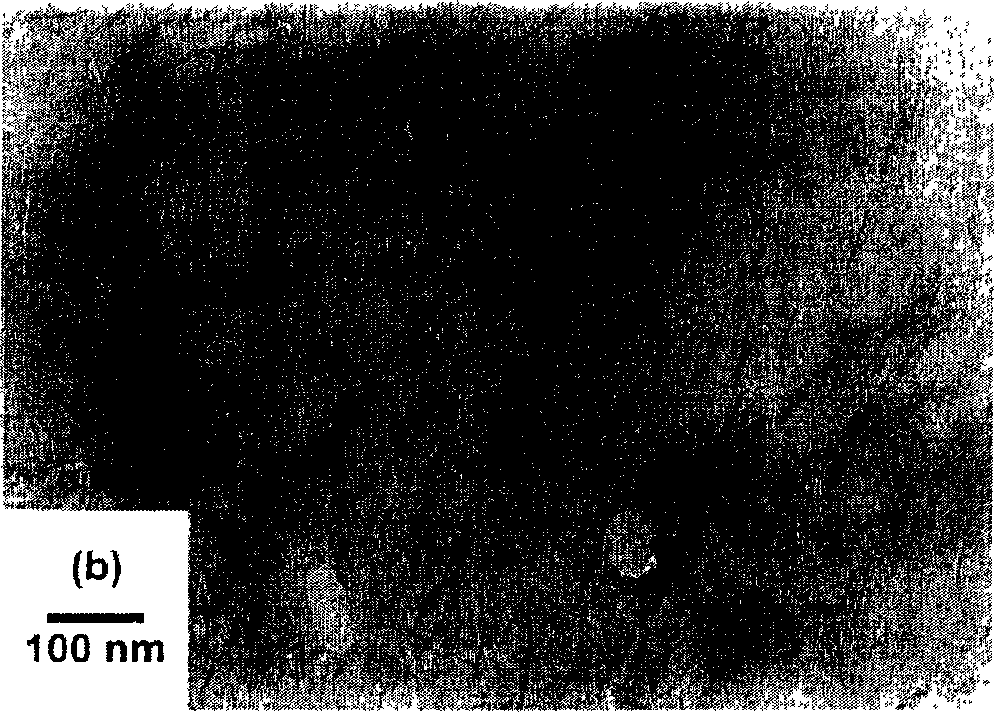
[0045] Take 15 grams of montmorillonite with the sample number PK802 after purification and sodium ion exchange modification, its average particle size is 2 μm, and the average emissivity of far-infrared radiation in the range of far-infrared wavelength 4 to 20 μm at 40 ° C is 0.919, the montmorillonite and CPL (caprolactam), H 2 O, H 3 PO 4 Mix according to the ratio of 15:1500:23.5:5.1 to carry out normal pressure polymerization. Blow with nitrogen for about 5 minutes, stir at 90°C for 1 to 3 hours, then raise the temperature to 260°C and dehydrate. Then pour in 15 C.C. of water at 260° C. for 1 hour. At 260°C, react for 5 hours. Blanking, cutting into pellets, washing with water until the CPL residual amount is less than 5 wt%, and drying to obtain the polymer / clay nanocomposite material containing far-infrared radiation function clay of the present invention. The micrographs of the scanning electron microscope were measured as figure 1 , it can be seen from the figur...
Embodiment 2
[0047] Manufacture the polymer / clay nanocomposite material that contains far-infrared radiation function clay of the present invention in the same manner as Example 1, but use the nontronite 15 grams that the sample number of sodium ion exchange modification is PK805 through purification, its The average particle size is 5 μm, and the average emissivity of far-infrared radiation in the range of far-infrared wavelength 4 to 20 μm at 40° C. is 0.927, replacing montmorillonite. Nontronite and CPL, H 2 O, H 3 PO 4 The mixing ratio was 15:1500:23.5:5.1. The micrographs taken by scanning electron microscope are as follows: figure 2 , it can be seen from the figure that the layered clay material is dispersed in the polymer matrix nylon 6 with a nanoscale size. And the average emissivity of far-infrared radiation measured at 40°C is 0.888.
Embodiment 3
[0049] Manufacture the macromolecule / clay nanocomposite material that contains far-infrared radiation functional clay of the present invention in the same manner as Example 1, but use is purified, and the sample number that sodium ion exchange is modified is CL11 sericite 15 grams, and its average The particle size is 5 μm, and the average emissivity of far-infrared radiation in the range of far-infrared wavelength 4 to 20 μm at 40° C. is 0.873, replacing montmorillonite. Sericite and CPL, H 2 O, H 3 PO 4 The mixing ratio was 15:1500:23.5:5.1. The micrographs taken by scanning electron microscope are as follows: image 3 , it can be seen from the figure that the layered clay material is dispersed in the polymer matrix nylon 6 with a nanoscale size. And the average emissivity of far-infrared radiation measured at 40°C is 0.847.
[0050]
PUM
| Property | Measurement | Unit |
|---|---|---|
| The average particle size | aaaaa | aaaaa |
Abstract
Description
Claims
Application Information
 Login to View More