Check patentability & draft patents in minutes with Patsnap Eureka AI!

Sampling rate converting system and filtering method

一种变换装置、比率的技术,应用在抽样比率变换装置领域,能够解决没有考虑输入图像信号、折返干扰和图像质量变差等问题,达到高质量变换图像质量、抑制折返干扰的效果

Inactive Publication Date: 2005-10-05
JVC KENWOOD CORP
View PDF2 Cites 0 Cited by
  • Summary
  • Abstract
  • Description
  • Claims
  • Application Information

AI Technical Summary

Problems solved by technology

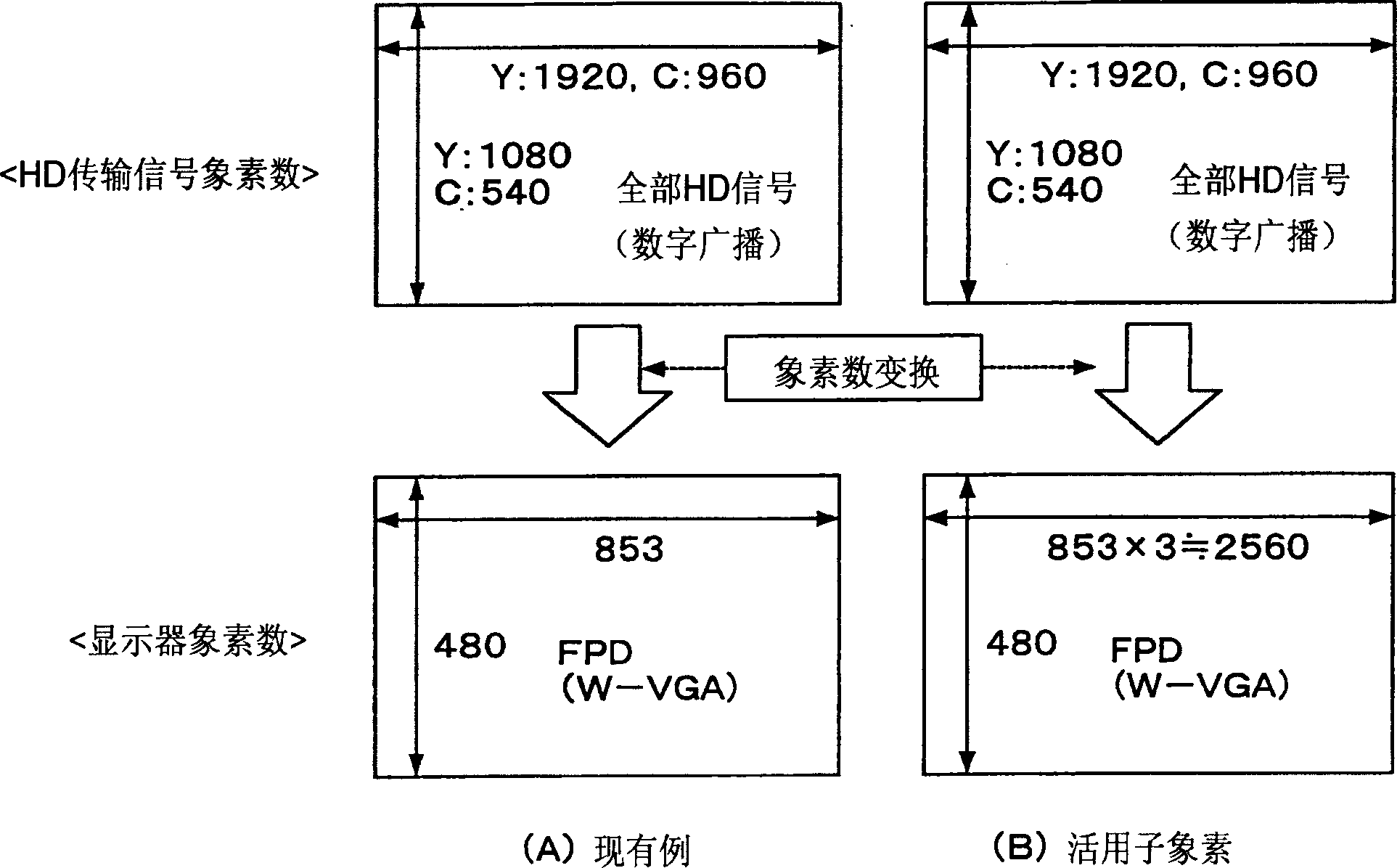
[0013] However, in the methods shown in Patent Documents 1 and 2, there is no conversion of the number of pixels that takes into account the case where the number of pixels of the input image signal (signal source) is larger than the number of pixels of the display.
Therefore, even if the methods shown in Patent Document 1 and Patent Document 2 are applied to the number of pixels conversion in the case where the number of pixels of the input image signal is larger than the number of pixels of the display, the above-mentioned occurrence of foldback cannot be solved. Problems with noise and poor image quality

Method used

the structure of the environmentally friendly knitted fabric provided by the present invention; figure 2 Flow chart of the yarn wrapping machine for environmentally friendly knitted fabrics and storage devices; image 3 Is the parameter map of the yarn covering machine
View more

Image

Smart Image Click on the blue labels to locate them in the text.
Viewing Examples
Smart Image
  • Sampling rate converting system and filtering method
  • Sampling rate converting system and filtering method
  • Sampling rate converting system and filtering method

Examples

Experimental program
Comparison scheme
Effect test

no. 1 approach

[0062] First, with reference to the drawings, the number of pixels conversion (hereinafter referred to as "sub-pixel rendering technology") applied to the sampling rate conversion device according to the first embodiment of the present invention (Sub-pixel Rendering Technology) "Pixel Number Conversion") for description.

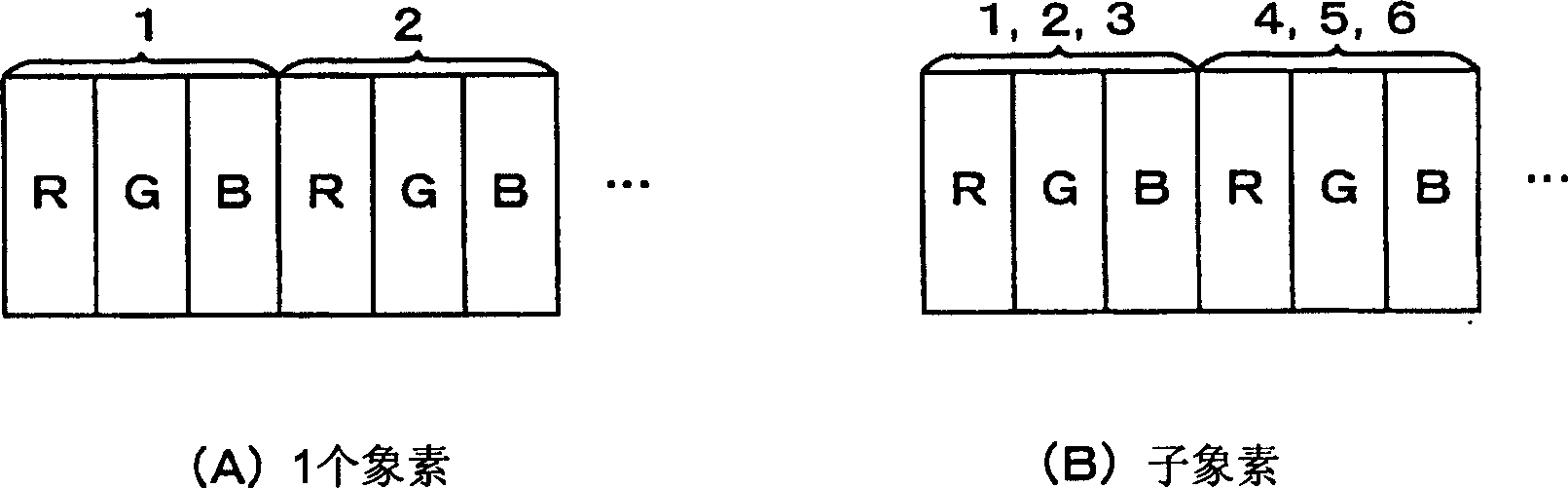
[0063] Sub-pixel rendering techniques are generally as figure 1 As shown in (A), a pixel is constituted by three sub-pixels of RGB, as opposed to this, as figure 1 As shown in (B), each sub-pixel is regarded as one pixel, and luminance is reproduced for each sub-pixel.

[0064] image 3 (B) is a diagram showing a conversion model of the sub-pixel number of pixels for displaying a high-definition image whose number of pixels is larger than that of a display. Here, since the sub-pixels of RGB are sequentially arranged in the horizontal direction, the number of pixels in the horizontal direction becomes 2560 pixels (853×3 pixels). Strictly speaking, this i...

no. 2 approach

[0104] Figure 17 It is a block diagram showing the configuration of the sampling rate conversion device according to the second embodiment of the present invention. Here, the same symbols are assigned to the same constituent elements as those of the device according to the first embodiment.

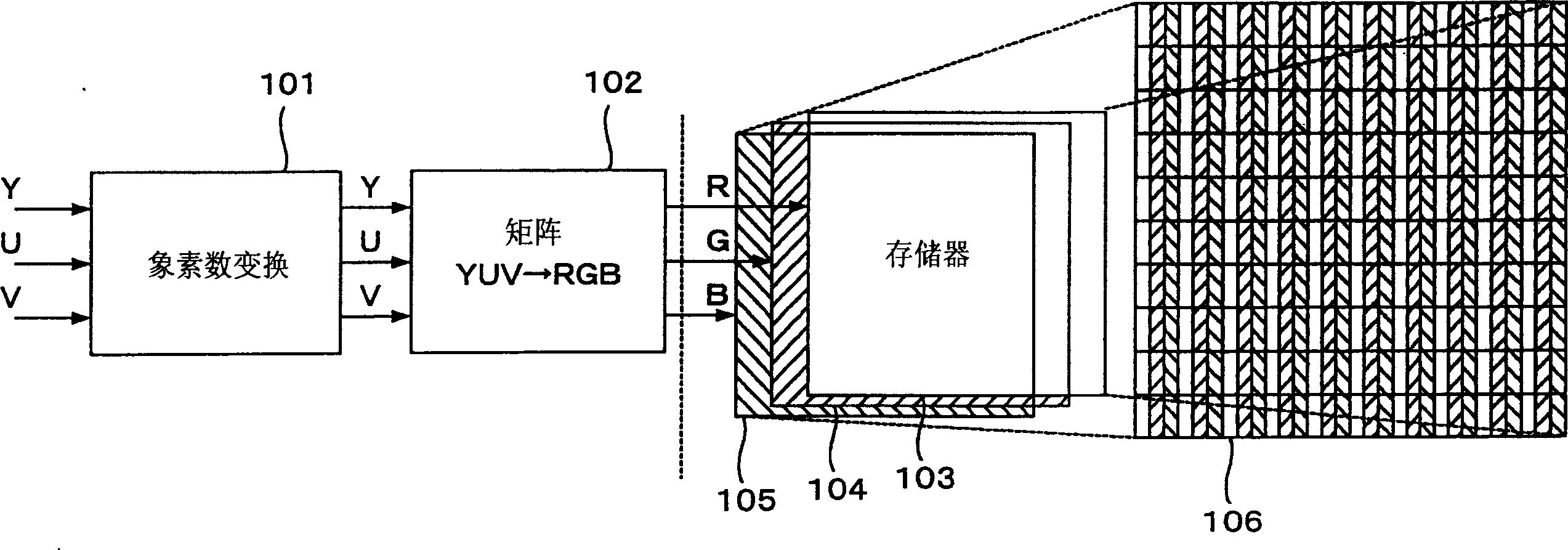
[0105] The sampling rate conversion device according to the second embodiment has a sub-pixel pixel number converter 1, a sub-pixel oversampling filter 8, a second pixel unit pixel number converter 3, an image feature detector 4a, a mixing Device 5, YUV→RGB matrix converter 6.

[0106] Sub-pixel pixel number converter 1 utilizes sub-pixel pixel number conversion, output such as Image 6 with Figure 7 For the brightness signal Y2 of 2560cpL output in (D), the second pixel unit pixel number converter 3 outputs a color difference signal of 853cpL. Here, the output luminance signal Y2 of the sub-pixel pixel number converter 1 and the output color difference signals U and V of the second...

no. 3 approach

[0112] Figure 19 It is a diagram for explaining the pixel completion variable filtering process applied to the sampling ratio conversion device of this embodiment. In this diagram, the horizontal direction corresponds to the time axis which is the horizontal direction on the display.

[0113] Figure 19 (A) shows the pixel arrangement related to the horizontal direction of the display, Figure 19 (B) shows the luminance signal after sub-pixel pixel number conversion, that is, Figure 7 (D) The data column of the luminance signal of 2560 cpL. In this data sequence, the luminance signal changes in time series (t1 to t12). Figure 19 (C) to (F) show pixel-complete variable filters that change with time series (t1 to t12). Figure 19 The "mark" in (C) to (F) is an output sampling point, and indicates the phase of the luminance signal corresponding to each RGB sub-pixel of the display and after converting the number of sub-pixels. The output sampling point and the time elapse...

the structure of the environmentally friendly knitted fabric provided by the present invention; figure 2 Flow chart of the yarn wrapping machine for environmentally friendly knitted fabrics and storage devices; image 3 Is the parameter map of the yarn covering machine
Login to View More

PUM

No PUM Login to View More

Abstract

The present invention provided a sampling rate converting system in which a high definition converted image is attained while suppressing aliasing interference, when converting the number of pixels in the case that the number of pixels of an input image signal is larger than the number of pixels of a display. A high-definition luminance signal Y1 is converted into a luminance signal Y2 of a rate (subpixel sampling rate) corresponding to the number of subpixels in the horizontal direction on a display by a subpixel number-of-pixel converter 1. The luminance signal Y1 is converted into a luminance signal Y3 of a sampling rate of the display by a number-of-pixels-in-pixel-units converter 2. The luminance signal Y2 and the luminance signal Y3 are mixed by a mixer 5, and a luminance signal having a frequency characteristic located between a frequency characteristic of the luminance signal Y2 and a frequency characteristic of the luminance signal Y3 is outputted. A mixing rate of the mixer 5 is controlled according to a control value [alpha] that is generated by an image feature detecting portion 4.

Description

technical field [0001] The present invention relates to a sampling rate conversion device and a screening method applicable to the sampling rate conversion device, which are used for performing an input image signal on a display in which pixels composed of a plurality of sub-pixels are arranged in a matrix. Sampling rate conversion. Background technique [0002] In various display devices (displays), in which pixels are arranged in a matrix and lighted in a certain order, each pixel corresponds to each signal data value. Such displays include, for example, flat panel displays (FPDs) such as PDP (Plasma Display Panel) and LCD (Liquid Crystal Display). [0003] Among these displays, such as figure 1 As shown in (A), three light-emitting elements (sub-pixels) corresponding to the three primary colors of R (red), G (green), and G (blue) are arranged, and they are used as one pixel to reproduce brightness and color. Then, an image display device having such a display such as ...

Claims

the structure of the environmentally friendly knitted fabric provided by the present invention; figure 2 Flow chart of the yarn wrapping machine for environmentally friendly knitted fabrics and storage devices; image 3 Is the parameter map of the yarn covering machine
Login to View More

Application Information

Patent Timeline
no application Login to View More
Patent Type & Authority Applications(China)
IPC IPC(8): G09G3/36G09G3/20G09G5/00G09G5/02G09G5/36G09G5/391H04N5/66H04N7/01H04N7/015H04N9/64
CPCG09G3/2092G09G3/20G09G2340/0407G09G5/02H04N9/64
Inventor 北浦正博
Owner JVC KENWOOD CORP
Features
  • R&D
  • Intellectual Property
  • Life Sciences
  • Materials
  • Tech Scout
Why Patsnap Eureka
  • Unparalleled Data Quality
  • Higher Quality Content
  • 60% Fewer Hallucinations
Social media
Patsnap Eureka Blog
Learn More