Unlock instant, AI-driven research and patent intelligence for your innovation.

Optical pickup device-use optical element, coupling lens and optical pickup device

An optical pickup, optical element technology, applied in beam guiding devices, optical recording/reproducing, optical recording heads, etc., can solve the problems of not considering diffraction efficiency, unable to ensure the luminous flux of light spots, etc.

Inactive Publication Date: 2005-12-07
KONICA MINOLTA OPTO
View PDF1 Cites 4 Cited by
  • Summary
  • Abstract
  • Description
  • Claims
  • Application Information

AI Technical Summary

Problems solved by technology

Yet, although above-mentioned patent document 1 is provided with the optical pick-up device of diffractive structure to object lens, disclose, because do not consider diffraction efficiency on the diffractive structure used, so also exist can not guarantee optimum light spot luminous flux Happening

Method used

the structure of the environmentally friendly knitted fabric provided by the present invention; figure 2 Flow chart of the yarn wrapping machine for environmentally friendly knitted fabrics and storage devices; image 3 Is the parameter map of the yarn covering machine
View more

Image

Smart Image Click on the blue labels to locate them in the text.
Viewing Examples
Smart Image
  • Optical pickup device-use optical element, coupling lens and optical pickup device
  • Optical pickup device-use optical element, coupling lens and optical pickup device
  • Optical pickup device-use optical element, coupling lens and optical pickup device

Examples

Experimental program
Comparison scheme
Effect test

Embodiment 1

[0269] Table 1 shows lens data of an optical element (objective lens) as an example suitable for the above-mentioned embodiment. As can be seen from Table 1, in the objective lens, a diffraction structure is provided in a region (referred to as a common region) where light beams from the first semiconductor laser, the second semiconductor laser, and the third semiconductor laser pass. In addition, if a change occurs in which the wavelength of the light source becomes longer, the diffractive structure has an optical characteristic that makes spherical aberration more insufficient in the light beam passing through the diffractive structure. This embodiment corresponds to the optical elements described in items 6 and 7. Here, hereafter (including the lens data of the table), it is stipulated that E (for example, 2.5×E-3) represents a power multiplier of 10 (for example, 2.5×10 -3 ).

[0270] Example 1 Lens data

Objective lens focal length

f 1 =2.4mm

...

Embodiment 2

[0284] Table 2 shows lens data of an optical element (objective lens) as an example suitable for the above-mentioned embodiment. As can be seen from Table 2, in the objective lens, a diffraction structure is provided in a region (referred to as a common region) where light beams from the first semiconductor laser, the second semiconductor laser, and the third semiconductor laser pass. In addition, if a change occurs in which the wavelength of the light source becomes longer, the diffractive structure has an optical characteristic that makes spherical aberration more insufficient in the light beam passing through the diffractive structure. This embodiment corresponds to the optical element described in Item 11.

[0285] Example 2 Lens data

Objective lens focal length

f 1 =2.4mm

f 2 =2.46mm

f 2 =2.49mm

Image side numerical aperture

NA1: 0.65

NA2: 0.65

NA3: 0.45

Diffraction times

n1:6

n2:4

n3:3

...

Embodiment 3

[0300] Table 3 shows lens data of an optical element (objective lens) as an example suitable for the above-mentioned embodiment. As can be seen from Table 3, in the objective lens, a diffraction structure is provided in a region (referred to as a common region) where light beams from the first semiconductor laser, the second semiconductor laser, and the third semiconductor laser pass. In addition, if a change occurs in which the wavelength of the light source becomes longer, the diffractive structure has an optical characteristic that makes spherical aberration more insufficient in the light beam passing through the diffractive structure. This embodiment corresponds to the optical element described in Item 11.

[0301] Example 3 Lens data

Objective lens focal length

f 1 =2.4mm

f 2 =2.4mm

f 2 =2.5mm

Image side numerical aperture

NA1: 0.65

NA2: 0.65

NA2: 0.45

Diffraction times

n1:6

n2:4

n3:3

m...

the structure of the environmentally friendly knitted fabric provided by the present invention; figure 2 Flow chart of the yarn wrapping machine for environmentally friendly knitted fabrics and storage devices; image 3 Is the parameter map of the yarn covering machine
Login to View More

PUM

No PUM Login to View More

Abstract

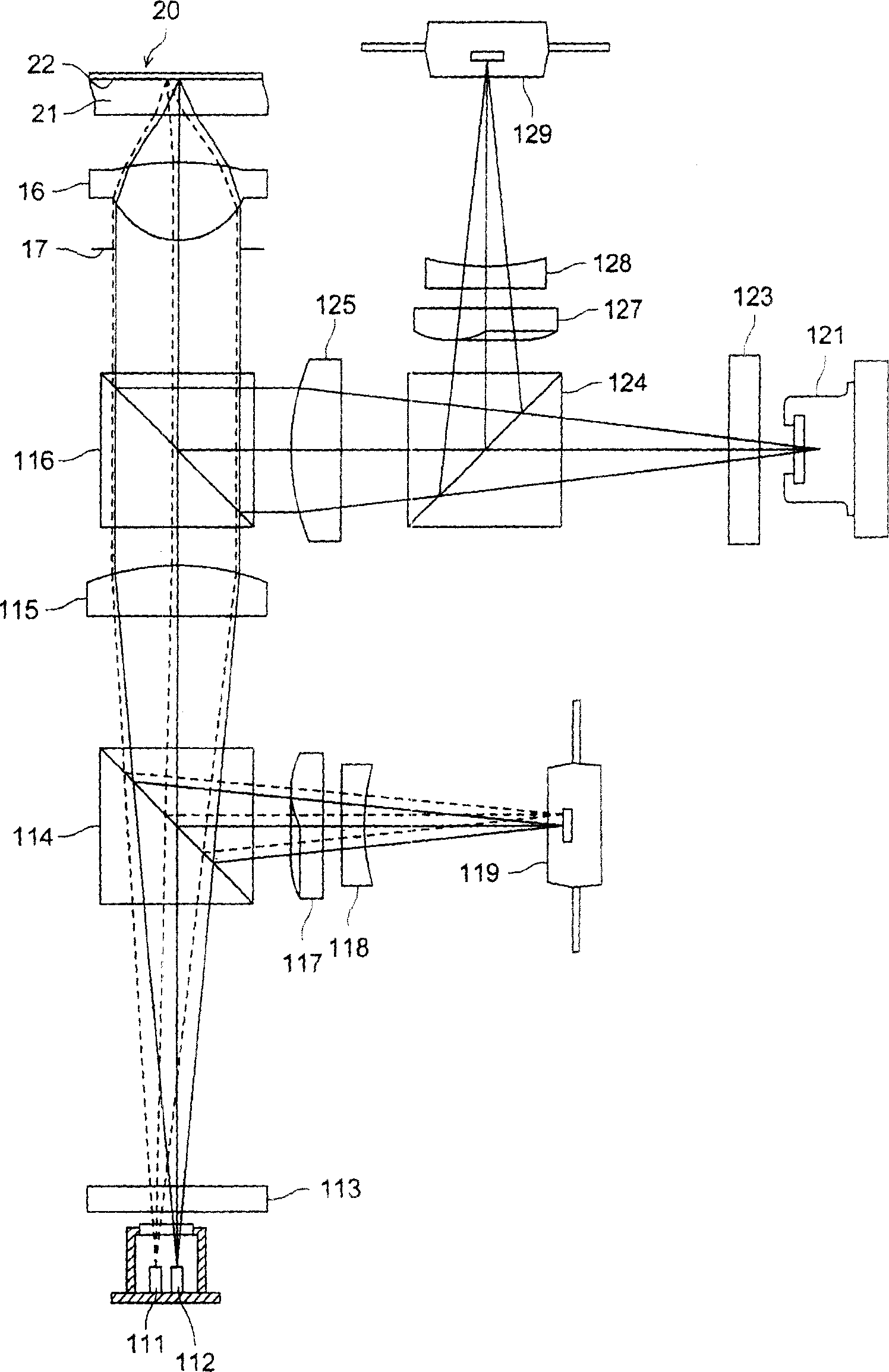
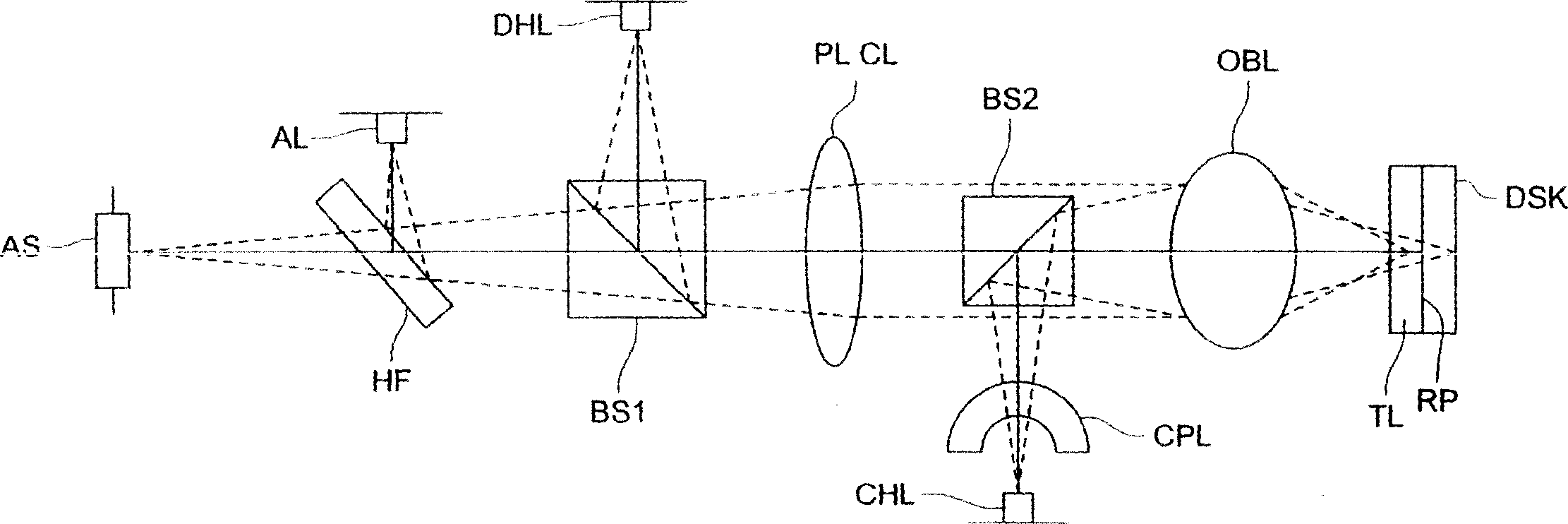
The present invention provides an optical element for an optical pickup device, a relay lens, and an optical pickup device. Since the diffraction structure of the objective lens (16) has the optical characteristic that spherical aberration will become more insufficient in the light beam passing through the above-mentioned diffraction structure if the wavelength of the light source becomes longer if a change occurs, it can be used for the objective lens accompanied by temperature changes. Changes in the refractive index and wavelength shifts of the light source that accompany temperature changes better correct for spherical aberration. In addition, because by satisfying 1.1≥(n1×λ1) / (n3×λ3)≥0.9, the luminous flux of the diffracted beam irradiated to the information recording surface of the high-density DVD and irradiated to the CD through the diffraction structure of the objective lens (16) can be further improved. The luminous flux of the diffracted beam on the information recording surface can effectively suppress the occurrence of writing errors or reading errors of information.

Description

technical field [0001] The present invention relates to an optical element for an optical pickup device, a relay lens, and an optical pickup device, and particularly relates to recording information on three different optical information recording media by using light beams emitted from three light sources with different wavelengths of the light sources and / or reproduced optical elements for optical pickup devices, relay lenses, and optical pickup devices. Background technique [0002] In recent years, along with the practical use of short-wavelength red semiconductor lasers, people have developed and commercialized high-capacity lasers with the same size and capacity as CDs (Compact Disks), which are conventional optical disks (also called optical information recording media). DVD (Digital Versatile Disc), which is a high-density optical disc, can be expected to debut with a higher-density next-generation optical disc in the near future. In the condensing optical system o...

Claims

the structure of the environmentally friendly knitted fabric provided by the present invention; figure 2 Flow chart of the yarn wrapping machine for environmentally friendly knitted fabrics and storage devices; image 3 Is the parameter map of the yarn covering machine
Login to View More

Application Information

Patent Timeline
no application Login to View More
IPC IPC(8): G11B7/1353G11B7/1374G11B7/1378G11B7/139G11B7/1392
Inventor 池中清乃
Owner KONICA MINOLTA OPTO