Frame creating method based on crossing frequency division multiplexing in time-division duplex mode
An orthogonal frequency division and time division duplex technology, applied in the field of digital communication, can solve the problems of not having to consider the problem of ultra-long coverage, the change of the number of accesses, and the frame structure that does not meet the requirements of future communication, etc., and achieves low sensitivity , ISI) strong effect
- Summary
- Abstract
- Description
- Claims
- Application Information
AI Technical Summary
Problems solved by technology
Method used
Image



Examples
no. 1 example
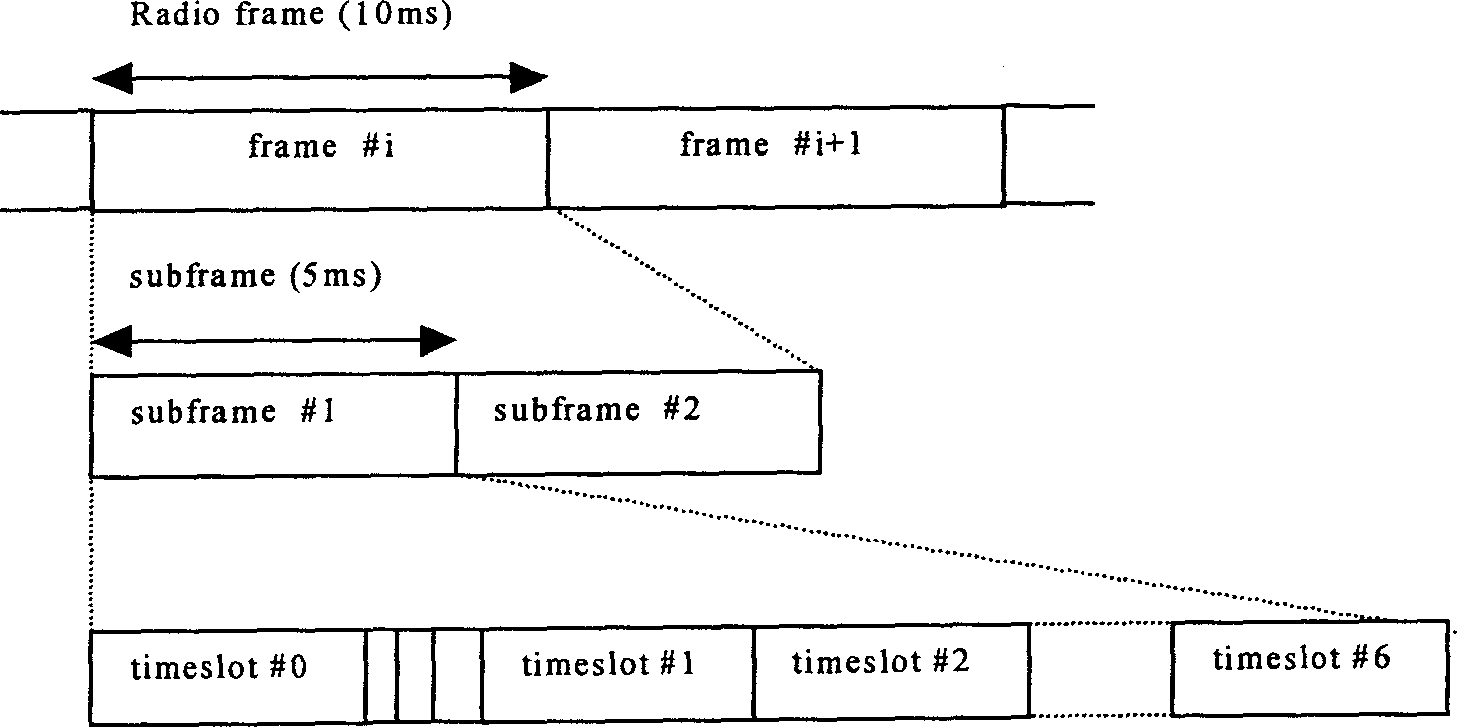
[0032] first please refer to figure 2 Understand the frame structure based on OFDM technology in the TDD mode generated in this embodiment, the wireless frame is used for wireless transmission between the base station and the mobile station, and then describe the method for generating the frame structure.
[0033] Such as figure 2 As shown, the radio frame in this embodiment adopts a three-layer structure: radio frame, subframe, and time slot. In order to be compatible with the existing W-CDMA and TD-SCDMA systems, the wireless frame of this embodiment is consistent with the wireless frame length of W-CDMA, which is 10 ms, and then divided into two 5 ms subframes with the same structure. Each subframe includes a part for transmitting service data, a downlink synchronization part, an uplink synchronization part, and a switching interval between downlink and uplink and uplink to downlink. But the order of each part is different from the frame structure of systems such as TD-...
no. 2 example
[0045] The frame structure of this embodiment and its generation method are basically the same as those of the first embodiment, such as image 3 As shown, the only differences are in the following points:
[0046] First, the downlink synchronization symbol in this embodiment is independent of the time slot structure, but is generated before the time slot TS0.
[0047] Second, in order to meet the requirements of 30km or even 100km ultra-long coverage and avoid the waste of too long DUG in the case of non-ultra-long coverage, the base station of this embodiment can also generate at the front end of time slot TS1 or the back end of time slot TS0 according to the business situation Idle symbol (that is, an empty symbol, not shown in the figure), so that a shorter DUG can be designed, and this DUG only needs to meet the non-ultra-distance coverage situation.
[0048] Whether the specific insertion position is the back end of TS0 or the front end of TS1 is determined by the posit...
no. 3 example
[0051] The aforementioned frame structures of the first and second embodiments can meet general delay requirements. When there is a more stringent delay requirement (such as when the delay requirement is less than 10ms), the structure of this embodiment can be adopted, such as Figure 4 shown.
[0052] The frame structure and its generation method of this embodiment are basically the same as those of the first embodiment, the only difference being the following points:
[0053] First, the downlink synchronization symbol of this embodiment is inserted inside the time slot structure, at the front end of the time slot TS0, as a component of the TS0.
[0054] Second, this embodiment adds a flexible configuration symbol (FS: FlexibleSymbol) at the end of several time slots. The end symbol of the slot is still used to transmit service data. Combined with the main switching interval, this symbol constitutes multiple switching points, which can realize multiple switching between up...
PUM
 Login to View More
 Abstract
Description
Claims
Application Information
 Login to View More
 - R&D
- Intellectual Property
- Life Sciences
- Materials
- Tech Scout
- Unparalleled Data Quality
- Higher Quality Content
- 60% Fewer Hallucinations
Browse by: Latest US Patents, China's latest patents, Technical Efficacy Thesaurus, Application Domain, Technology Topic, Popular Technical Reports.
© 2025 PatSnap. All rights reserved.Legal|Privacy policy|Modern Slavery Act Transparency Statement|Sitemap|About US| Contact US: help@patsnap.com