Supercharge Your Innovation With Domain-Expert AI Agents!

Methods for treating insulin resistance and for sensitizing patients to GLP1 agonist therapy

a technology of glp1 and agonist therapy, applied in the field of molecular biology and endocrinology, can solve the problems of significantly less effective regulating glucose homeostasis, reduce the amount of insulin, reduce the effective concentration of each therapeutic compound, and limit undesirable side effects of the compound

Active Publication Date: 2019-04-16
RES DEVMENT FOUND
View PDF8 Cites 0 Cited by
  • Summary
  • Abstract
  • Description
  • Claims
  • Application Information

AI Technical Summary

Benefits of technology

Restores the effectiveness of beta cells in regulating glucose homeostasis, making GLP1 agonist therapies more responsive and reducing the need for frequent insulin administration, thus improving treatment outcomes for insulin resistance and type 2 diabetes.

Problems solved by technology

Without being bound by any particular mechanism, it is proposed that the prolonged activation of beta cells results in an effective de-differentiation of the cells thereby rendering them significantly less effective regulating glucose homeostasis.

Method used

the structure of the environmentally friendly knitted fabric provided by the present invention; figure 2 Flow chart of the yarn wrapping machine for environmentally friendly knitted fabrics and storage devices; image 3 Is the parameter map of the yarn covering machine
View more

Image

Smart Image Click on the blue labels to locate them in the text.
Viewing Examples
Smart Image
  • Methods for treating insulin resistance and for sensitizing patients to GLP1 agonist therapy
  • Methods for treating insulin resistance and for sensitizing patients to GLP1 agonist therapy
  • Methods for treating insulin resistance and for sensitizing patients to GLP1 agonist therapy

Examples

Experimental program
Comparison scheme
Effect test

example 1

The Role of CREB Signaling in Beta Cell Dysfunction

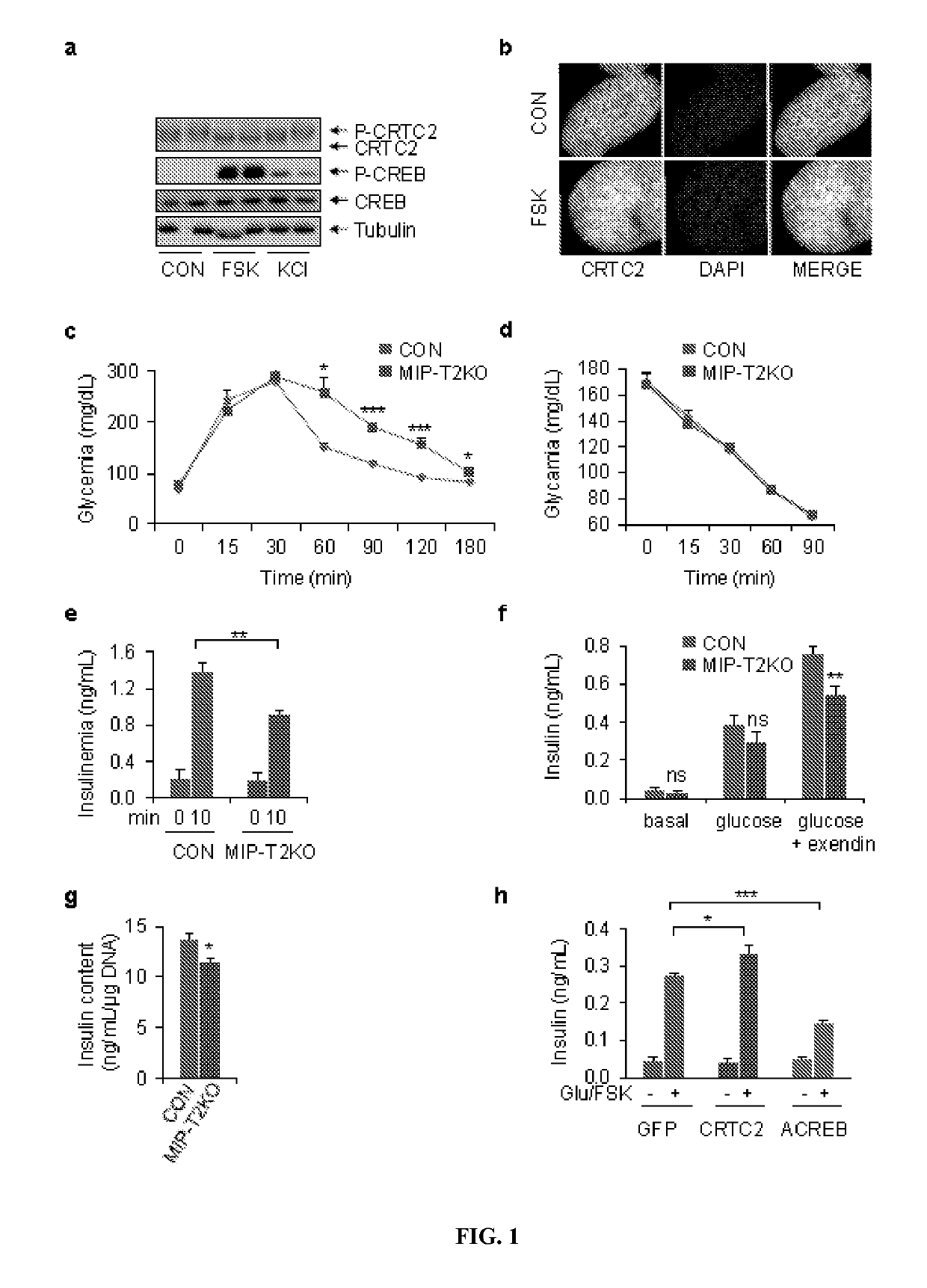
[0082]The second messenger cAMP has been shown to mediate effects of incretin hormones, in part through induction of the Ser / Thr protein kinase PKA. Blocking cAMP signaling in beta cells through targeted disruption of the Gsa subunit of the heterotrimeric G protein leads to severe glucose intolerance and beta cell apoptosis (Xie et al., 2007). Conversely, mutations that increase PKA activity, either via disruption of the R1α regulatory subunit (Song et al., 2011) or via a gain of function mutation in the PKA catalytic subunit (Kaihara et al., 2013), enhances insulin secretion.

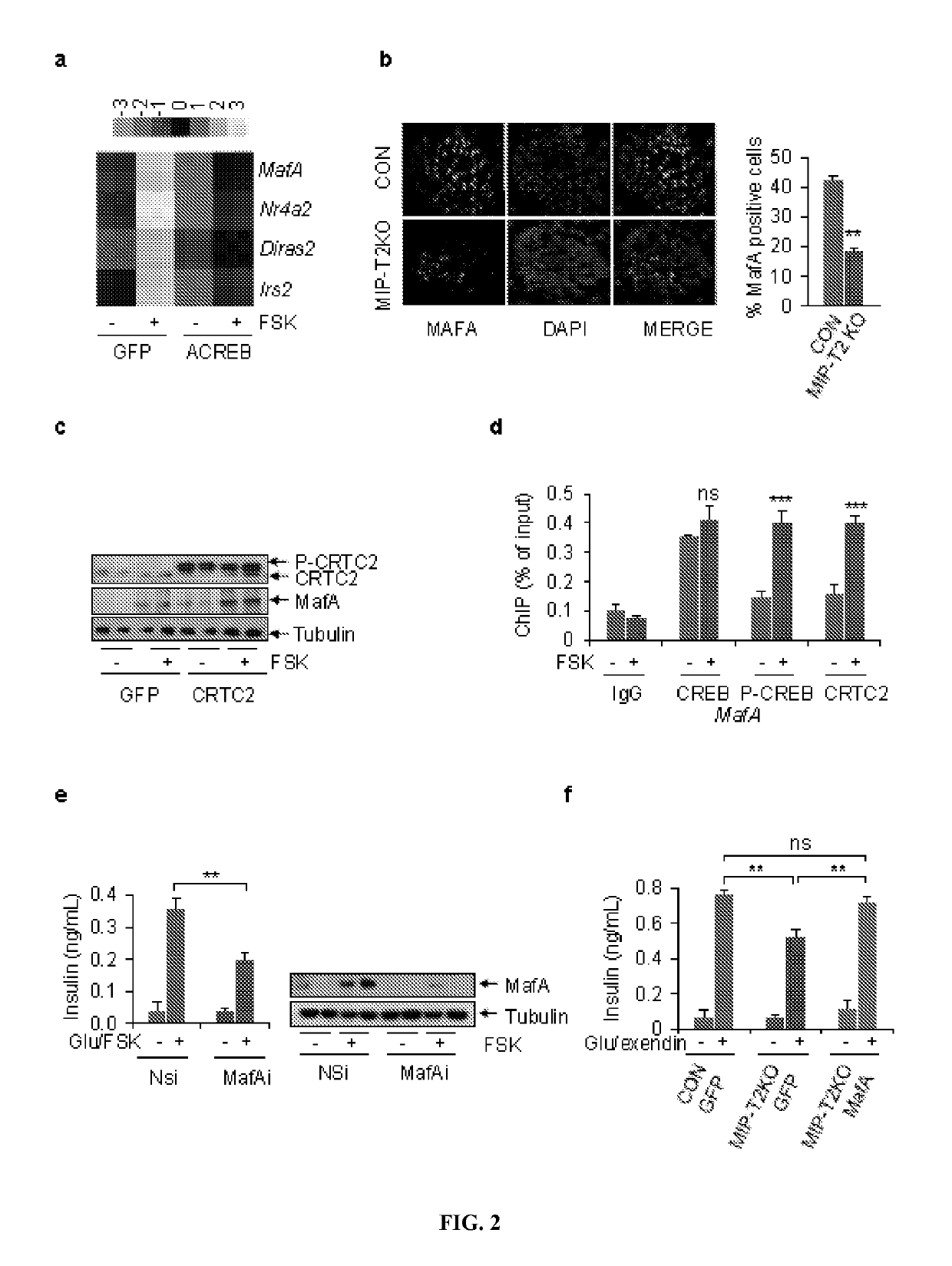
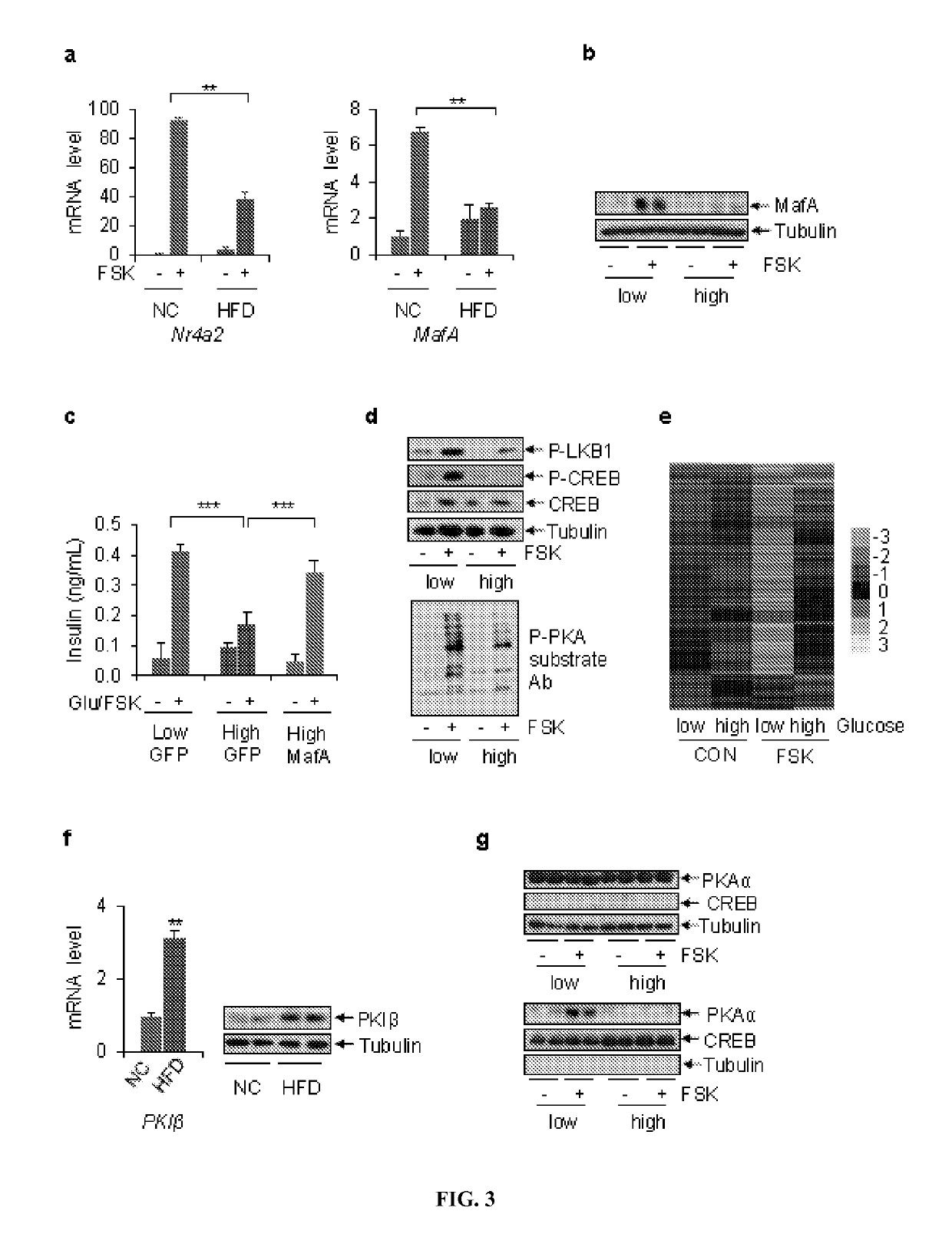
[0083]cAMP promotes cellular gene expression via the PKA-mediated phosphorylation of the CREB family of activators and via the de-phosphorylation of the cAMP Regulated Transcriptional Coactivators (CRTCs). Following its activation, CREB has been found to promote islet function in part by upregulating the insulin receptor substrate 2 (IRS2) in beta cells (Jhala ...

example 2

Materials and Methods

[0105]Animals

[0106]All studies except for high fat and high carbohydrate diets studies were performed using 10 to 12 weeks old males mice in a C57Bl6 background. Animals were adapted to their environment for 1 week before studies and were housed in colony cages with a 12 hours light / 12 hours dark cycle in a temperature-controlled environment. C57BL6 were purchased from Jackson laboratories. For high fat diet studies, C57BL6 mice were fed with high fat diet for 20 weeks beginning at 8 weeks of age (60% kcal fat, D12492, Research Diet Inc). Age-matched C57BL6 on normal chow were used as controls. For high carbohydrate diet studies, 8 weeks old males C57BL6 where maintain in diet with 73% carbohydrate during 10 weeks (AIN-93M, Resarch Diet Inc). PKIB mice were purchased from MMRRC (B6.129P2-Pkibtm1Idz / Mmmh) MIP-CreERT mice were a gift from Dr. Phillipson of the University of Chicago. The CRTC2flox / flox mice are homozygous for a “floxed” CRTC2 allele in which CRTC2 ...

the structure of the environmentally friendly knitted fabric provided by the present invention; figure 2 Flow chart of the yarn wrapping machine for environmentally friendly knitted fabrics and storage devices; image 3 Is the parameter map of the yarn covering machine
Login to View More

PUM

PropertyMeasurementUnit
body weightaaaaaaaaaa
total volumeaaaaaaaaaa
resistanceaaaaaaaaaa
Login to View More

Abstract

Methods for treatment of insulin resistance and type II diabetes by administration of inhibitors of the PKI pathway are provided. In some aspects, inhibitors of the PKI pathway, such as inhibitors of PIKB, HIF1 and / or mTOR, can be used to treat subject having insulin resistance who are refractory to GLP1 agonist therapy.

Description

[0001]This application is a national phase application under 35 U.S.C. § 371 of International Application No. PCT / US2015 / 029411, filed May 6, 2015, which claims the benefit of U.S. Provisional Patent Application Nos. 61 / 989,108, filed May 6, 2014, and 62 / 113,670, filed Feb. 9, 2015, each of which are incorporated herein by reference.[0002]The invention was made with government support under Grant Nos. R01-DK049777, R01-DK083834, and R01-DK091618 awarded by the National Institutes of Health. The government has certain rights in the invention.INCORPORATION OF SEQUENCE LISTING[0003]The sequence listing that is contained in the file named “CLFR_P0422WO_ST25.txt”, which is 49 KB (as measured in Microsoft Windows®) and was created on May 5, 2015, is filed herewith by electronic submission and is incorporated by reference herein.BACKGROUND OF THE INVENTION[0004]1. Field of the Invention[0005]The present invention relates generally to the field of molecular biology and endocrinology. More p...

Claims

the structure of the environmentally friendly knitted fabric provided by the present invention; figure 2 Flow chart of the yarn wrapping machine for environmentally friendly knitted fabrics and storage devices; image 3 Is the parameter map of the yarn covering machine
Login to View More

Application Information

Patent Timeline
no application Login to View More
Patent Type & Authority Patents(United States)
IPC IPC(8): A61K31/70A61K31/565A61K38/26A61K31/713A61K31/436C12N5/00
CPCA61K31/713A61K31/436A61K31/565A61K38/26A61K2300/00
Inventor MONTMINY, MARCVAN DE VELDE, SAMBLANCHET, EMILIE
Owner RES DEVMENT FOUND
Features
  • R&D
  • Intellectual Property
  • Life Sciences
  • Materials
  • Tech Scout
Why Patsnap Eureka
  • Unparalleled Data Quality
  • Higher Quality Content
  • 60% Fewer Hallucinations
Social media
Patsnap Eureka Blog
Learn More