
1,6-naphthyridine derivatives as CDK4/6 inhibitor
a technology of naphthyridine and derivatives, which is applied in the field of compounds as cdk4/6 inhibitors, can solve the problems of poor brain permeability, inability to treat brain metastases, and difficult to penetrate the blood-brain barrier, and achieves significant inhibitory activity, significant proliferation inhibitory activity, and high inhibitory activity.
- Summary
- Abstract
- Description
- Claims
- Application Information
AI Technical Summary
Benefits of technology
Problems solved by technology
Method used
Image

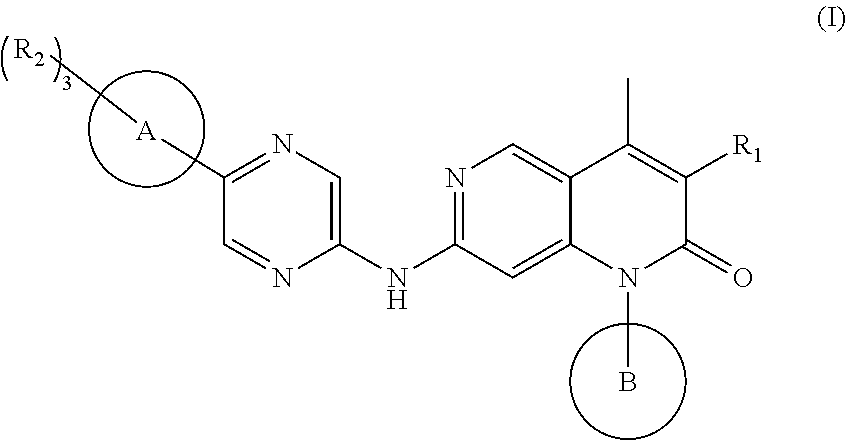
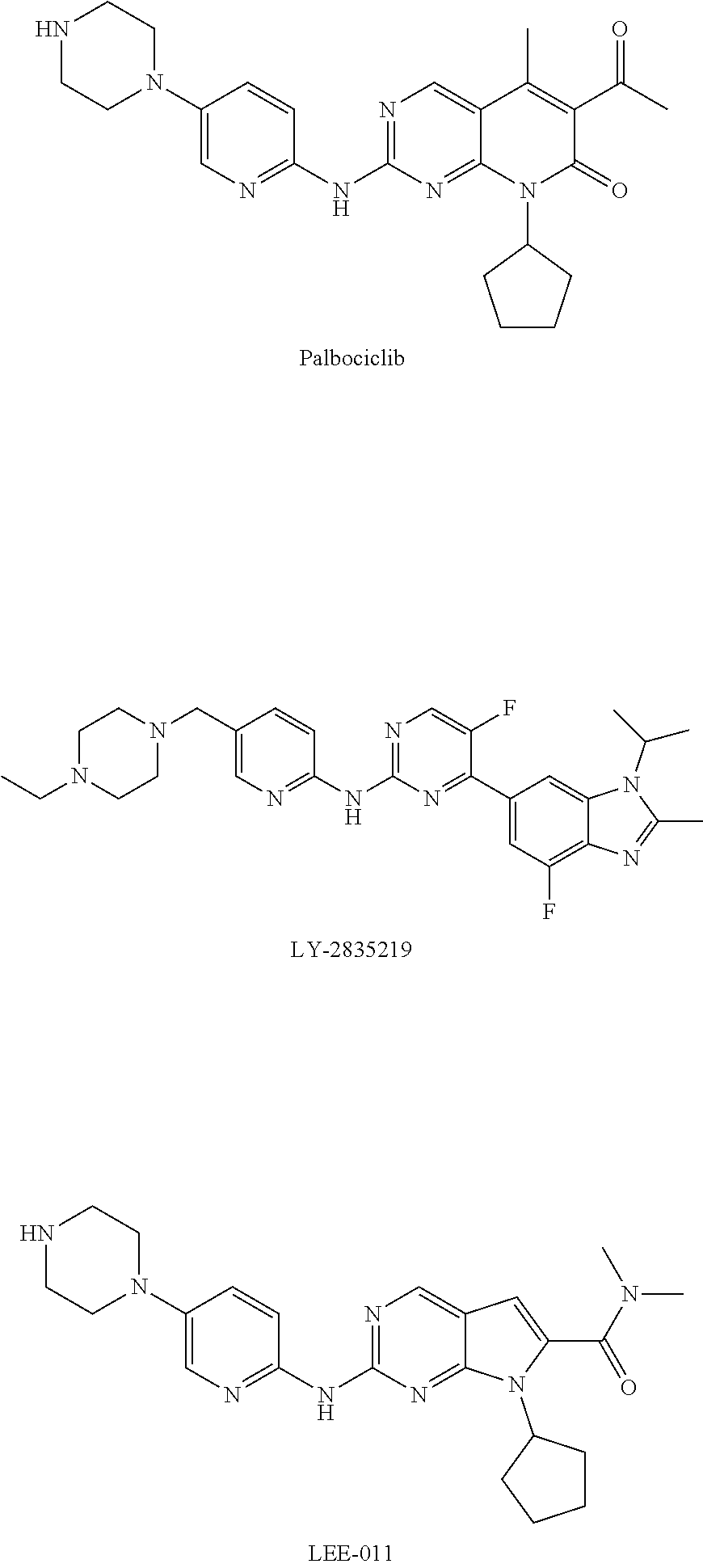
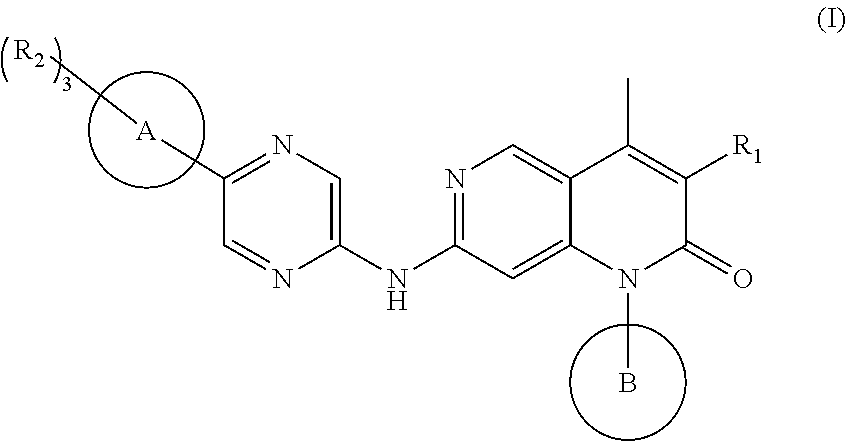
Examples
example 1
[0188]
[0189]Step 1:
[0190]
[0191]Tert-butyl piperazine-1-carboxylate (7.83 g, 42.04 mmol, 1.00 eq.) and potassium carbonate (8.72 g, 63.06 mmol, 1.50 eq.) were added to a solution of 2,5-dibromopyrazine (10.00 g, 42.04 mmol, 1.00 eq.) in 1-methylpyrrolidin-2-one (100.00 mL). The mixture was heated to 100° C. and stirred for 18 hours. The completion of the reaction was confirmed by TLC (petroleum ether:ethyl acetate=10:1). The reaction mixture was diluted with water (200 mL), and extracted with ethyl acetate (200 mL×2). The combined organic layer was dried over anhydrous sodium sulfate, followed by filtration. The filtrate was concentrated and the obtained crude product was purified by silica gel column chromatography (petroleum ether:ethyl acetate=20:1 to 5:1) to give the title compound (11.00 g, 32.05 mmol, yield: 76.24%). 1H NMR (400 MHz, CDCl3) δ 8.15 (d, J=1.38 Hz, 1H), 7.87 (d, J=1.38 Hz, 1H), 3.56 (m, 8H), 1.49 (s, 9H).
[0192]Step 2:
[0193]
[0194]LiHMDS (1 M, 60.00 mL, 2.06 eq.) an...
example 2
[0201]
[0202]Acetaldehyde solution (553.66 mg, 5.03 mmol, 700.83 μL, 15.00 eq.) and sodium triacetoxyborohydride (213.11 mg, 1.01 mmol, 3.00 eq.) were added to a solution of 3-acetyl-1-cyclopentyl-4-methyl-7-[(5-piperazin-1-ylpyrazin-2-yl)amino]-1,6-naphthyridin-2-one (150.00 mg, 335.17 μmol, 1.00 eq.) in dichloroethane (2.00 mL) at 25° C. The mixture was stirred for 1 hour. About 26% of the title compound was detected by LCMS. The mixture was concentrated, and the obtained crude product was purified by preparative HPLC (alkaline) to give the title compound (14.35 mg, 27.71 μmol, yield: 8.27%, purity: 91.83%). 1H NMR (400 MHz, CDCl3) δ 8.65 (s, 1H), 8.17 (d, J=1.3 Hz, 1H), 7.89-7.75 (m, 2H), 7.65 (s, 1H), 5.73 (quin, J=9.3 Hz, 1H), 3.60-3.48 (m, 4H), 2.65-2.58 (m, 4H), 2.55 (s, 3H), 2.49 (q, J=7.3 Hz, 2H), 2.40 (s, 3H), 2.29 (br dd, J=12.4, 7.3 Hz, 2H), 2.13 (br dd, J=7.9, 5.5 Hz, 2H), 2.02-1.95 (m, 2H), 1.82-1.73 (m, 2H), 1.15 (t, J=7.2 Hz, 3H); LCMS (ESI) m / z: 492.3 (M+1).
example 3
[0203]
[0204]The synthesis of Example 3 is referred to as that of Example 2. 1H NMR (400 MHz, CDCl3) δ 8.65 (s, 1H), 8.17 (d, J=1.3 Hz, 1H), 7.87-7.74 (m, 2H), 7.46 (s, 1H), 5.74 (quin, J=9.3 Hz, 1H), 3.63-3.43 (m, 4H), 2.77 (td, J=13.0, 6.5 Hz, 1H), 2.73-2.66 (m, 4H), 2.56 (s, 3H), 2.41 (s, 3H), 2.35-2.24 (m, 2H), 2.19-2.07 (m, 2H), 2.03-1.95 (m, 2H), 1.77 (br d, J=4.8 Hz, 2H), 1.11 (d, J=6.5 Hz, 6H); LCMS (ESI) m / z: 490.2 (M+1).
PUM
| Property | Measurement | Unit |
|---|---|---|
| pH | aaaaa | aaaaa |
| pH | aaaaa | aaaaa |
| pH | aaaaa | aaaaa |
Abstract
Description
Claims
Application Information
 Login to View More