
Methods and materials for detection of mutations
a technology of mutation detection and materials, applied in the field of methods and materials for detection of mutations, can solve the problems of reducing signal intensity, affecting the detection effect, and affecting the response of mcrc patients to expensive drugs, so as to achieve the effect of reducing signals
- Summary
- Abstract
- Description
- Claims
- Application Information
AI Technical Summary
Benefits of technology
Problems solved by technology
Method used
Image



Examples
example 1
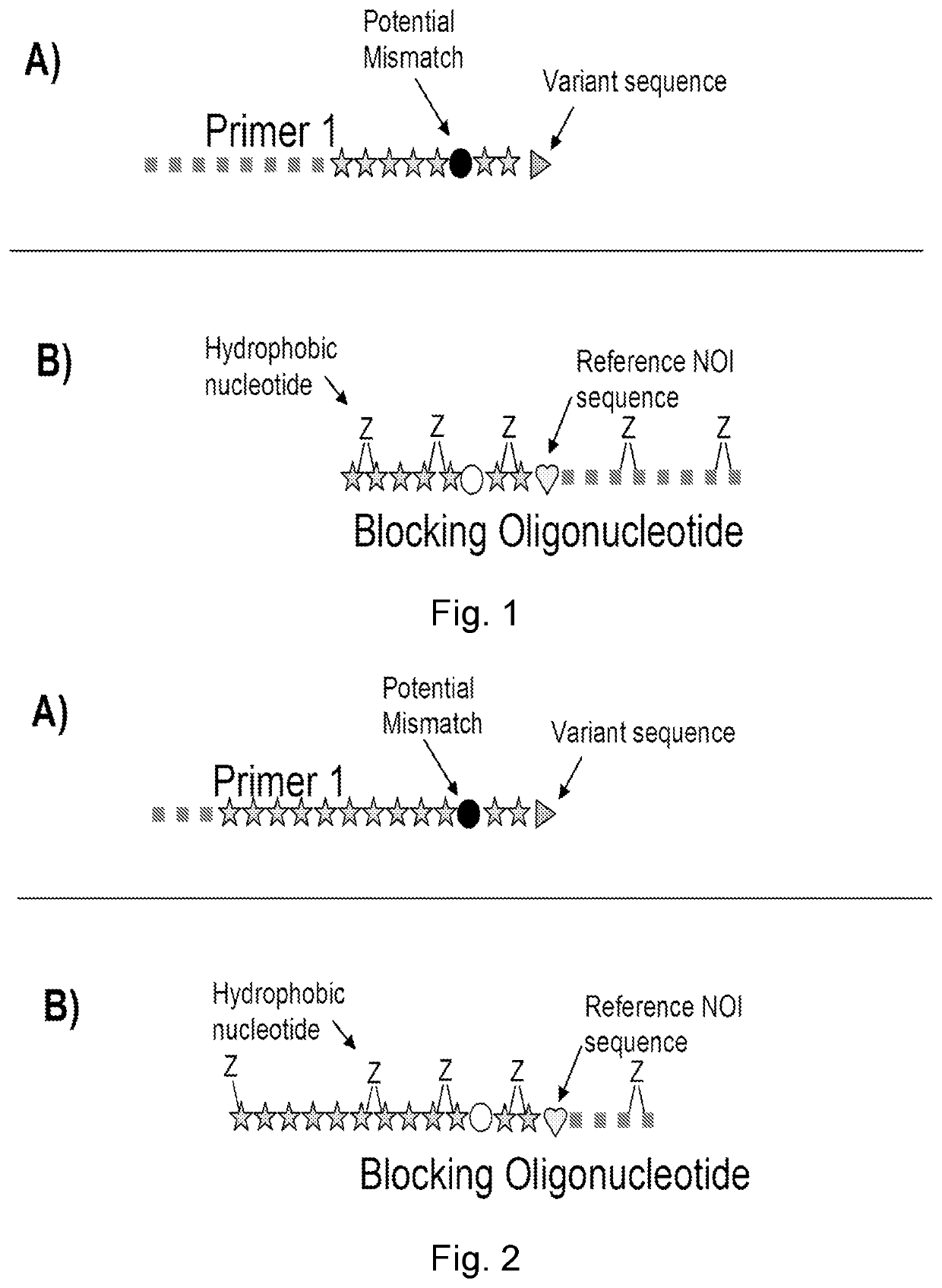
[0521]The present invention is based on the use of a blocking oligonucleotide comprising at least two hydrophobic nucleotides as defined in claim 1 and where at least part of the sequence of said blocking oligonucleotide is fully identical to a target nucleic acid sequence comprising a reference NOI sequence. The blocking oligonucleotide may suppress the signal (here measured as the threshold cycle, CT), wherein suppressing by the blocking oligonucleotide is observed as CT being delayed / higher. In addition, in some embodiments it is preferred that the sequence of said blocking oligonucleotide analogue is partly but not fully identical to at least the last 3 nucleotides of the 3′ end of at least one of the primers used together with said blocking oligonucleotide (herein referred to as Primer 1). Three examples of useful design of the blocking oligonucleotide are described below. The first example illustrated in FIG. 1 is with a medium overlap of primer 1 and the blocking oligonucleot...
example 2
Blocking Oligonucleotide Increases Specificity in Simplex Reactions
[0527]In this example, we illustrate how the addition of a blocking oligonucleotide according to the present invention can increase the specificity, ΔCT, of a PCR (measured as the CT from a target nucleic acid sequence comprising the variant sequence minus the CT when there is only reference target sequence present, background signal).
[0528]The present example is illustrating how addition of a blocking oligonucleotide according to the present application identical to the reference sequence comprising the wild type (WT) version of codon 59 of NRAS (Ala59) can remove the signal (CT, WT) from a WT template, while at the same time only have minimal effect on the signal (measured as CT, NRASA59D) from the variant sequence comprising a NRAS Ala59Asp (A59D) mutation (see FIG. 4).
[0529]FIG. 4 shows that blocking oligonucleotides described in the present invention are highly specific. Addition of a blocking oligonucleotide id...
example 3
Blocking Oligonucleotide Increases Specificity Towards a Certain Variant Sequence in a Simplex Reaction
[0535]A Blocking oligonucleotide as described in the present invention may also be used to increase specificity of a PCR reaction towards a particular variant sequence. Thus, in the example illustrated in FIG. 6, we show how addition of a Blocking oligonucleotide according to the present invention identical to the KRAS Gly12Arg (G12R) allele comprising variant sequence 1 suppresses amplification from the KRAS Gly12Arg template as seen as a delayed signal at the threshold (CT, KRAsGly12Arg), with minimal effect on the amplification of the KRAS Gly12Val (G12V) template comprising variant sequence 2 (Ct, KRASGly12Val).
[0536]FIG. 6 shows that a. blocking oligonucleotide designed as described in the present invention also can be highly specific towards a non-WT reference NOI sequence preferentially inhibiting this over a variant sequence. An assay for the detection KRAS Gly12Val (G12V) ...
PUM
| Property | Measurement | Unit |
|---|---|---|
| temperature | aaaaa | aaaaa |
| melting temperatures | aaaaa | aaaaa |
| temperature | aaaaa | aaaaa |
Abstract
Description
Claims
Application Information
 Login to View More