
Enhanced multimode fiber
a multi-mode fiber and fiber technology, applied in the field of optical fiber communications, can solve the problem that the new core-core interface is not sufficiently spaced from the core-cladding interface, and achieve the effect of widening the operating bandwidth and large coarse wavelength division multiplexed channel sets
- Summary
- Abstract
- Description
- Claims
- Application Information
AI Technical Summary
Benefits of technology
Problems solved by technology
Method used
Image

Examples
example 1
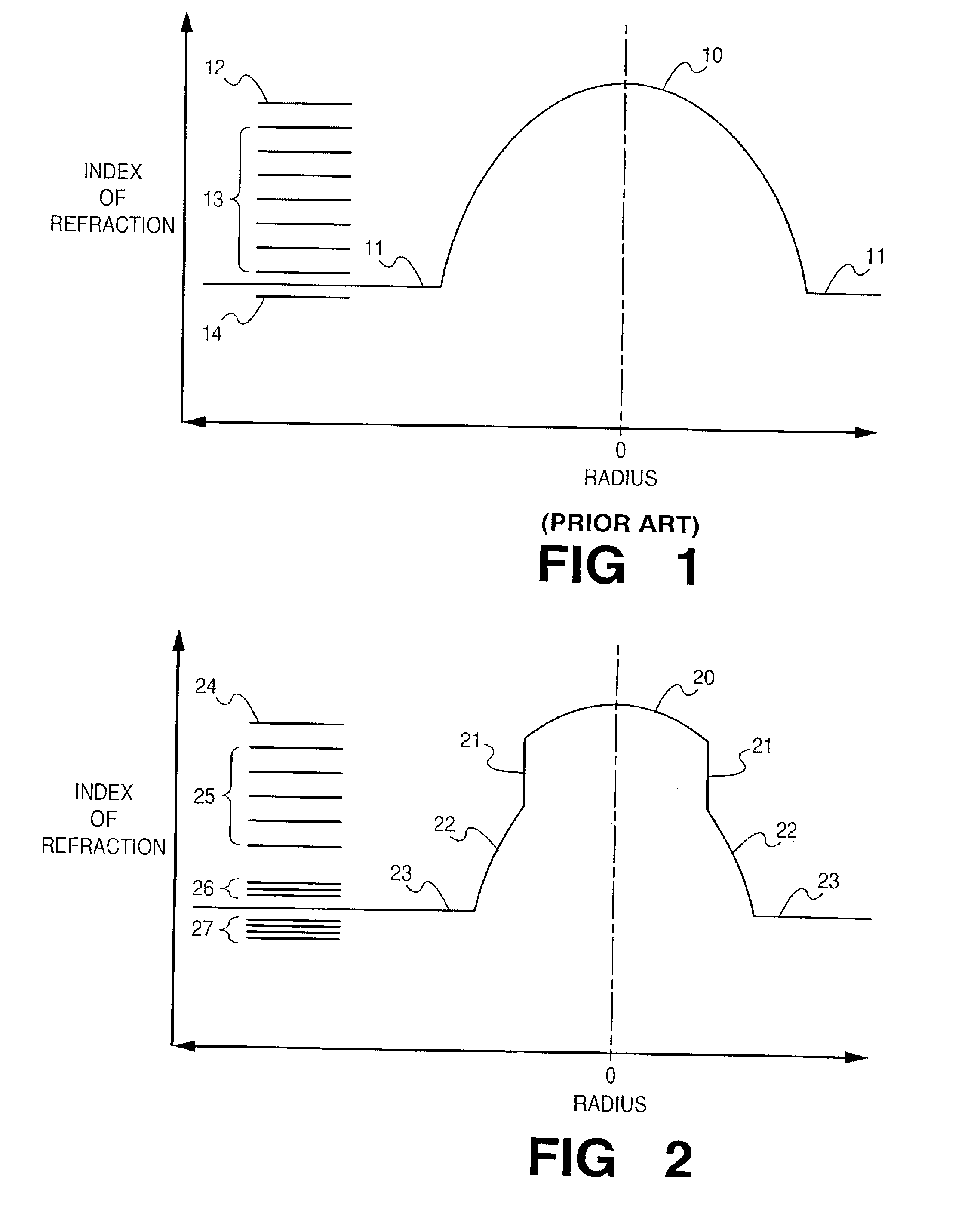
[0139] A conventional, Design 1 fiber, of the profile form shown in FIG. 1, has a .DELTA. of 2% and a core radius of 31.25 .mu.m. At the period of maximum loss, which occurs at A=1000 .mu.m, the loss for 6 pounds load is 12.4 dB. Loss is less than 0.4 dB with a 50 .mu.m increase or decrease in the period. Measured maximum loss period correlates well with the value of 990 .mu.m predicted by Eq. 5.
example 2
[0140] A conventional Design 2 fiber, of the profile of FIG. 1, has a delta of 1% and core radius of 25 .mu.m. At the period of maximum loss, which occurs at .LAMBDA.=1150 .mu.m, the loss for 6 pounds load is 25 dB. Loss is less than 0.4 dB with increase or decrease of 50 .mu.m in the period. This correlates well with the predicted location of the maximum loss at 1110 .mu.m, from Eq. 5. The relative magnitude of the maximum loss ratio of Design 2 to Design 1 is 1.9, which is to be compared with a calculated value of 2.1.
example 3
[0141] A conventional fiber, of the profile form shown in FIG. 1, has a core radius of 30 .mu.m and a .DELTA. value of 1.2%. Location and value of the maximum loss peak, are consistent with Eq. 5 prediction.
PUM
 Login to View More
 Abstract
Description
Claims
Application Information
 Login to View More