

Pitch detection of speech signals
a technology of pitch detection and speech signals, applied in the field of pitch detection of speech signals, can solve the problems of high computational cost, pitch halving or pitch doubling, and autocorrelation techniques are susceptible to frequency overlap problems, so as to eliminate pitch halving and pitch doubling problems
- Summary
- Abstract
- Description
- Claims
- Application Information
AI Technical Summary
Benefits of technology
Problems solved by technology
Method used
Image

Examples
embodiment
Preferred Embodiment
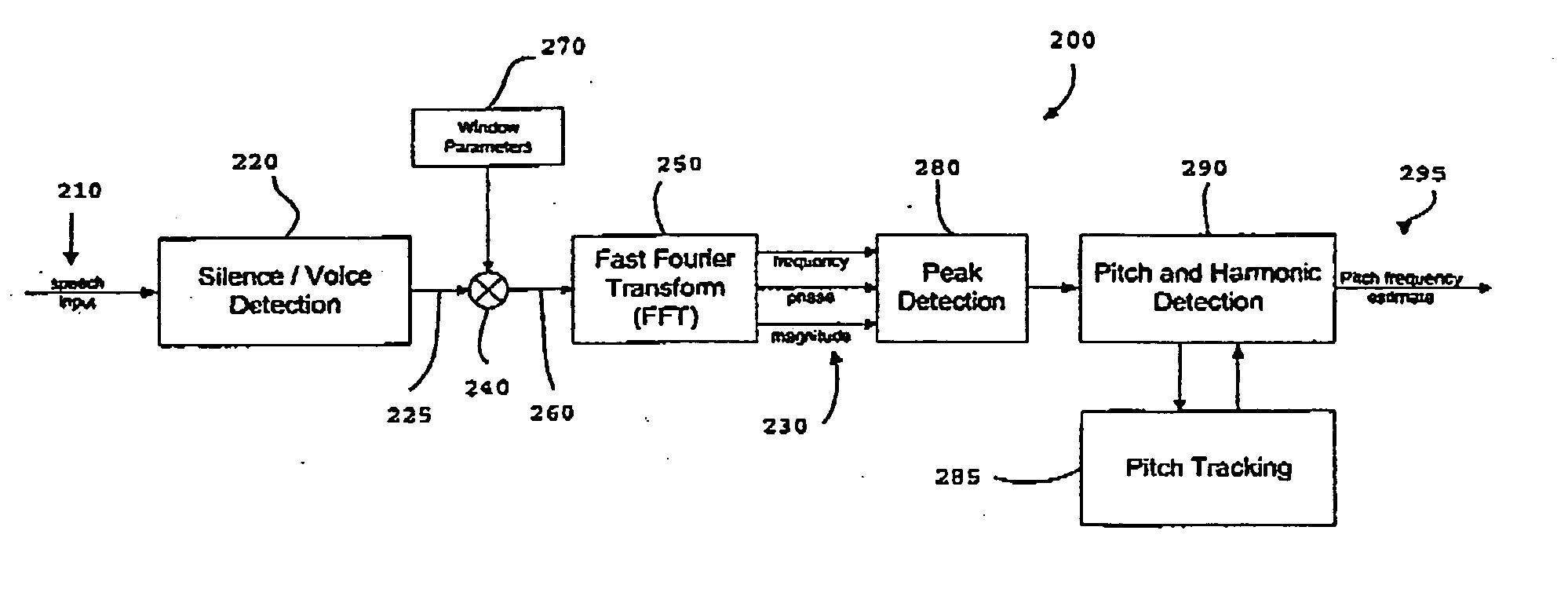
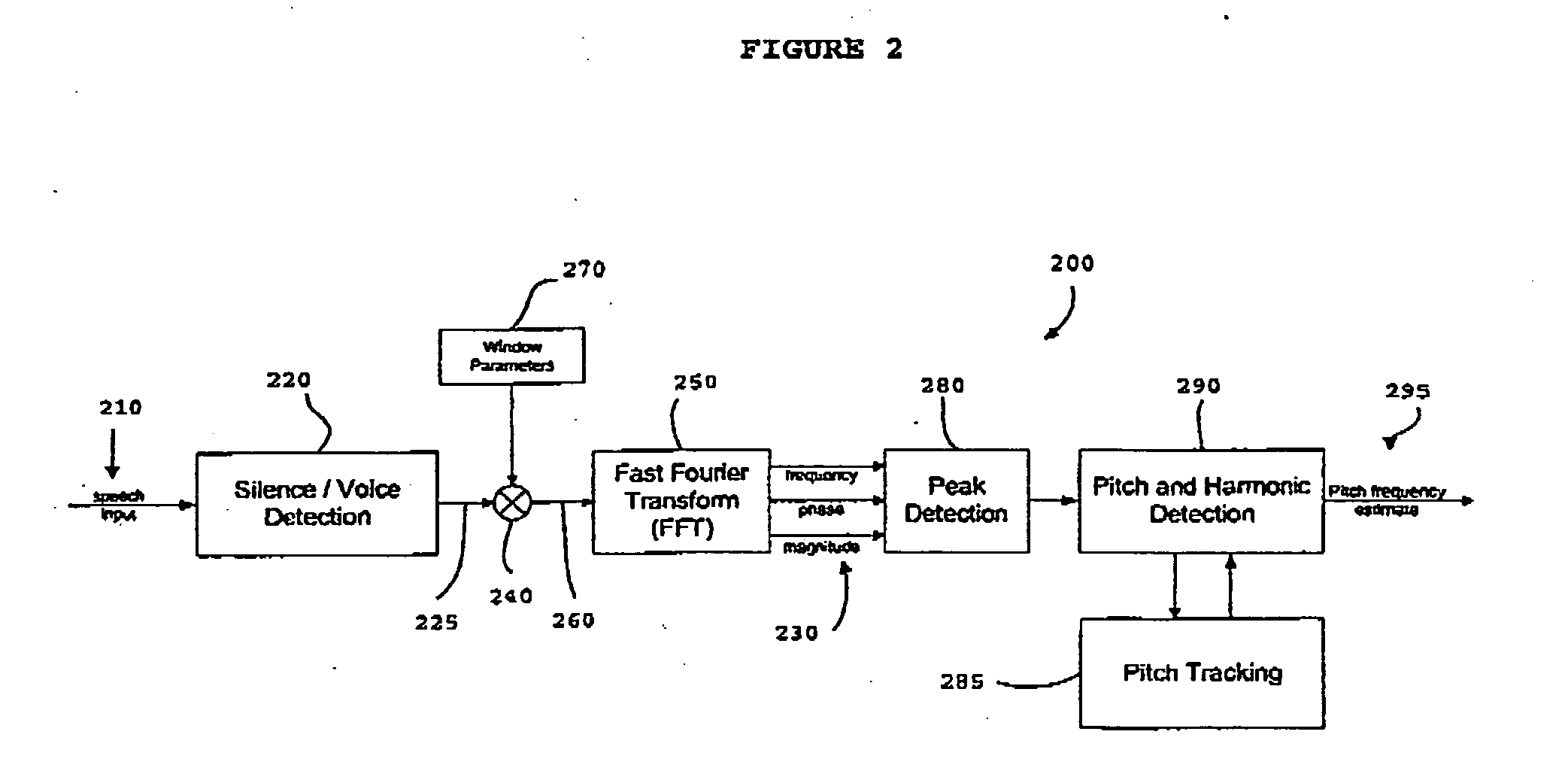
[0067] In the figures, incorporated to illustrate the features of the present invention, like reference numerals are used to identify like parts throughout the figures.
[0068] A sinusoidal model (see T. F. Quatieri and R. J. McAulay, “Speech transformations based on a sinusoidal representation”, IEEE Transactions on Acoustics, Speech and Signal Processing, December 1986, vol. 34, no. 6, pg. 1449) is utilized, in which the speech signal x(n), can be represented as the sum of sinusoids of varying amplitudes (Alk) and frequency peaks (m). (Lk=Signal Bandwidth / Pitch) is the maximum number of frequencies in the frame. That is, x(n)=∑m=1Lk Akl(n)·cos(θkl(n))(3)
[0069] If φlk is the starting phase of the of the kth sinusoid in the lth frame, θlk(n) is defined in Equation 4, θkl(n)=2·π·k·nN+ϕkl(4)
[0070] This allows calculation of the frequency domain parameters of the signal and use of the phase information to determine the true frequency components present in th...
PUM
 Login to View More
 Abstract
Description
Claims
Application Information
 Login to View More