[0025] To enhance the securing of the baseplates to the vertebral bones, each baseplate further comprises a porous area, which at least extends in a ring around the lateral rim of each outwardly facing surface. The porous area may be, for example, a sprayed deposition layer, or an
adhesive applied beaded
metal layer, or another suitable
porous coating known in the art. The porous ring permits the long-term ingrowth of
vertebral bone into the baseplate, thus permanently securing the
prosthesis within the
intervertebral space. The
porous layer may extend beneath the domed mesh as well, but is more importantly applied to the lateral rim of the outwardly facing surface of the baseplate that seats directly against the
vertebral body.
[0027] The
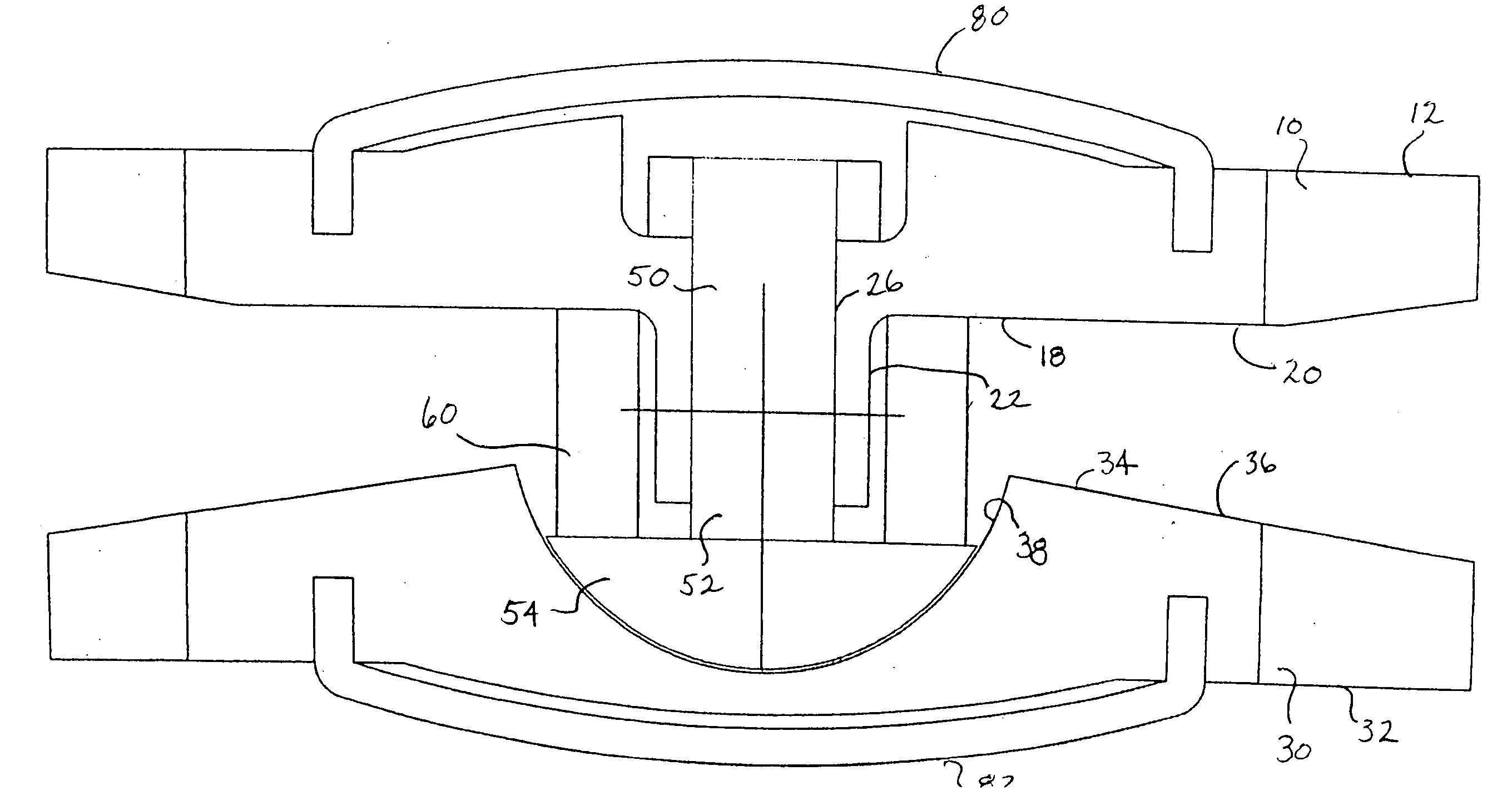
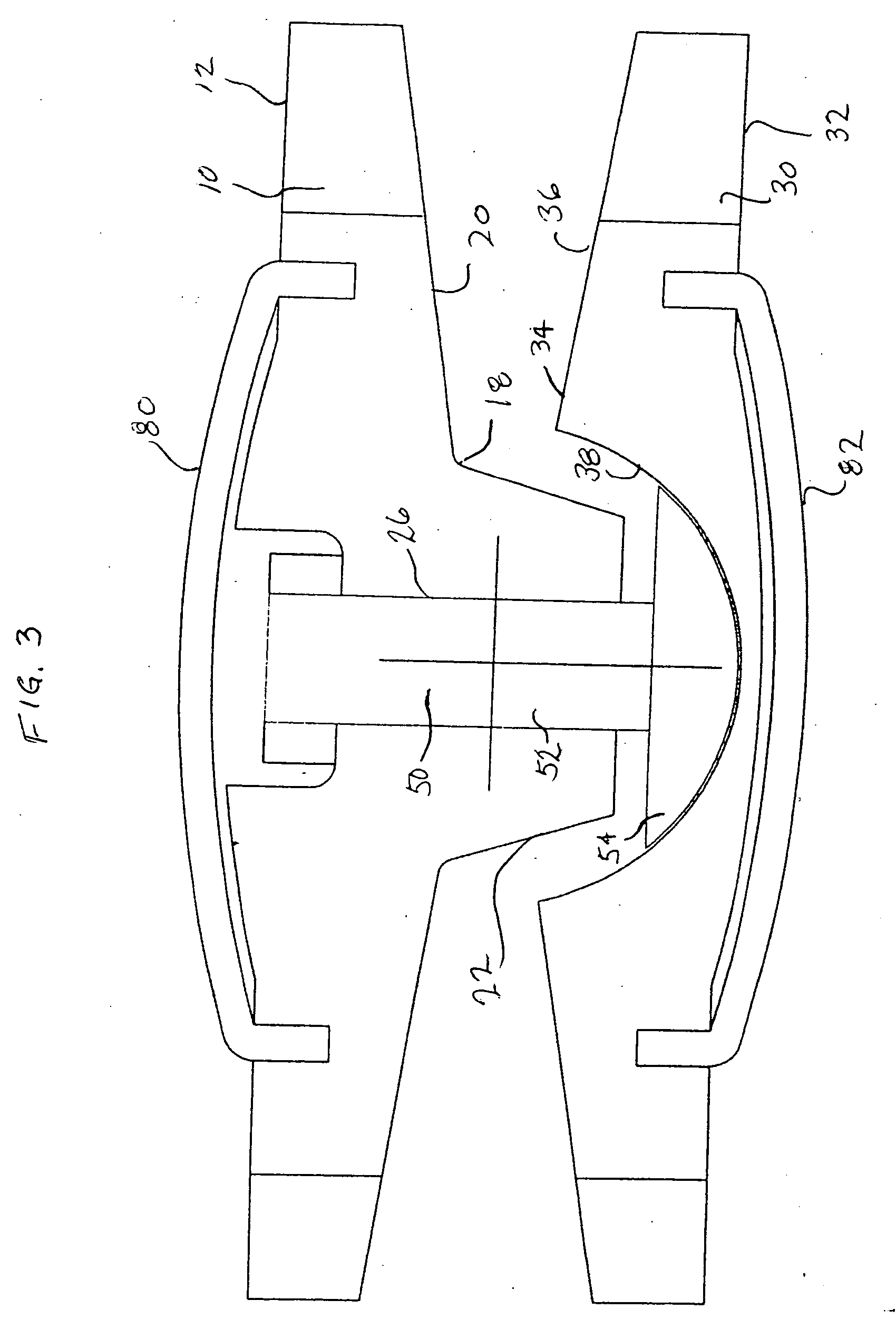
ball and socket joint, employing a partial spherical member that is not captured, disposed between the baseplates permits rotation and angulation of the two baseplates relative to one another about a
centroid of motion centrally located between the baseplates. A variety of embodiments are contemplated. In some embodiments, the joint is used in conjunction with a resilient member to additionally permit the two baseplates to axially compress relative to one another. Further in each of the embodiments, the
assembly prevents lateral translation of the baseplates during rotation and angulation.
[0029] Each of the embodiments discussed herein share the same basic elements, some of which retain identical functionality and configuration across the embodiments, and some of which
gain or lose functionality and / or configuration across the embodiments to accommodate mechanical and / or manufacturing necessities. More specifically, each of the embodiments includes two baseplates, each having an inwardly directed articulation surface, having a
ball and socket joint disposed therebetween employing an uncaptured partial spherical member that is established centrally between the baseplates. The partial spherical member has a large
radius and substantially continuous arc of curvature to minimize point loading and reduce the risk and incidence of fatigue failure. Each of the embodiments will be understood further in light of the additional descriptions of the embodiments herein.
[0033] The elongated portion of the pin member preferably comprises a continuous cylindrical cross section; however, the cross section may vary toward the distal end thereof, such as by gradually or abruptly thickening near the juncture of the elongated member and the head portion, to provide structural strength.
[0036] The curvate socket defines a spherical contour that closely accommodates the partial spherical member for
free rotation and angulation. Therefore, when seated in the curvate socket, the partial spherical member can rotate and angulate freely relative to the curvate socket through a range of angles, thus permitting the opposing baseplates to rotate and angulate freely relative to one another through a corresponding range of angles equivalent to the fraction of normal
human spine rotation and angulation (to mimic normal disc rotation and angulation). Because the baseplates are made angulatable relative to one another by the partial spherical member being rotatably and angulatably coupled in the curvate socket, the
disc assembly provides a
centroid of motion within the sphere defined by the partial spherical member. Accordingly, the
centroid of motion of the
disc assembly remains centrally located between the vertebral bodies, similar to the centroid of motion in a healthy natural
intervertebral disc.
[0038] In other preferred embodiments of the present invention, an intervertebral device includes a first plate having an outer face and an inner face, and a second plate juxtaposed with the first plate, the second plate having an outer face, an inner face that opposes the first plate and a concavity that opposes the first plate. The device preferably includes an elongated member extending from the first plate toward the second plate, the elongated member having a distal end with a spherical surface that is engageable with the concavity of the second plate for providing an articulating joint between the first and second plates. The device also desirably includes a resilient member in contact with the elongated member for counteracting compressive loads on the plates, whereby the resilient member is surrounded by the concavity of the second plate.



 Login to View More
  Login to View More