For purposes of book inventory to physical inventory reconciliation, the multiple tanks that are plumbed together can be treated as one tank, since it is not always feasible to assign a sales transaction to any one of the tanks individually.
For larger operating facilities that have continual activity (e.g., popular
truck fueling stations), however, such required inactivity of the dispensers causes a great burden on the owner and is a big inconvenience for customers who must wait while the measurements are taking place.
Another problem with such SIR systems is they cannot provide real-time monitoring of the delivery of liquid product for accurate inventory.
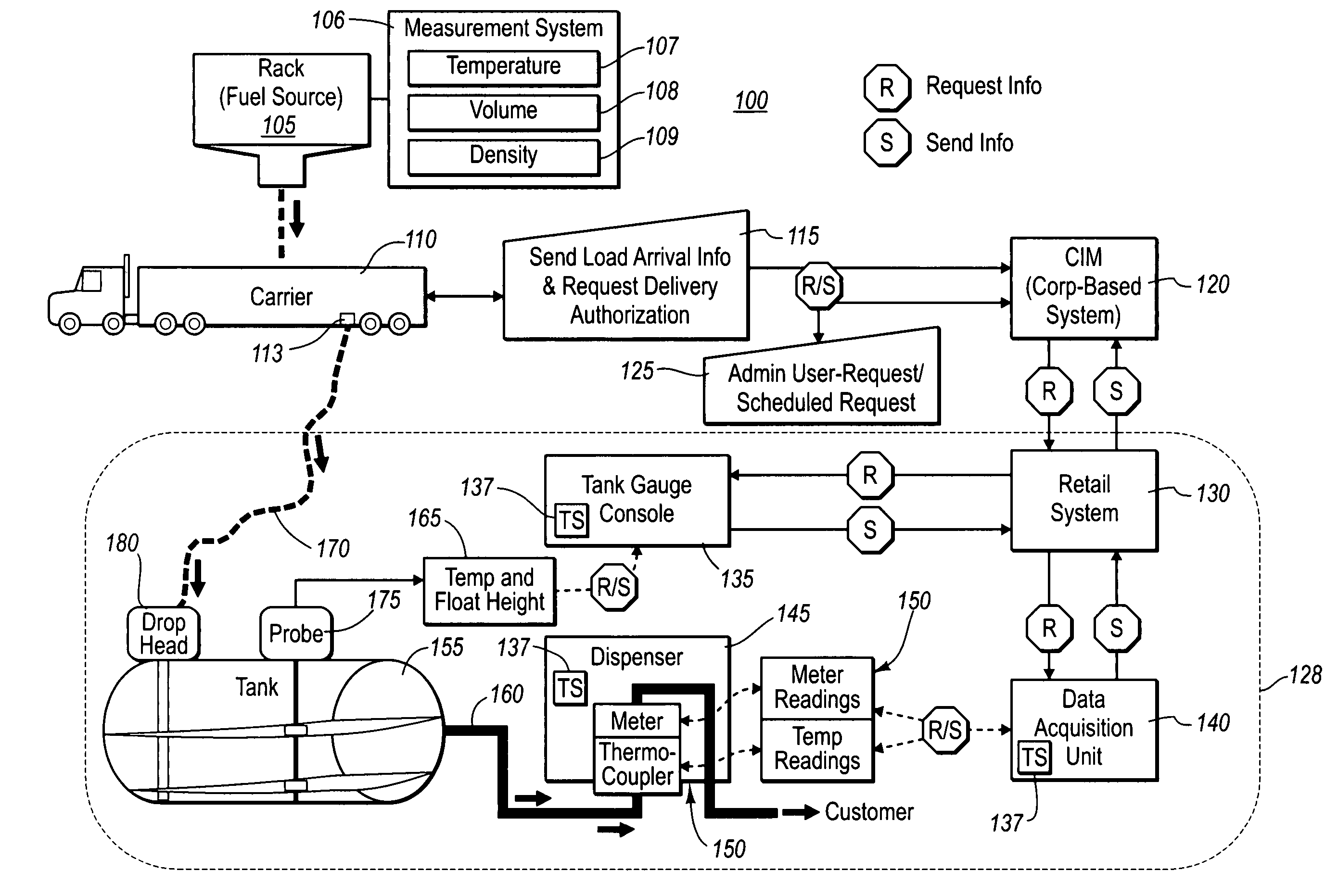
Frequently, there may be overages and shortages in the delivery of the liquid product as opposed to what gets reported in the bill-of-lading.
These delivery inconsistencies may be caused by any number of things, for example, inaccurate metering at the rack where the fuel is dispensed into the delivery
truck, inconsistencies in the delivery
truck's tank not allowing all of the fuel to drop, a bad release valve on the delivery truck, temperature changes from the rack to the tank where it's delivered, and even theft.
Regardless of the reason for the inconsistency, as mentioned above because these SIR systems typically require data taken over a large period of time (e.g., a month), they cannot immediately identify overages or shortages in deliveries by taking instant reconciliations before and after a delivery.
Nevertheless, even if they could do a real-time reconciliation, because they cannot operate in a dynamic environment, they cannot give on-demand reconciliation when pumps are active.
Accordingly, in order to use SIR for determining delivery shortages, deliveries would need to be made during idle times, which could be difficult, if not impossible, to schedule.
A related problem with current SIR systems is that, because they cannot do real-time monitoring of the change in volume within a tank, they cannot immediately determine if liquid product is being dropped into an unauthorized tank or if the level of water within the tank is too high.
An unauthorized drop, however, can have serious consequences.
For example, if the wrong
petroleum product is unknowingly dropped into an improper tank, extreme damage may occur to vehicles fueled with the improper product.
In addition, during a drop, the
sediment at the bottom of the tank may be disturbed causing the level of water within the tank to rise dramatically.
Such a rise in
water volume, however, can also be siphoned into the dispensing
system, causing those vehicles fueling during the surge to get water instead of fuel.
For example, often times a drop cannot be anticipated; and therefore one might not even know when an unauthorized drop has occurred.
In addition, by the time it is determined that the unauthorized drop is occurring or that the level of water in the tank is rising to dangerous levels, it may take several minutes to run out and stop the unauthorized or dangerous drop, while the damage has already occurred.
Another problem with SIR reports is that they don't take into account temperature differences at every
physical point in the distribution process.
These temperature differences, however, can have an enormous effect of the measured volume of the liquid product and can be the cause of error in the SIR system.


 Login to View More