However, today's audiences have become more demanding, expecting so much more from television at home, including a large variety of more sophisticated dramas, comedies, adventures, horrors, etc.
Still, customers remain unsatisfied.
Since the number of movies offered by these movie channels are limited, more disciplined viewers may
record all desirable movies currently being provided and have to wait until additional titles come available.
Since the number of movies offered on movie channels is limited and since the movies start at irregular times, movie channels do not effectively satisfy current customer demand.
However, given the many shortcomings of today's technology and network-related infrastructure, true
video on demand is currently unavailable to the general public.
Communication capacity and speed in
satellite, cable and DSL networks are insufficient, unreliable, unpredictable and inconsistent.
Because of the insufficient and inconsistent communication capacity and speed, if true
video on demand were available, viewers on a
system of today would have to settle for unwanted pauses and other erratic behavior.
This service is not available over traditional
broadband connections.
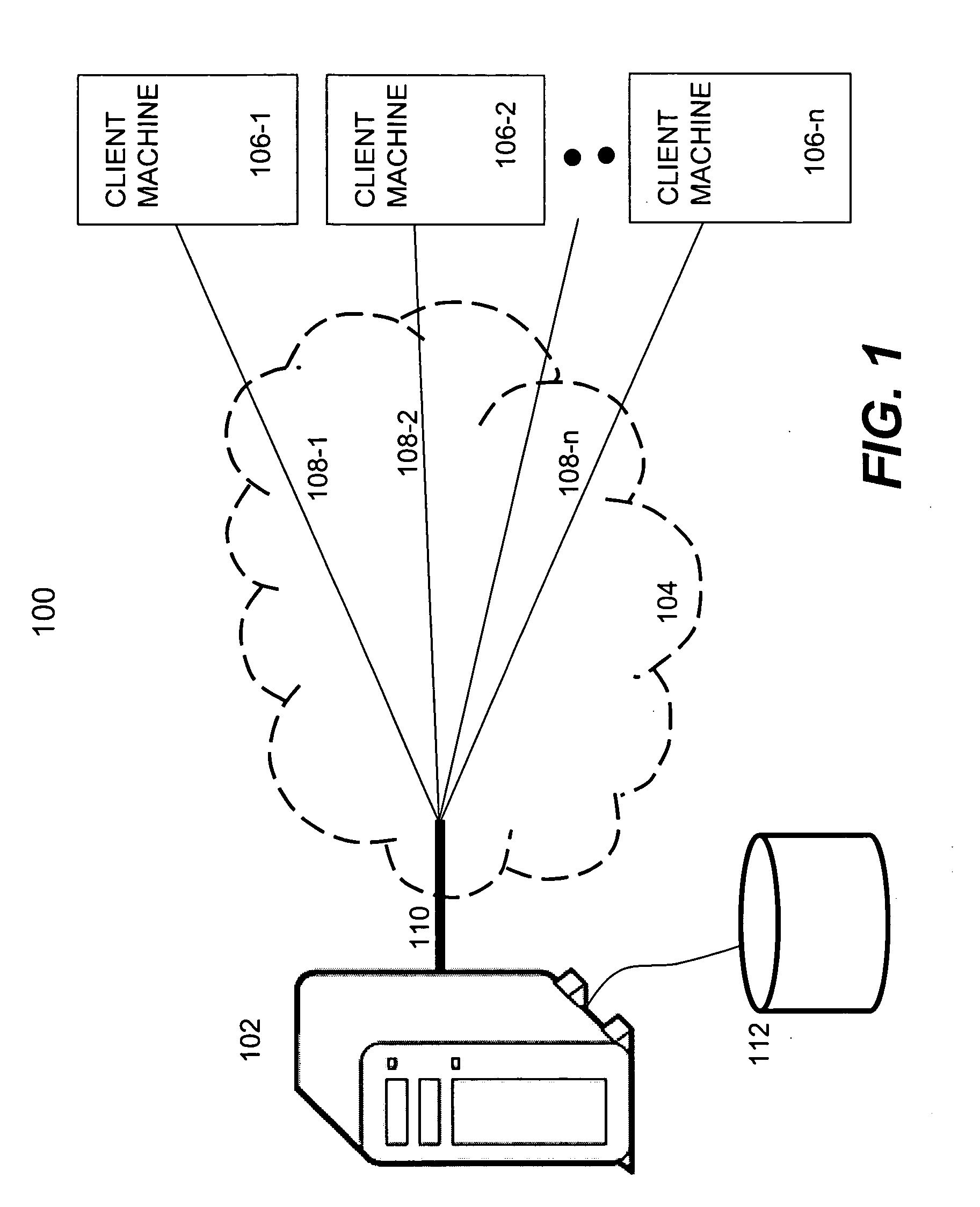
However, as the number of the subscribers continues to increase, the demand on the bandwidth of the
backbone network path 110 increases linearly, and the overall cost of the
system 100 increases considerably at the same time.
If the
server has a fixed bandwidth limit and
system support capability, an increase in the number of subscribers beyond a certain threshold will result in slower transfer of data to clients.
When the video data is not received in a
client machine on time, the display of the video data may fail or at least become jittery.
Subsequently, overall costs go up considerably when more subscribers sign up with the
video delivery system 100.
Further, in cases where the set-top box does not support two-way communication with the
service provider, the customer has to inconveniently telephone a service to order the selected movie.
However, because of slow download speeds and considerable movie size, the viewer has to wait significant time, e.g., one (1) to two (2) hours, for the movie to download.
Although in many ways better than pay-per-view, this option is still far from ideal.
The solution makes customers wait a long time before receiving the movie, fails to give consumers immediate gratification, and fails to take
advantage of impulsive nature of many purchasers.
Satellite providers specifically will have difficulty providing true
video on demand or current alternatives because
satellite communication offers no return path, i.e., offers only one-way communication from the satellite provider to the customer, and because satellite bandwidth which is sufficient for broadcast (i.e. point-to-multipoint) is insufficient for point-to-point communication.
Because of the limited capabilities of satellite networks, satellite providers are at a substantial
disadvantage to cable providers who can offer cable, internet
broadband,
voice over IP, and other network services.
However, Blockbuster requires customers to get off the sofa, get dressed, go to a hopefully local business establishment, select a movie (which is often unavailable), and return home before being able to start the movie.
These two models do not offer anything “
on demand.”



 Login to View More
  Login to View More