

Semiconductor integrated circuit
a technology of integrated circuits and semiconductors, applied in logic circuits, logic circuit coupling/interface arrangements, pulse techniques, etc., can solve the problems of total operation speed or power consumption, factor of deterioration in performance, etc., and achieve the effect of reducing power consumption and power consumption of semiconductor integrated circuits
- Summary
- Abstract
- Description
- Claims
- Application Information
AI Technical Summary
Benefits of technology
Problems solved by technology
Method used
Image


Examples
first embodiment
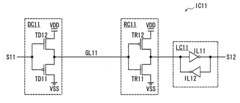
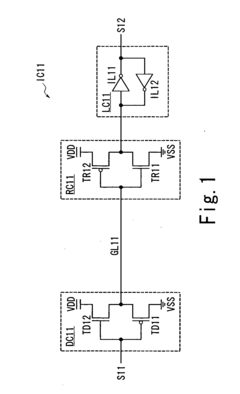
[0039] Embodiments of the invention are described with reference to the accompanying drawings. FIG. 1 shows the invention. A semiconductor integrated circuit IC11 includes: a signal line GL11; a driver circuit DC11 for driving the signal line GL11 in accordance with an input signal S11; a receiver circuit RC11 for generating an output signal in accordance with the potential of the signal line GL11; and a latch circuit LC11 for latching the output signal of the receiver circuit RC11 to generate an output signal S12. For example, the driver circuit DC11 and the receiver circuit RC11 are disposed in different circuit blocks arranged at a spacing. The latch circuit LC11 is disposed in the same circuit block as that of the receiver circuit RC11. The signal line GL11 is the so-called global signal line (e.g., an inter-block signal line) and has a large load.
[0040] The driver circuit DC11 includes a pMOS transistor TD11 (e.g., a first p-type transistor) and an nMOS transistor TD12 (e.g., a...
second embodiment
[0052]FIG. 5 shows the operation waveforms of the invention. When the input signal S11 transits from the ground potential VSS to the power supply potential VDD (FIG. 5(a)), only the nMOS transistor TD12 is turned ON to raise the potential of the signal line GL11 (FIG. 5(b)). When the potential of the signal line GL11 is raised to the intermediate potential VMH, the nMOS transistor TD12 is turned OFF. When the control signal CTL transits in this state from the ground potential VSS to the power supply potential VDD (FIG. 5(c)), the nMOS transistor TR13 and the pMOS transistor TR14 are turned ON so that the output signal of the receiver circuit RC12 transits from the power supply potential VDD to the ground potential VSS. As a result, the output signal S12 of the latch circuit LC11 transits from the ground potential VSS to the power supply potential VDD (FIG. 5(d)). When the control signal CTL transits from the power supply potential VDD to the ground potential VSS (FIG. 5(e)), the nMO...
fifth embodiment
[0063]FIG. 8 shows the invention. A semiconductor integrated circuit IC21 is configured to include: a signal line GL21; a driver circuit DC21 for driving the signal line GL21 in accordance with an input signal S21; a receiver circuit RC21 for generating an output signal in accordance with the potential of the signal line GL21; and a latch circuit LC21 for latching the output signal of the receiver circuit RC21 to generate an output signal S22. For example, the driver circuit DC21 and the receiver circuit RC21 are disposed in different circuit blocks arranged at a spacing. The latch circuit LC21 is disposed in the same circuit block as that of the receiver circuit RC21. The signal line GL21 is a global signal line of a large load.
[0064] The driver circuit DC21 is configured to include a pMOS transistor TD21 (e.g., a first p-type transistor), a pMOS transistor TD22 (e.g., a second p-type transistor) and an inverter ID21. The pMOS transistor TD21 has its source connected with the signa...
PUM
 Login to View More
 Abstract
Description
Claims
Application Information
 Login to View More