[0006]Proceeding from the above, one object of the invention is to specify a method for recovering the heat energy released by laundry machines, which can thus reduce the energy requirements of a laundry.
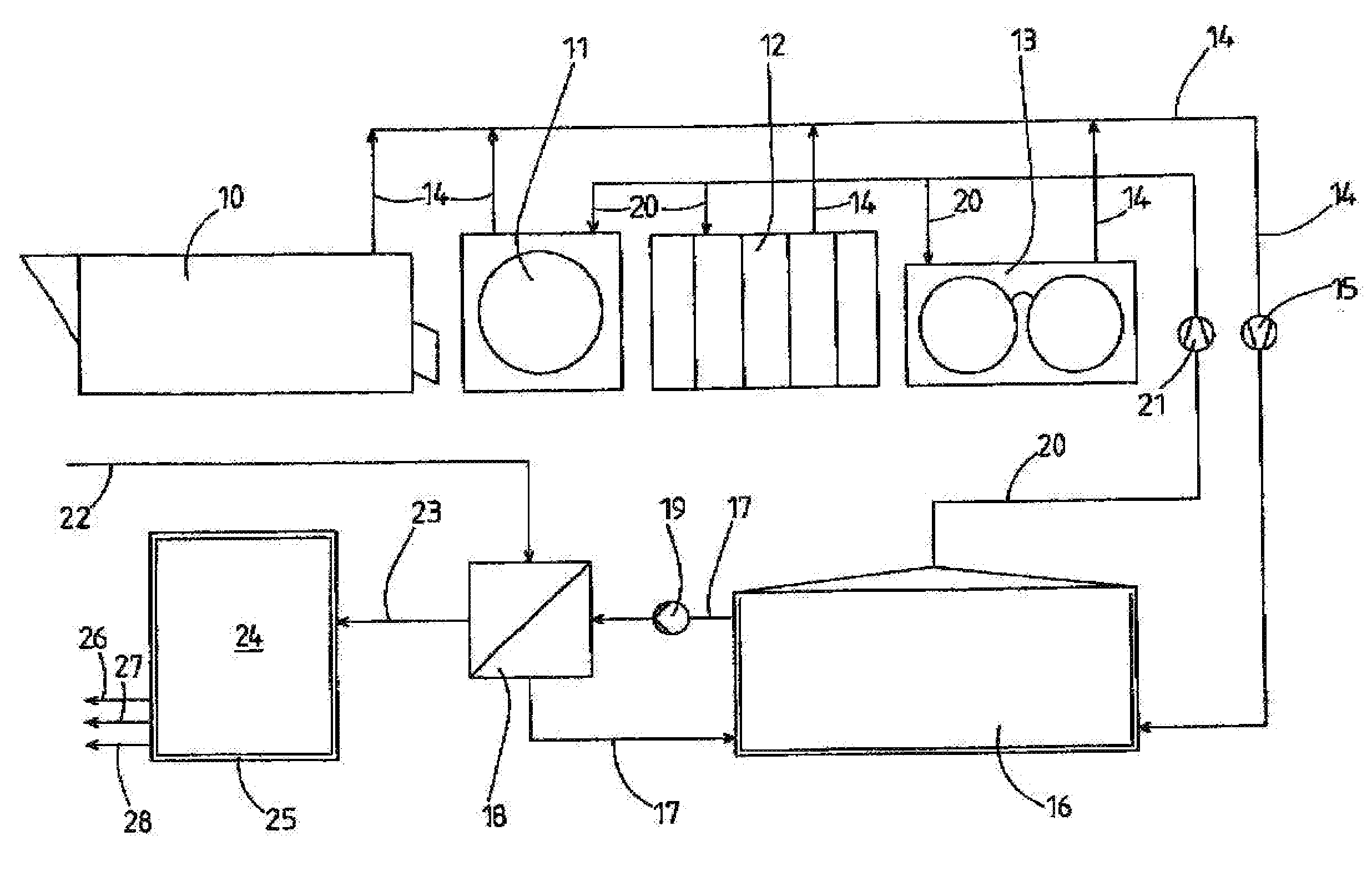
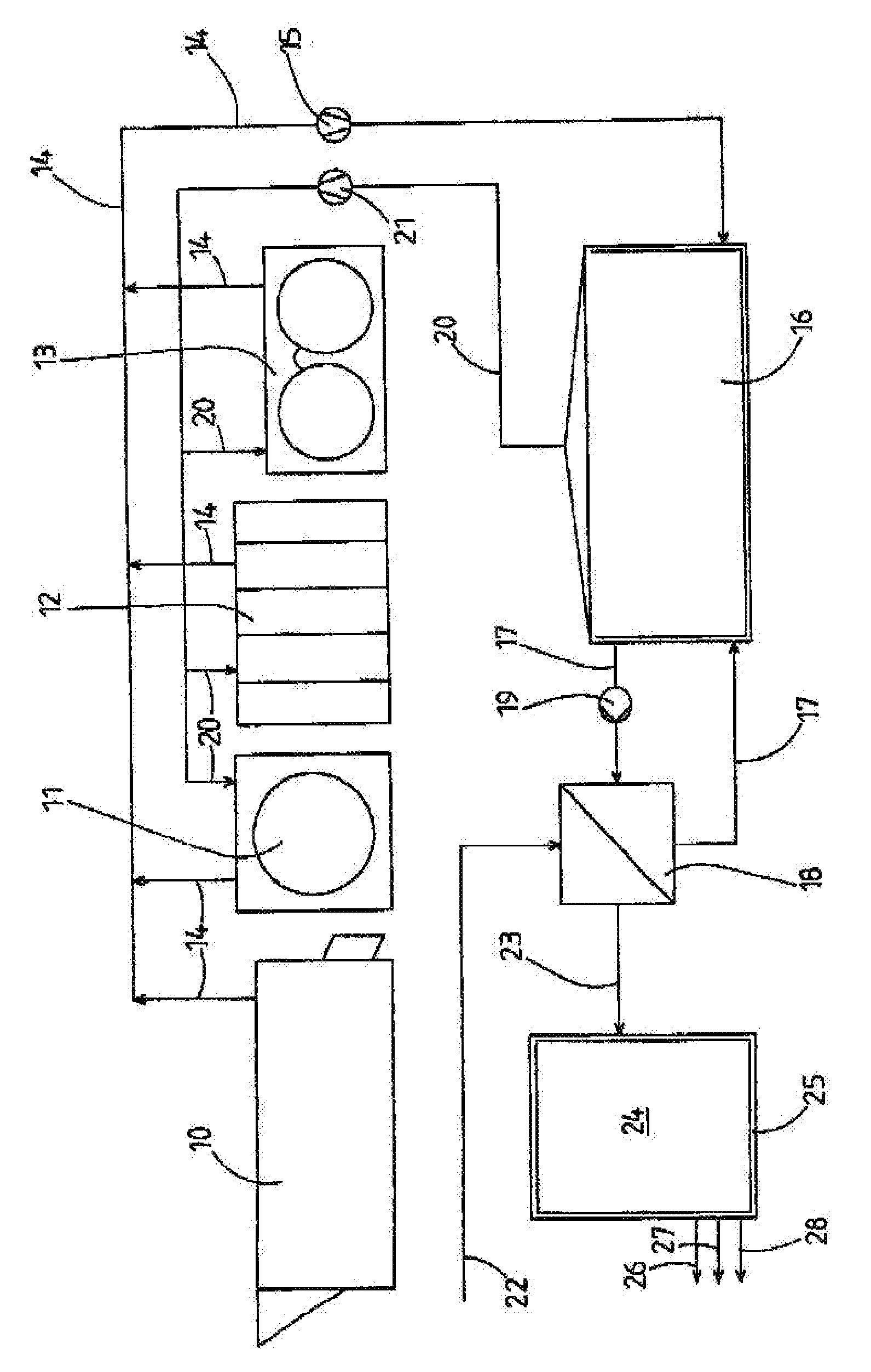
[0007]A method for achieving this object is where the heat energy released by a plurality of laundry machines is conducted to at least one common
heat exchanger. It is possible to assign groups each comprising a plurality of laundry machines to a central
heat exchanger. But it is also conceivable to assign all laundry machines in a laundry establishment or in a room of the laundry to at least one central heat exchanger. This allows for heat
recovery to take place centrally. No space is required for the at least one heat exchanger in the region of the respective laundry machines. Above all, the number of heat exchangers for recovering heat can be reduced. There is no need for each laundry
machine to be assigned at least one heat exchanger having its own
process control.
[0012]The water and / or the air heated by the second heat exchanger is preferably fed to a wash
machine, a spin dryer, a dryer, a finisher and / or a mangle. The air to be fed to said laundry machines then does not require any further heating, or if so, only to a slight extent, and is thus an energy-saving measure. The same apples to water, which is fed in particular to a washing
machine or a hydroextractor spin-dryer. If
fresh water is being used, there is no need to input energy in order to heat cold water up to the predetermined desired temperature. This task is completely or partially accomplished by recovering the energy in the gland steam expelled by the respective laundry machine.
[0015]It is also possible to conduct the dried hot air through a further, preferably second, heat exchanger, which uses the dried hot air to warm the secondary air, in particular
fresh air. In this manner it is possible to keep contaminated hot air from the gland steam, in particular hot air containing lint and / or germs, from being supplied to the laundry machine. By warming
fresh air by means of the additional heat exchanger, heated uncontaminated air containing the
residual energy can be reutilized for supplying the laundry machines in question.
[0018]A further method for achieving the object stated at the outset, which may also be a preferred further development of the previously described method, is a method for recovering heat energy released by laundry machines, characterized in that
heat transfer medium heated during the
recovery of energy is stored at least in part. Accordingly, in the
recovery of energy, heated water, heated air or a heated
heat transfer medium, preferably water heated in a further, second heat exchanger, is at least partially stored or temporarily stored. This is expediently carried out in at least one insulated storage container. In this manner, it is possible to store the recovered energy until needed. For example, during down-time intervals in laundry operations, in particular overnight, the
warm water recovered on the previous day can be stored until the next working day, thus making it possible to start operations on the next working day with
warm water that is immediately available for the laundry machines, thus eliminating the need to heat cold water in order for laundry operations to commence.
[0019]The or each heat exchanger preferably charges at least one energy store. Such an energy store can be accessed as needed whenever energy is required at a particular laundry machine or in the entire laundry. The energy store can also accumulate the energy recovered from discharged air, waste water and in particular the gland steam from laundry machines. This makes it possible to accumulate hot air or even hot water whose temperature is at least equal, if not greater, than the waste water, discharged air or gland steam of the laundry machines. To this end, the energy store preferably has an
energy storage medium that stores heat at a temperature greater than 100° C.


 Login to View More
  Login to View More