
Color forming compositions with improved marking sensitivity and image contrast and associated methods
a color forming composition and marking sensitivity technology, applied in thermography, instruments, photosensitive materials, etc., can solve the problems of slow development time, less than acceptable contrast, adversely affecting the performance of the disk upon spinning at high speed, etc., to improve the marking sensitivity and improve the image contrast. , the effect of rapid developmen
Patent Information
- Authority / Receiving Office
- US · United States
- Patent Type
- Applications(United States)
- Current Assignee / Owner
- Publication Date
- 2007-12-06
- Estimated Expiration
- Not applicable · inactive patent
Smart Images
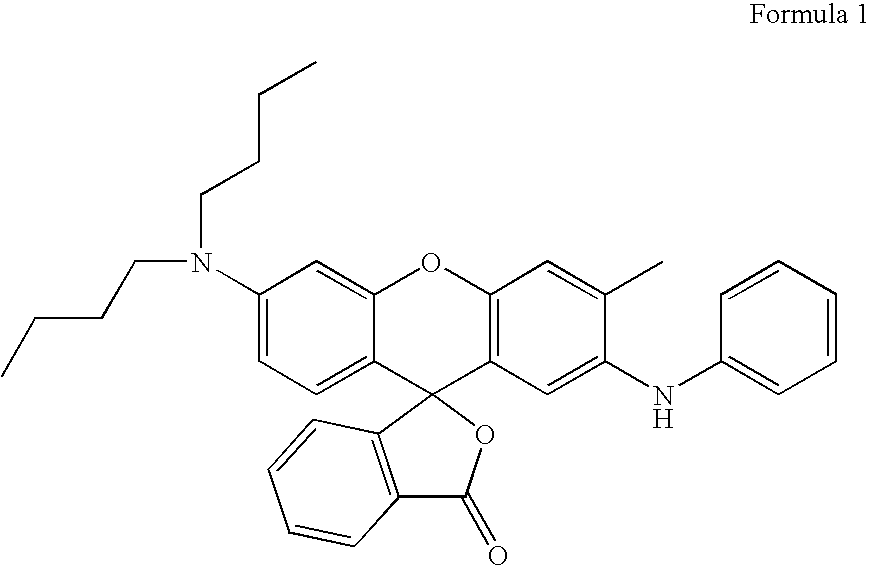
Figure 1 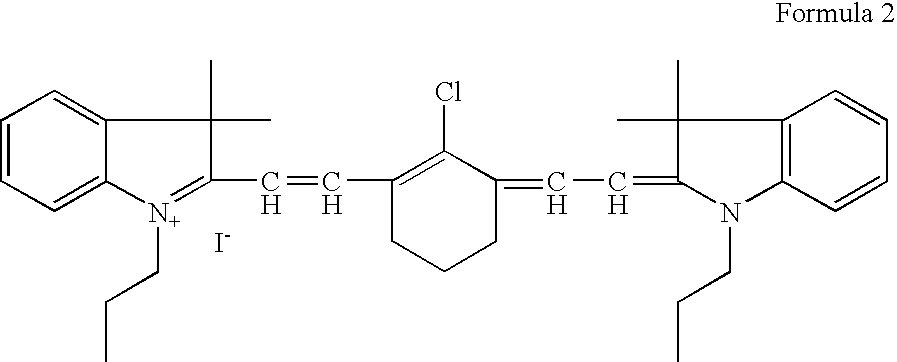
Figure 2
Abstract
Description
FIELD OF THE INVENTION
[0001] The present invention relates generally to color forming compositions. More particularly, the present invention relates to methods and compositions which can form images upon interaction with energy, such as light energy, with improved marking sensitivity and image contrast. BACKGROUND OF THE INVENTION
[0002] Compositions which produce a color change upon exposure to energy in the form of light or heat are of great interest in producing images on a variety of substrates. Optical disks represent a significant percentage of the market for data storage of software as well as of photographic, video, and / or audio data. Typically, optical disks have data patterns embedded thereon that can be read from and / or written to one side of the disk, and a graphic display or label printed on the other side of the disk.
[0003] In order to identify the contents of the optical disk, printed patterns or graphic display information can be provided on the non-data, or label,...
Examples
example 1
[0076] a) Preparation of Color Former Particles for Color Former Phase (Discontinuous Phase)
[0077] About 10 g of m-terphenyl (accelerator) was melted in a beaker, and the melt was heated to about 110° C. About 100 g of BK400 was added in small increments to the melt upon constant stirring. The added BK400 is a leuco-dye (2′-anilino-3′-methyl-6′-(dibutylamino)fluoran) available from Nagase Corporation, the structure of which is set forth below as Formula 1:
The temperature of the mixture was increased up to about 170° C. to 180° C. Stirring was continued until complete dissolution of BK400 in the melt (usually takes about 10 to 15 min) was obtained to form an accelerator / leuco dye solution. Next, about 1.8 g of Cirrus-715 (radiation absorber IR dye) was added to the melt upon constant stirring. Heating and stirring was continued for about two to three additional minutes until the Cirrus-715 was completely dissolved in the melt to form a leuco dye / antenna / accelerator alloy (eutecti...
example 2
[0082] a) Preparation of Color Former Particles for Color Former Phase (Discontinuous Phase)
[0083] About 10 g of m-terphenyl (accelerator) was melted in a beaker, and the melt was heated to about 110° C. About 100 g of BK400 was added in small increments to the melt upon constant stirring. The added BK400 is a leuco-dye (2′-anilino-3′-methyl-6′-(dibutylamino)fluoran) available from Nagase Corporation, the structure of which is set forth in Formula 1 above. The temperature of the mixture was then increased up to about 170° C. to 180° C. Stirring was continued until complete dissolution of BK400 in the melt (usually takes about 10 to 15 min) was obtained to form an accelerator / leuco dye solution melt. About 1.2 g of IR780-iodide (radiation absorber IR dye) was then added to the melt upon constant stirring. IR780-iodide is also known as 3H-Indolinium, 2-[2-chloro-3-[91,3-dihydro3,3-dimethyl-1-propyl-2H-indol-2-ylidene)ethylidene]-1-cyclohexen-1yl]ethenenyl]-3,3-dimethyl-1-propyl-, iod...
example 3
[0088] a) Preparation of Color Former Particles for Color Former Phase (Discontinuous Phase)
[0089] About 10 g of m-terphenyl (accelerator) was melted in a beaker, and the melt was heated to about 110° C. About 100 g of BK400 was added in small increments to the melt upon constant stirring. The added BK400 is a leuco-dye (2′-anilino-3′-methyl-6′-(dibutylamino)fluoran) available from Nagase Corporation, the structure of which is set forth in Formula 1 above. The temperature of the mixture was increased up to about 170° C. to 180° C. Stirring was continued until complete dissolution of BK400 in the melt (usually takes about 10 to 15 min) was obtained to form an accelerator / leuco dye solution. Next, about 1.8 g of Cirrus-715 (radiation absorber IR dye) was added to the melt upon constant stirring. Heating and stirring was continued for about two to three additional minutes until the Cirrus-715 was completely dissolved in the melt to form a leuco dye / antenna / accelerator alloy (eutectic)...