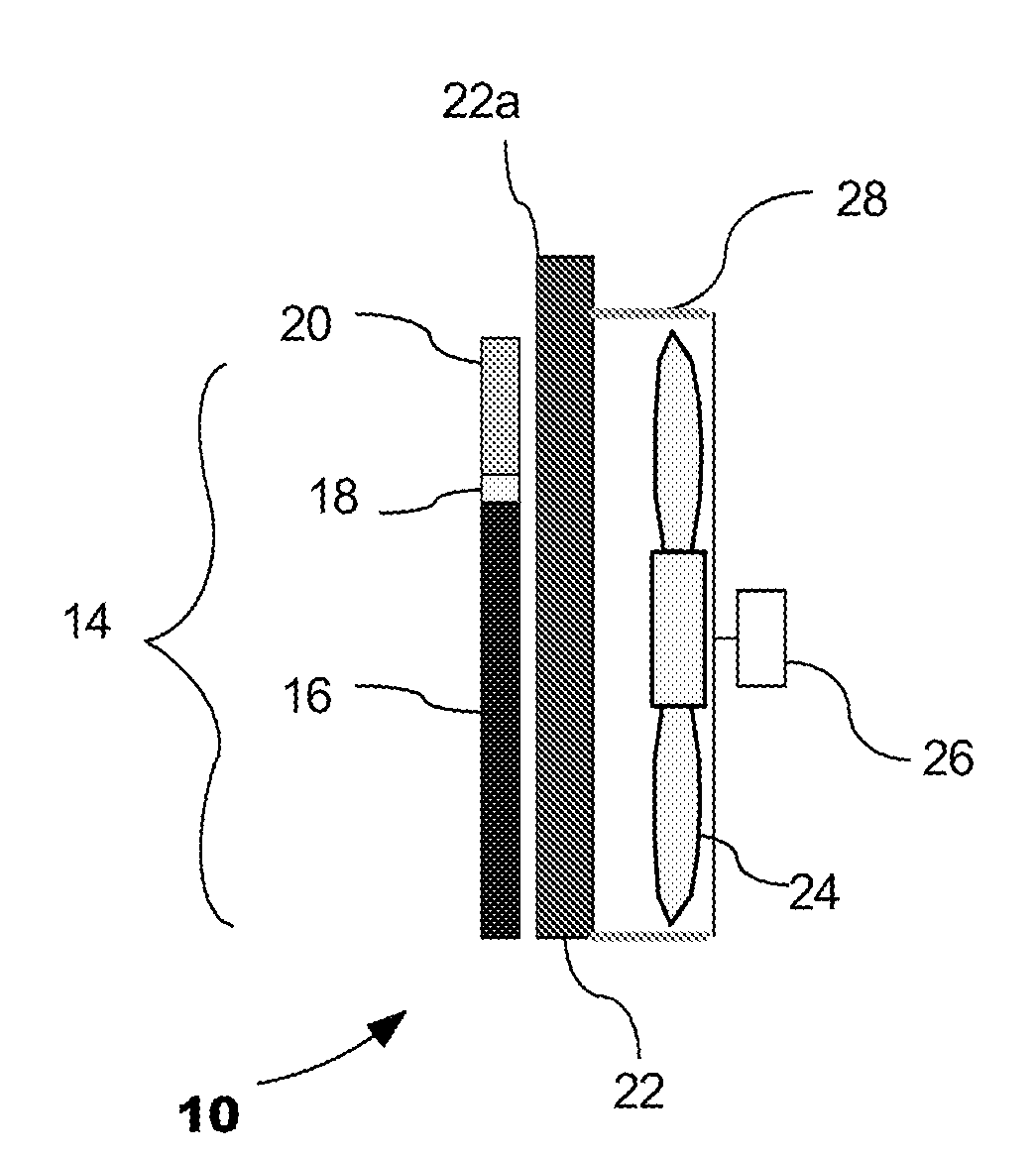
[0019]In various aspects of the present invention, a fan shroud (when used in automotive cooling applications hereinto referred to as a “cooling fan shroud”) is designed that provides or allows for higher airflow to be achieved through the radiator and oil cooler heat exchangers for higher vehicle operating speeds; this higher airflow is higher than those currently achieved using current art fan shrouds. Any measurable improvement in airflow is of benefit. The amount of increased airflow of the
partial coverage shroud design is driven by combinations of independent variables such as: specific areas of covered and non-covered heat exchanger surface area, meter per second value of vehicle ram flow, fan
power level, vehicle speeds, heat exchanger pressure restriction levels, etc. The cooling fan shroud designs, in accordance with aspects of the present invention, when used in conjunction with condenser related applications, actually increases condenser airflow for idle operation, without adding cost to the overall system.
[0021]One embodiment of the present invention, in various aspects, can be used with a variety of cooler modules. In some of the embodiments of these aspects, a combo-cooler design (design wherein tubes share a common set of manifolds) (see, for example, US
Patent Application No. US2003-0209344A1, published on Nov. 13, 2003, incorporated herein by reference and made a part hereof), is used for the heat exchanger. In heat exchanger assemblies comprising a fan cooling module, a combo-cooler design heat exchanger is used in combination with a
partial coverage shroud design. By partial coverage shroud design, one meaning is that the shroud covers less than 100% of the frontal area established by the perimeter of the airflow area of the heat exchangers. A heat exchanger
assembly comprising a fan cooling module and heat exchanger, and, particularly, a combo-cooler design heat exchanger, combines the benefits and
cost savings of a combo-cooler design along with a partial coverage shroud design. In combo-cooler design heat exchangers comprising an oil cooler portion and a condenser portion, the partial coverage shroud allows ram airflow full and / or virtually unimpeded access to areas of the oil cooler portion of the combo-cooler, as well as a radiator, where present, to higher levels of ram airflow at higher vehicle speeds while maintaining 100% coverage of the condenser portion of the combo-cooler heat exchanger face area.
[0023]This configuration allows cooling flow to be maximized through the radiator and oil cooler portions of the combo-cooler for grade trailer tow requirements, while maintaining or improving airflow though the condenser for Idle operating conditions.
[0024]This maximizes airflow at higher speed trailer grade operating conditions while actually increasing idle airflow through the condenser portion.
[0025]Aspects of the present invention, therefore, have the
advantage of the combo-cooler design along with the
advantage of a unique fan shroud configuration. The overall combination of combo-cooler heat exchanger and cooling fan shroud design is particularly useful in light
truck and SUV market segments where high speed trailer tow requirements are often a worst case cooling system design consideration. These aspects provide both a cost and a performance
advantage formerly not seen in other heat exchanger assemblies. The cooling fan shroud, though providing a competitive advantage in and of itself in automotive applications, its use in combination with a
specific heat exchanger design, provides heretofore unforeseen advantages when used with various combo-cooler heat exchanger designs.
[0026]Illustrated aspects of the present invention provide for a combo-cooler design or type heat exchanger having a cooling fan shroud, wherein the shroud substantially covers the condenser. For example, under various conditions, it might be best for idle operation to cover 100% of the condenser, but there could be times where covering less than 100% of the condenser is desired by specification to improve high speed cooling, even at some expense to maximizing idle condenser performance. About 100%, of the condenser tube face area of the condenser core portion of the combo-cooler design heat exchanger for example, can be covered, leaving portions of the oil cooler tube area of the combo-cooler design heat exchanger open to or subjected to ram flow.


 Login to View More
  Login to View More