Rinsing Fluid for Lithography

a technology of lithography and rinsing fluid, which is applied in the direction of detergent compounding agents, non-aqueous electrolyte cells, instruments, etc., can solve the problems of resisting falling, reducing the yield and reliability of products, and pattern falling during formation, so as to achieve high-quality products and prevent pattern falling

a technology of lithography and rinsing fluid, which is applied in the direction of detergent compounding agents, non-aqueous electrolyte cells, instruments, etc., can solve the problems of resisting falling, reducing the yield and reliability of products, and pattern falling during formation, so as to achieve high-quality products and prevent pattern falling

US20080026975A1Inactive Publication Date: 2008-01-31TOKYO OHKA KOGYO CO LTD

Image

Smart Image Click on the blue labels to locate them in the text.
Viewing Examples
Smart Image
  • Rinsing Fluid for Lithography
  • Rinsing Fluid for Lithography
  • Rinsing Fluid for Lithography

Examples

Experimental program
Comparison scheme
Effect test

examples 1-3

[0028] The resist patterns obtained in the Reference Example were subjected to a rinse treatment by using 3 kinds of rinse solutions including 0.005% aqueous solutions of perfluoro(2-methyl-3-morpholino propionic acid (a product by Jemco Inc., product name PFMO3, referred to hereinbelow as PFMO3), bis(heptafluoropropylsulfonyl)amine (a product by Jemco Inc., product name EF-N331, referred to hereinbelow as EF-N331) and perfluoro(decane carboxylic acid) obtained on the market (referred to hereinbelow as PDC).

[0029] A mixed solvent of water and trifluoroethanol (volume proportion 99:1) was used as the solvent for PDC since this was insoluble in water.

[0030] This rinse treatment was conducted by dripping the aforementioned rinse solutions for 3 seconds at 500 rotations followed by rinse for 20 seconds with pure water.

[0031] The contact angles of the resist pattern surface before and after each rinse solution treatment were determined by using a contact angle tester (a product by Kyo...

the structure of the environmentally friendly knitted fabric provided by the present invention; figure 2 Flow chart of the yarn wrapping machine for environmentally friendly knitted fabrics and storage devices; image 3 Is the parameter map of the yarn covering machine
Login to View More

PUM

PropertyMeasurementUnit
contact angleaaaaaaaaaa
surface tensionaaaaaaaaaa
contact angleaaaaaaaaaa
Login to View More

Abstract

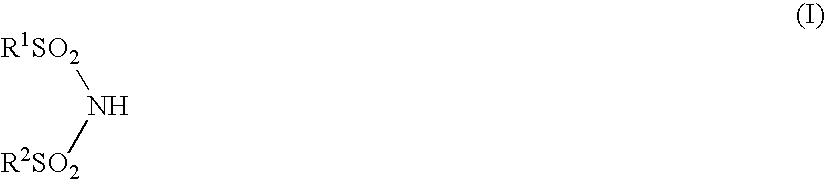
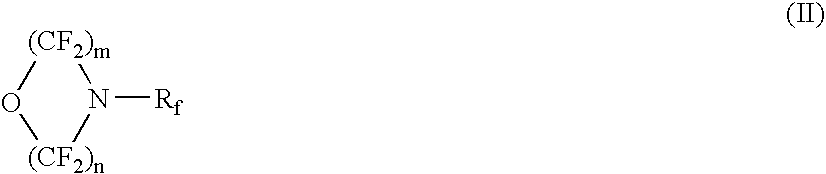
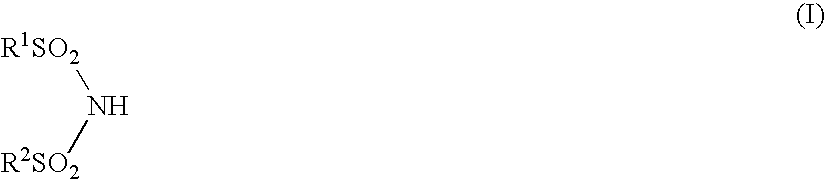
The invention provides a novel rinsing fluid which can convert an easily wettable resist pattern surface having a contact angle of 40° or below into one having a contact angle of 70° or above to inhibit pattern collapse effectively and thereby give high-quality products. The rinsing fluid consists of a solution containing at least one fluorine compound soluble in water or alcoholic solvents which is selected from among compounds represented by the general formula (I), those represented by the general formula (II), and those represented by the general formula: Rf′—COOH: wherein R1 and R2 are each optionally substituted C1-5 alkyl whose hydrogen atoms are partially or wholly replaced by fluorine, or R1 and R2 together with the SO2 groups to which they are bonded and the nitrogen atom may form a five- or six-membered ring; Rf is optionally substituted C1-5 alkyl whose hydrogen atoms are partially or wholly replaced by fluorine; m and n are each an integer of 2 or 3; and Rf′ is at least partially fluorinated alkyl having 8 to 20 carbon atoms.

Description

TECHNICAL FIELD [0001] The present invention relates to a rinse solution for lithography capable of effectively preventing pattern falling during formation of a fine pattern having a high aspect ratio. BACKGROUND TECHNOLOGY [0002] Along with the trend in recent years in the semiconductor devices toward compact size and high integration, development works were practiced for the use of light sources for the fine working including ultraviolet lights such as the g-line and i-line, excimer laser beams such as KrF and ArF and the like as well as photoresist compositions suitable thereto such as, for example, chemical-amplification photoresist compositions while many of the problems on the lithographic technology in this direction are now on the way of solution. [0003] Meanwhile, one of the problems is pattern falling during formation of a fine resist pattern or, in particular, pattern of a high aspect ratio by the lithographic technology. This pattern falling is a phenomenon encountered i...

Claims

the structure of the environmentally friendly knitted fabric provided by the present invention; figure 2 Flow chart of the yarn wrapping machine for environmentally friendly knitted fabrics and storage devices; image 3 Is the parameter map of the yarn covering machine
Login to View More

Application Information

Patent Timeline
31 Jan 2008
Publication
US20080026975A1
IPC
G03F7/32; H01L21/027; C11D3/24; C11D3/34; C11D11/00
CPC
C11D3/245; C11D3/349; G03F7/322; G03F7/32; C11D11/0041; C11D2111/20
Inventors
KOSHIYAMA, JUN; WAKIYA, KAZUMASA