Substituted 2-Aminopyrimidine-4-Ones, Their Pharmaceutical Compositions And Their Use In The Treatment And/Or Prevention Of Ab-Related Pathologies
Inactive Publication Date: 2009-01-22
ASTRAZENECA AB +1
View PDF8 Cites 33 Cited by
Summary
Abstract
Description
Claims
Application Information
AI Technical Summary
This helps you quickly interpret patents by identifying the three key elements:
Problems solved by technology
Method used
Benefits of technology
Benefits of technology
[0116]Thus, the skilled artisan can readily determine the amount of compound and optional additives, vehicles, and/or carrier in compositions and to be administered in methods of the invention.
[0117]Compounds of the present invention have been shown to inhibit beta secretase (including BACE) activity in vitro. Inhibitors of beta secretase have been shown to be useful in blocking formation or aggregation of Aβ peptide and therefore have a beneficial effect in treatment of Alzheimer's Disease and other neurodegenerative diseases associated with elevated levels and/or deposition of A
Problems solved by technology
The likelihood of developing Alzheimer's disease increases with age, and as the aging population of the developed world increases, this disease becomes a greater and greater problem.
This is thought to be due to the extra copy of the APP gene found in these patients, which leads to overexpression of APP and therefore to increased levels of APPβ causing the high prevalence of Alzheimer's disease seen in this population.
Method used
the structure of the environmentally friendly knitted fabric provided by the present invention; figure 2 Flow chart of the yarn wrapping machine for environmentally friendly knitted fabrics and storage devices; image 3 Is the parameter map of the yarn covering machine
View more
Image
Smart Image Click on the blue labels to locate them in the text.
Viewing Examples
Smart Image
Click on the blue label to locate the original text in one second.
Reading with bidirectional positioning of images and text.
Smart Image
Examples
Experimental program
Comparison scheme
Effect test
example 1
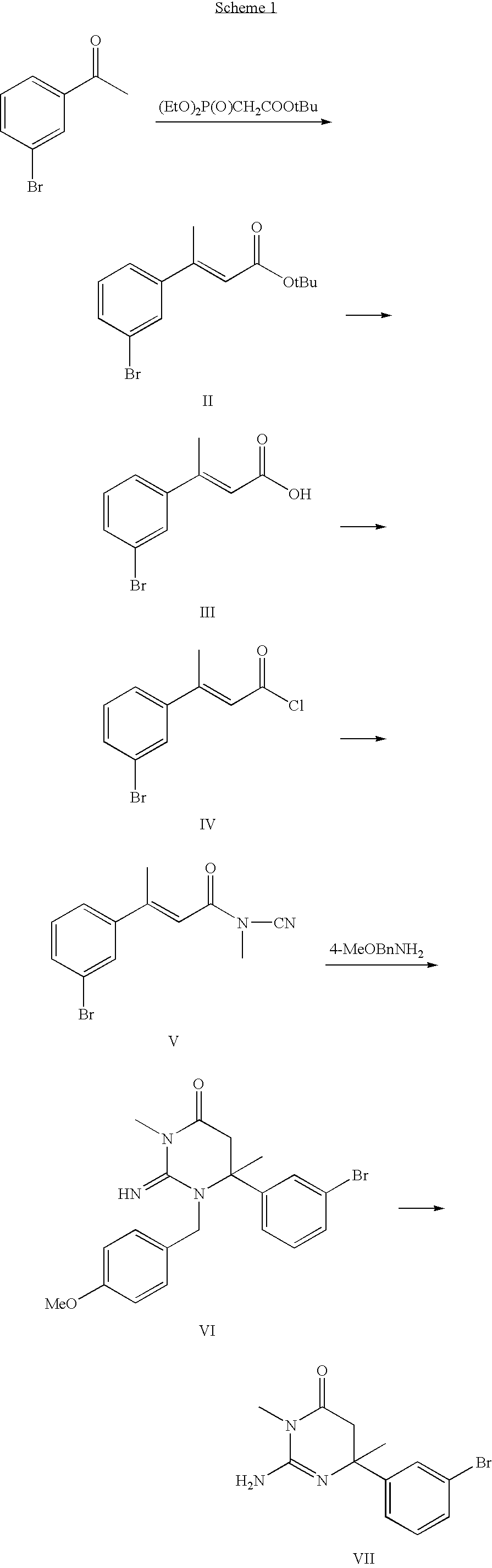
tert-Butyl (2E)-3-(3-bromophenyl)but-2-enoate
[0136]
[0137]To a −78° C. stirred solution of tert-butyldimethylphosphonoacetate (21.9 mL, 0.111 mol) in tetrahydrofuran (150 mL) was added n-butyl lithium in hexanes (1.6 M, 72.0 mL, 0.116 mol) and the reaction was stirred at −78° C. for 10 min. To this mixture was added 3′-bromoacetophenone (13.4 mL, 0.100 mole) and the reaction allowed to warm to room temperature and was stirred for 18 h. The tetrahydrofuran was removed under reduced pressure to yield a solid. Hexanes (300 mL) added and the solids triturated for 1 h. The mixture was filtered through Celite and the filtrate concentrated under reduced pressure to give 28.9 g of the title compound. This was carried directly into the next reaction. 1H NMR (300 MHz, DMSO-d6): δ 7.71 (s, 1H); 7.53 (m, 2H); 7.36 (t, J=7.8 Hz, 1H); 6.05 (s, 1H); 2.44 (s, 3H); 1.47 (s, 9H).
example 2
(2E)-3-(3-Bromophenyl)but-2-enoic acid
[0138]
[0139]A solution of tert-butyl (2E)-3-(3-bromophenyl)but-2-enoate (28.9 g) in a mixture of trifluororacetic acid:dichloromethane (1:1, 300 mL) was stirred at room temperature for 15 min., and the solvents removed under reduced pressure. The resulting solid was triturated in hexanes (400 mL), filtered, and dried under vacuum to give 8.87 g (38% yield) of the title compound. 1H NMR (300 MHz, DMSO-d6): δ 7.72 (t, J=1.5 Hz, 1H); 7.53 (m, 2H); 7.37 (t, J=7.8 Hz, 1H); 6.11 (s, 1H); 2.46 (s, 3H).
[0141]To a suspension of (2E)-3-(3-bromophenyl)but-2-enoic acid (1.00 g, 4.148 mmol) in 10 mL dichloromethane was added oxalyl chloride (434 uL, 4.98 mmol) followed by N,N-dimethylformamide (15 uL, 0.207 mmol) and the reaction was stirred at room temperature for 2 h. The solvent was removed under reduced pressure to give the title compound. 1H NMR (300 MHz, DMSO-d6): δ 7.63 (t, J=1.8 Hz, 1H); 7.57 (d, J=8.7 Hz, 1H); 7.43 (d, J=7.8 Hz, 1H); 7.29 (t, J=7.8 Hz, 1H); 6.44 (s, 1H); 2.51 (s, 3H).
the structure of the environmentally friendly knitted fabric provided by the present invention; figure 2 Flow chart of the yarn wrapping machine for environmentally friendly knitted fabrics and storage devices; image 3 Is the parameter map of the yarn covering machine
Login to View More
PUM
Property
Measurement
Unit
Current
aaaaa
aaaaa
Current
aaaaa
aaaaa
Molar density
aaaaa
aaaaa
Login to View More
Abstract
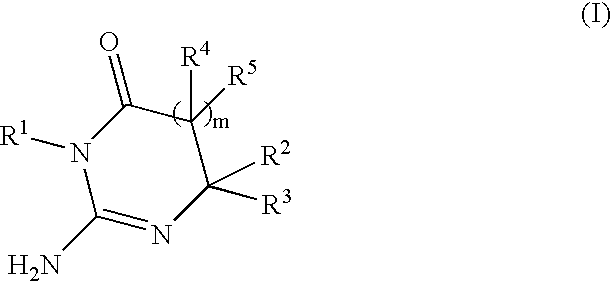
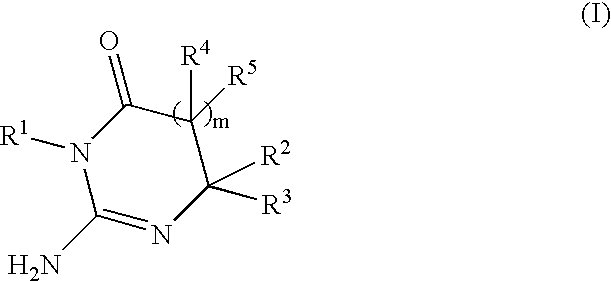
This invention relates to novel compounds having the structural formula (I) below: and to their pharmaceutically acceptable salt, compositions and methods of use. These novel en compounds provide a treatment or prophylaxis of cognitive impairment, Alzheimer Disease, neurodegeneration and dementia.
Description
[0001]The present invention relates to novel compounds, their pharmaceutical compositions. In addition, the present invention relates to therapeutic methods for the treatment and / or prevention of Aβ-related pathologies such as Downs syndrome and β-amyloidangiopathy, such as but not limited to cerebral amyloid angiopathy, hereditary cerebral hemorrhage, disorders associated with cognitive impairment, such as but not limited to MCI (“mild cognitive impairment”), Alzheimer Disease, memory loss, attention deficit symptoms associated with Alzheimer disease, neurodegeneration associated with diseases such as Alzheimer disease or dementia including dementia of mixed vascular and degenerative origin, pre-senile dementia, senile dementia and dementia associated with Parkinson's disease, progressive supranuclear palsy or cortical basal degeneration.BACKGROUND OF THE INVENTION[0002]Several groups have identified and isolated aspartate proteinases that have β-secretase activity (Hussain et al....
Claims
the structure of the environmentally friendly knitted fabric provided by the present invention; figure 2 Flow chart of the yarn wrapping machine for environmentally friendly knitted fabrics and storage devices; image 3 Is the parameter map of the yarn covering machine
Login to View More
Application Information
Patent Timeline
Application Date:The date an application was filed.
Publication Date:The date a patent or application was officially published.
First Publication Date:The earliest publication date of a patent with the same application number.
Issue Date:Publication date of the patent grant document.
PCT Entry Date:The Entry date of PCT National Phase.
Estimated Expiry Date:The statutory expiry date of a patent right according to the Patent Law, and it is the longest term of protection that the patent right can achieve without the termination of the patent right due to other reasons(Term extension factor has been taken into account ).
Invalid Date:Actual expiry date is based on effective date or publication date of legal transaction data of invalid patent.



 Login to View More