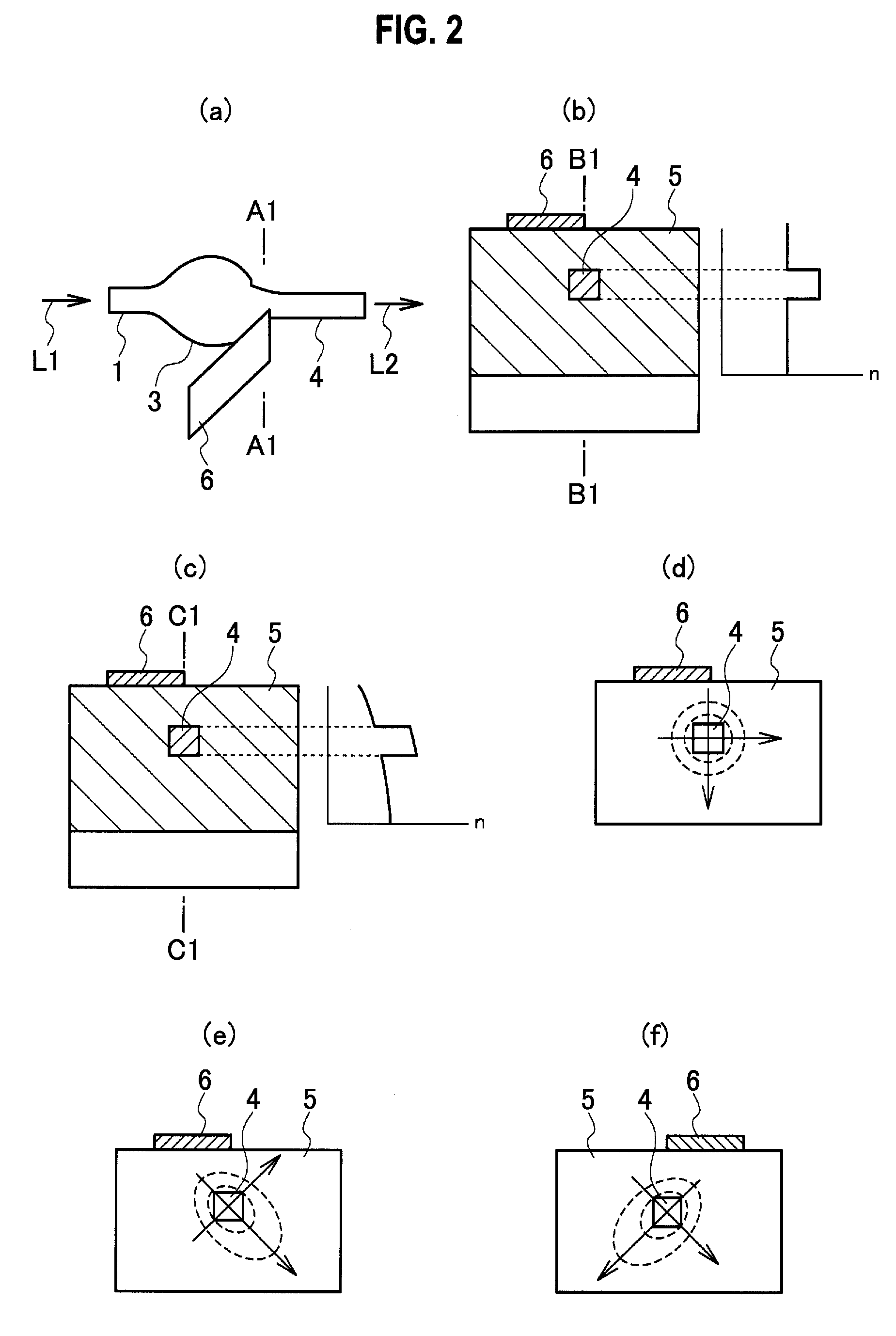
[0023]According to the optical attenuator of claim 1, since the first recess and the second recess are formed in the positional relationship of opposite directions with respect to the axial direction of the optic axis of light, the resulting optical waveguide configuration allows the light to be attenuated. Additionally, as the light is attenuated under condition that the refractive-index distributions caused by the first optical attenuating heater and the second optical attenuating heater differs from each other in between the first optical waveguide and the second optical waveguide, it is possible to reduce a
polarization dependent loss caused by an asymmetric refractive-index distribution. Thus, without utilizing the interference of lights, it is possible to reduce the
polarization dependent loss by a thermo-optic effect, accomplishing a desired optical attenuation.
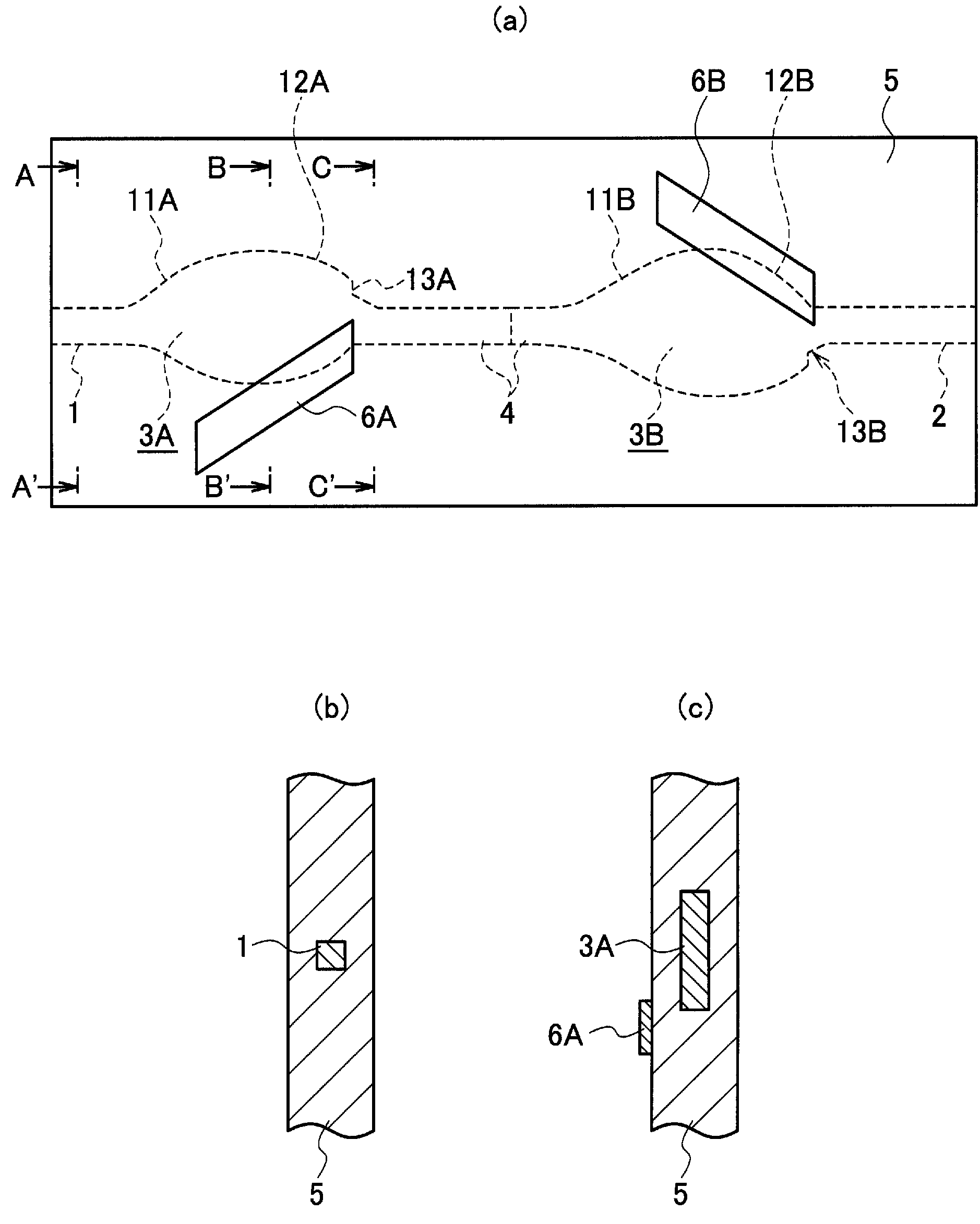
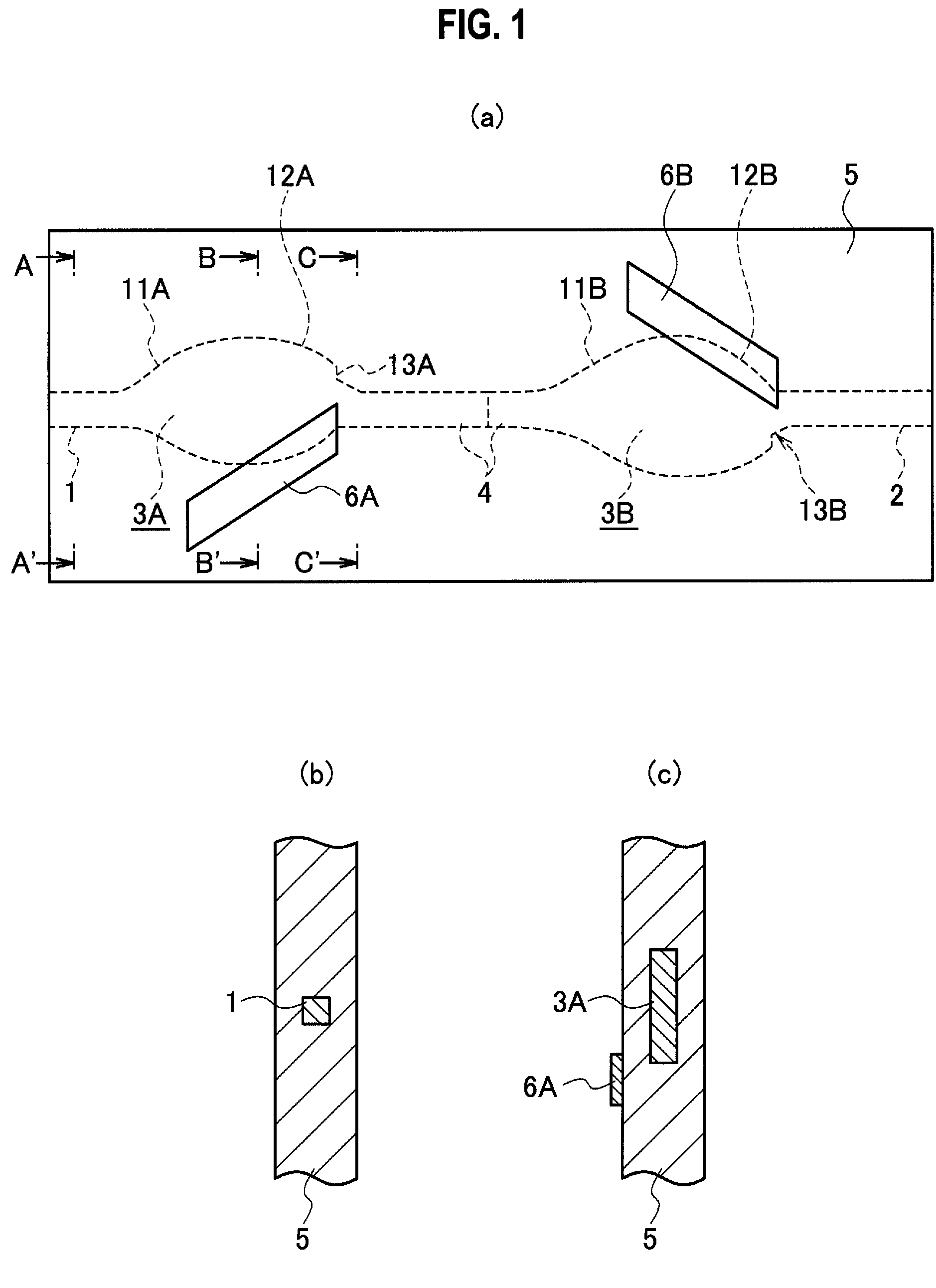
[0024]Further, according to the optical attenuator of claim 2, since the first recess / the first optical attenuating heater and the second recess / the second optical attenuating heater are formed in opposite positional relationships in the axial direction of the optic axis of the light that is inputted through the input optical waveguide, transmitted through the first optical waveguide, the connecting optical waveguide and the second optical waveguide and outputted from the output optical waveguide, it is possible to make an attenuation due to the optical waveguide profile and the refractive index distribution symmetrical in the width direction of an optical waveguide. Thus, when activating both of the first optical attenuating heater and the second optical attenuating heater to generate heat, a direction where the refractive index distribution is deflected by the first optical waveguide and the second optical waveguide is reversed to allow a difference in the polarized state to be averaged between the first optical waveguide and the second optical waveguide.
[0025]Further, according to the optical attenuator of claim 3, since at least either the positional relationship between the optic axis of the light inputted into the first optical waveguide through the input optical waveguide and the optic axis of the light outputted from the first optical waveguide to the connecting optical waveguide, or the positional relationship between the optic axis of the light inputted into the second optical waveguide through the connecting optical waveguide and the optic axis of the light outputted from the second optical waveguide to the output optical waveguide is out of alignment, it is possible to enhance the attenuating effect for light in comparison with a case of no misalignment.
[0026]Further, according to the optical attenuator of claim 4, since the connecting optical waveguide is formed, at its part in the vicinity of the first optical waveguide, with the optical waveguide width which is narrower than the optical waveguide width of the connecting optical waveguide part in the vicinity of the second optical waveguide, it is possible to diffuse light when passing through the narrowed connecting optical waveguide and also possible to diffuse unnecessary light leading to a deterioration of optical signals, suppressing a deterioration of optical signals accompanies with the attenuation of light.
[0027]Further, according to the optical attenuator of claim 5, since the connecting optical waveguide have the narrowed part arranged in the vicinity of the second optical waveguide to have a narrowed optical waveguide width, or the output optical waveguide have the narrowed part arranged in the vicinity of the second optical waveguide to have a narrowed optical waveguide width, the narrowed part can diffuse light, whereby it is possible to suppress a deterioration of optical signals accompanies with the attenuation of light.
[0028]Further, according to the optical attenuator of claim 6, the first recess / the first optical attenuating heater and the second recess / the second optical attenuating heater are formed in opposite positional relationships in the axial direction of the optic axis of the light that is inputted through the input optical waveguide, transmitted through the first optical waveguide, the connecting optical waveguide and the second optical waveguide and outputted from the output optical waveguide. Further, the first recess is arranged on one side of the output optical waveguide, while the second recess is arranged on one side of the input optical waveguide. Therefore, as the first optical attenuating heater and the second optical attenuating heater can be arranged inversely in the width direction of optical waveguide and also arranged completely symmetrically in the traveling direction of light, it is possible to reduce the polarization dependent loss furthermore.


 Login to View More