
Gas safety device and the control method of heating ventilating and air conditioning system
- Summary
- Abstract
- Description
- Claims
- Application Information
AI Technical Summary
Benefits of technology
Problems solved by technology
Method used
Image

Examples
first embodiment
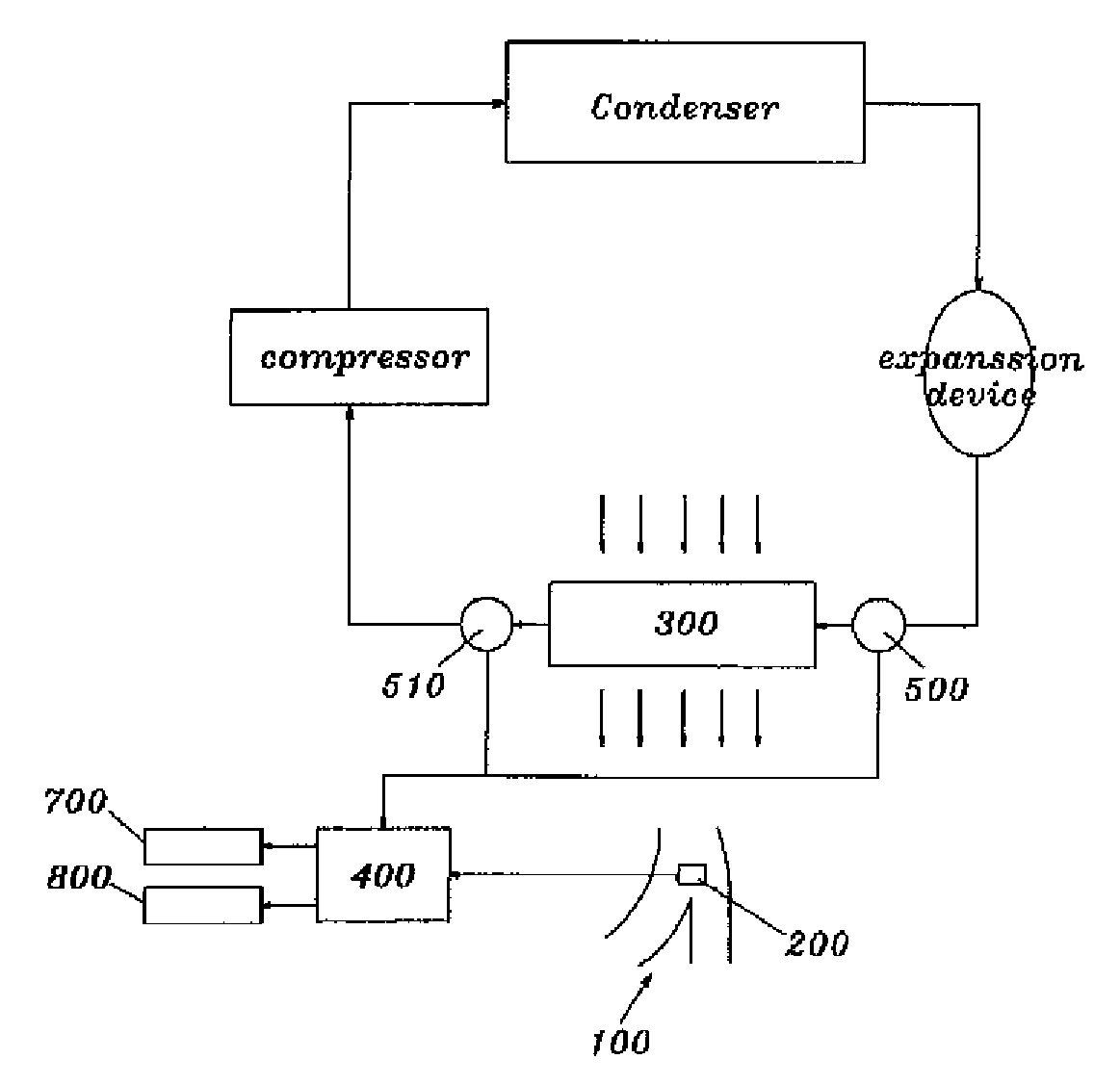
[0026]As shown in FIG. 1, a gas safety device of a heating, ventilating, and air conditioning system for vehicles in accordance with a first embodiment of the present invention includes a gas sensor 200, which is installed at an air inlet 100 connecting an engine room and the inside of a vehicle and senses a gas leakage, and refrigerant cutoff valves 500 and 510, which are installed at lines of an evaporator 300 at the sides of refrigerant inlet and outlet and restrict the flow of a refrigerant according to a signal value through a control unit 400.
[0027]The gas sensor 200 is installed in a passage of the air inlet 100 connecting the engine room and the inside of the vehicle, senses gas flowing in together with air, and outputs a corresponding signal value to the control unit 400.
[0028]The gas sensor 200 contains a combustible refrigerant or a non-combustible refrigerant, which is used as a refrigerant gas for vehicles. Here, R-152a may be used as the combustible refrigerant.
[0029]T...
second embodiment
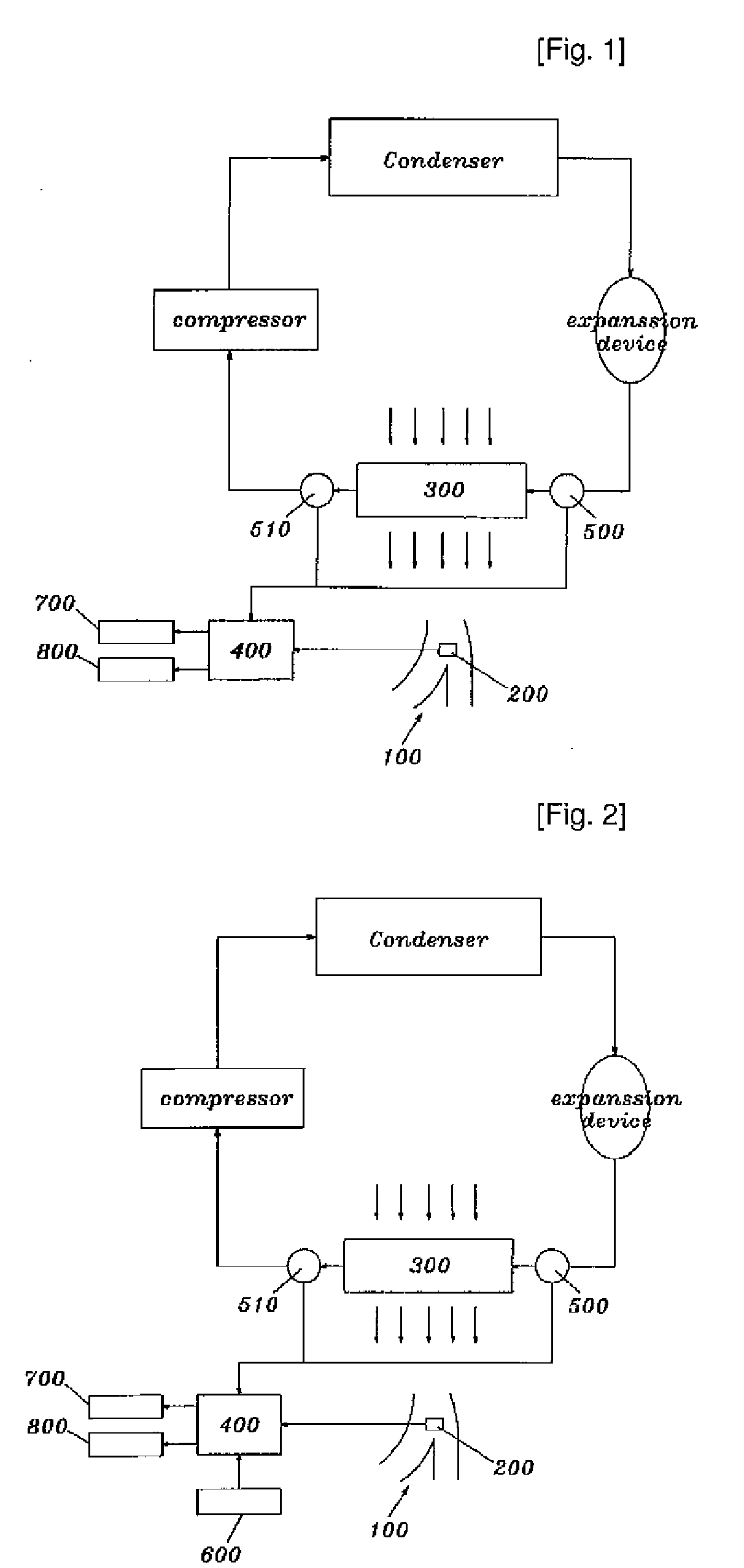
[0032]As shown in FIG. 2, a gas safety device of a heating, ventilating, and air conditioning system for vehicles in accordance with a second embodiment of the present invention includes a gas sensor 200, which is installed at an air inlet 100 connecting an engine room and the inside of a vehicle and senses a gas leakage, a shock sensor 600, which is installed in the vehicle and senses a shock when the shock is applied to the vehicle, and refrigerant cutoff valves 500 and 510, which are installed at lines of an evaporator 300 at the sides of refrigerant inlet and outlet and restrict the flow of a refrigerant according to a signal value through a control unit 400.
[0033]The gas sensor 200 is installed in a passage of the air inlet 100 connecting the engine room and the inside of the vehicle, senses gas flowing in together with air, and outputs a corresponding signal value to the control unit 400.
[0034]The gas sensor 200 contains a combustible refrigerant or a non-combustible refrigera...
PUM
 Login to View More
 Abstract
Description
Claims
Application Information
 Login to View More