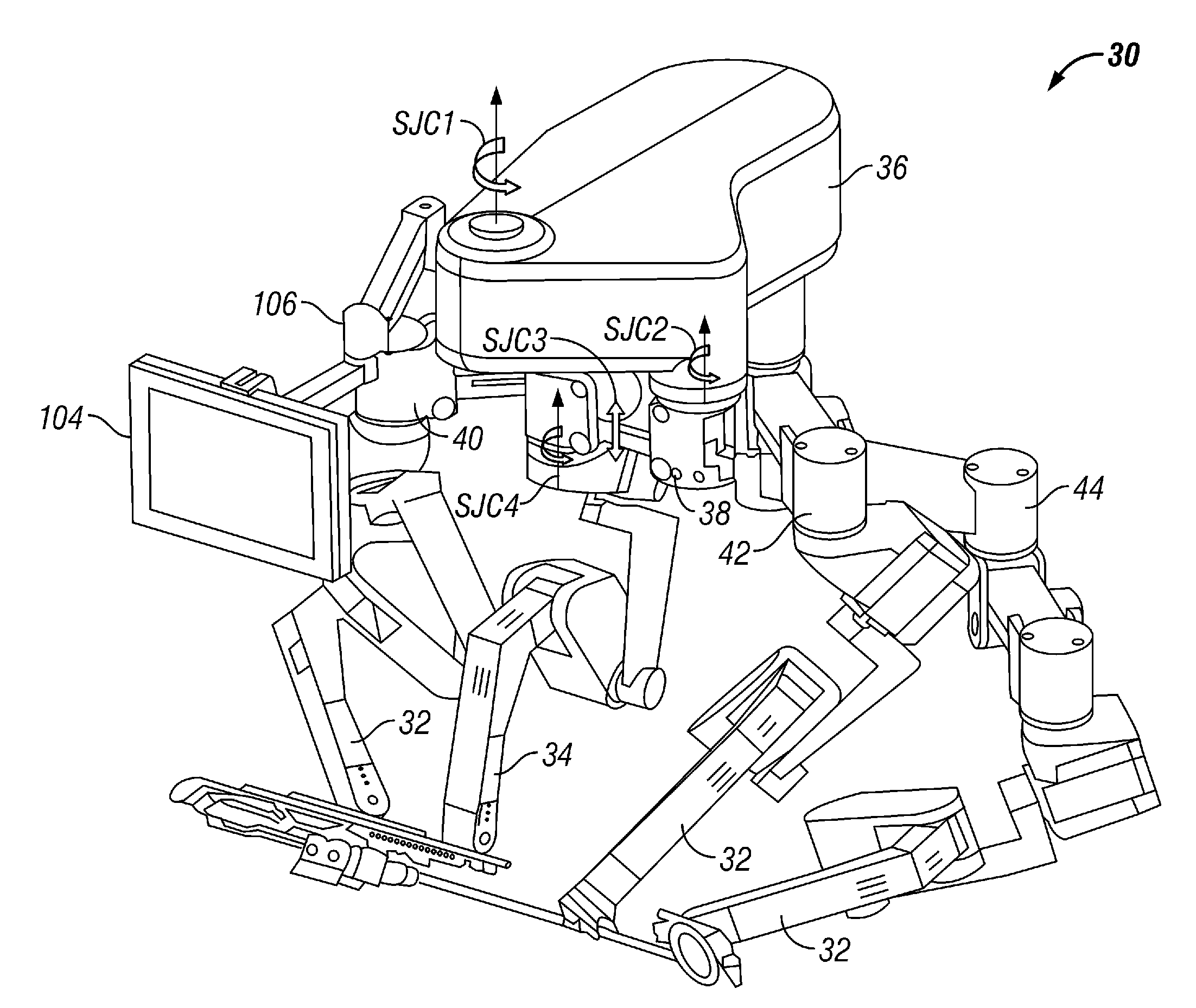
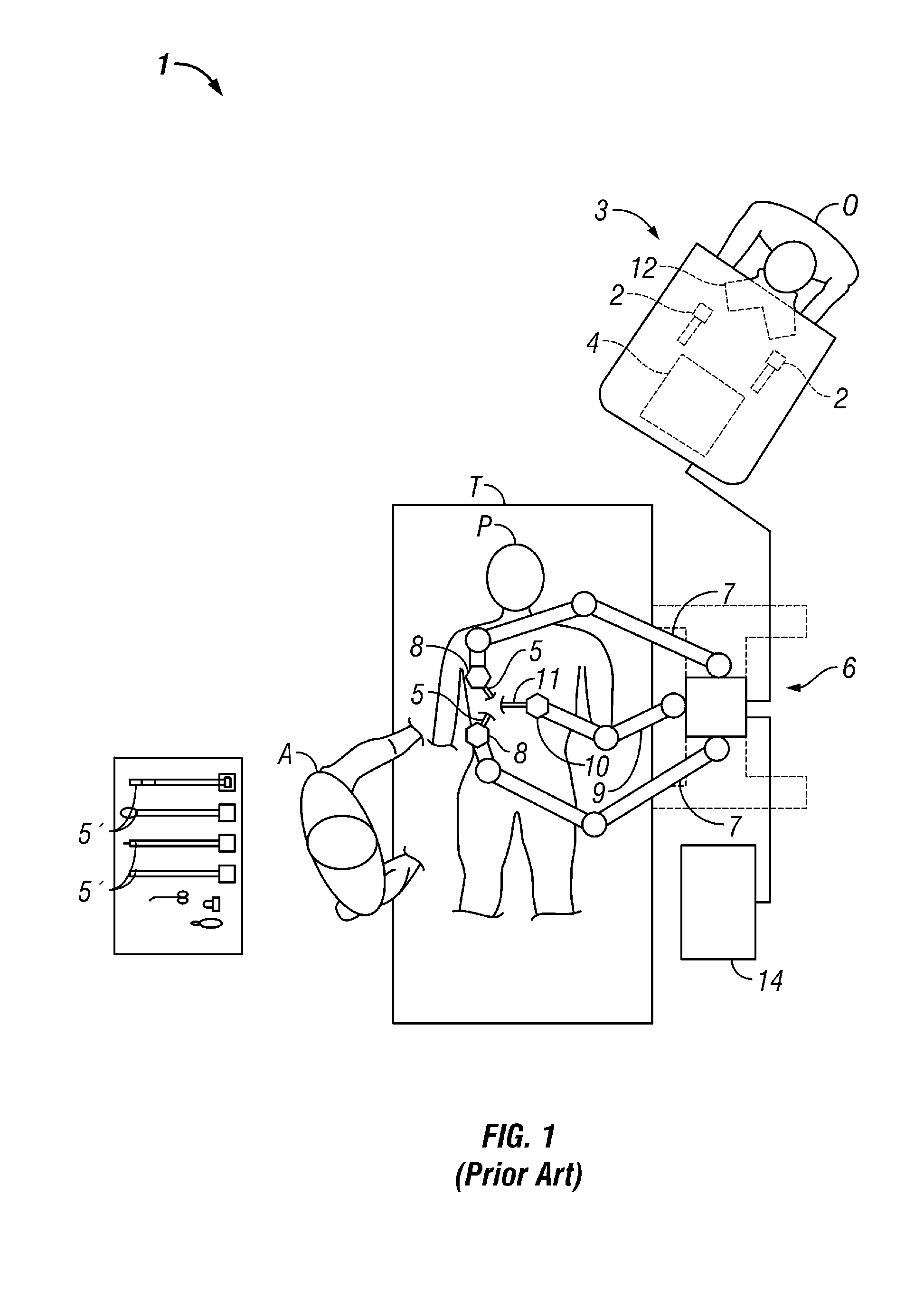
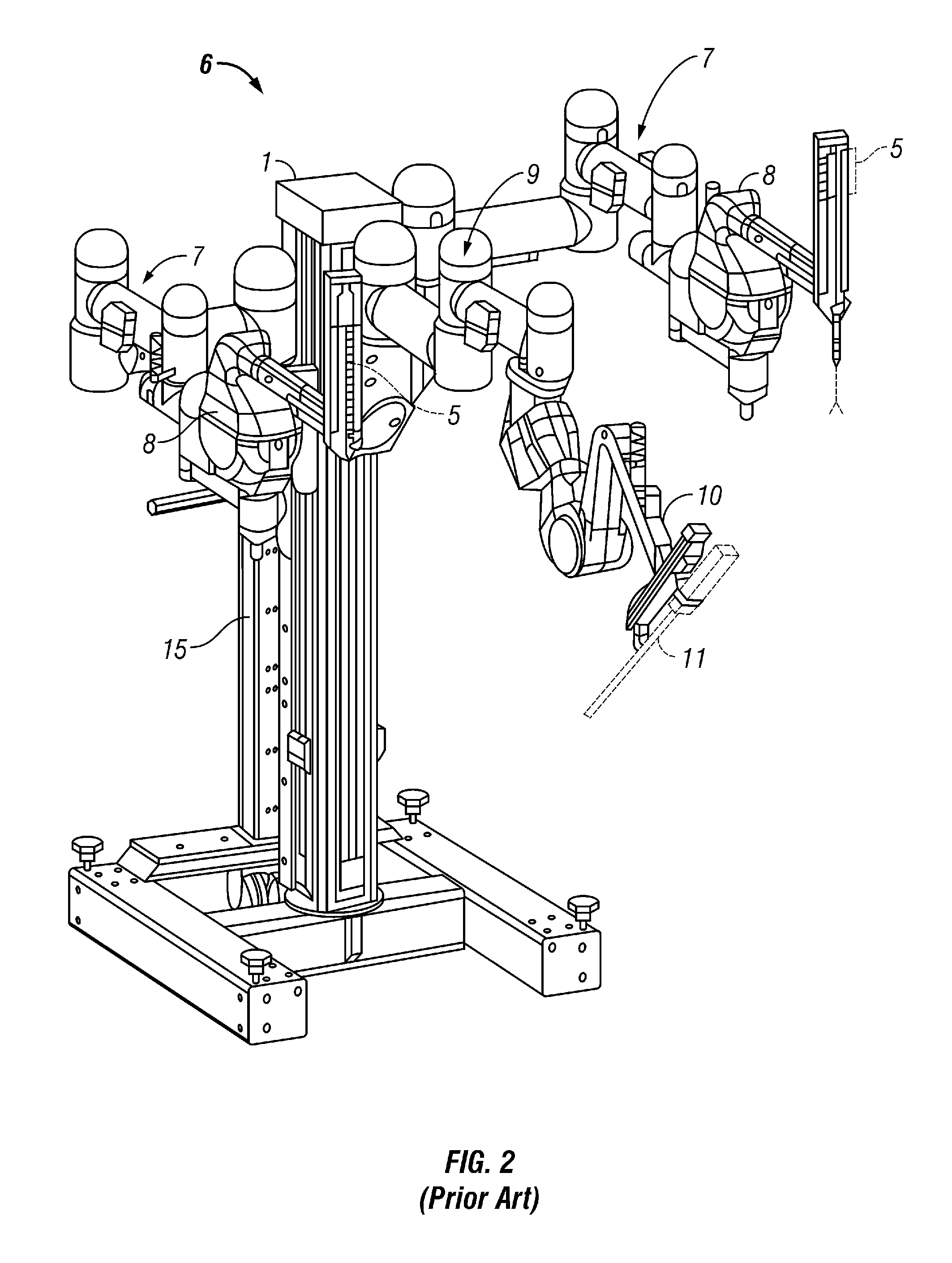
[0008]The present invention is generally related to medical, surgical, and / or robotic devices and systems. In many embodiments, the present invention provides minimally invasive robotic surgery systems having improved structures for supporting and aligning robotic manipulators, such as manipulators for moving a surgical instrument, an endoscope or other image capture device, with desired surgical incision sites in a patient's body. Improved modular manipulator support can provide several advantages, including increased maneuverability, improved space utilization in an operating room, a faster and easier set-up, collision inhibition between robotic devices during use, and / or reduced mechanical complexity and size of these new surgical systems. Such advantages in turn enhance the efficiency and ease of use of such robotic surgical systems.
[0010]The mounting base preferably comprises a ceiling supported structure so as to permit the articulate support assembly to extend generally downward from the base. A ceiling mounted articulate support assembly advantageously improves space utilization in an operating room, particularly clearing up space adjacent the operating table for personnel and / or other surgical equipment as well as minimizing robotic equipment and cabling on the floor. Further, a ceiling mounted articulate support assembly minimizes the potential for collisions or space conflicts with other adjacent manipulators during a procedure and provides for convenient storage when the robotic surgery system is not in use.
[0011]The platform linkage preferably comprises a linear rail, a slidable carriage coupleable to the rail, and at least one arm rotationally coupleable to the carriage on a proximal end and to the orienting platform on a distal end. The platform linkage advantageously enhances maneuverability of the articulate support assembly by accommodating translation of the orienting platform in at least three dimensions as well as rotation of the orienting platform about one axis. The orienting platform's enhanced range of motion permits access to incision sites over a wide range of the patient's body. This may be beneficial when performing complicated and lengthy procedures, such as colon surgery, multi-vessel coronary bypass graft procedures, heart surgery, gastric bypass, and the like, by facilitating quick repositioning of the manipulators mid-operation to alternative surgical sites.
[0013]Generally, the orienting platform supports three set-up joint arms for movably supporting instrument manipulators and one set-up joint arm for movably supporting an image capture device manipulator. Utilization of the orienting platform to support the individually positionable set-up arms and associated manipulators advantageously results in a relatively small and compact manipulator support structure that is mechanically less complex. For example, the single orienting platform can allow for a faster and easier set-up by avoiding delays and complexities associated with independently configuring each set-up arm.
[0017]Preferably, at least one manipulator comprises an offset remote center linkage for constraining spherical pivoting of the instrument about a pivot point in space, wherein actuation of the fixable links and joints of the set-up joint arm moves the pivot point. Surprisingly, the set-up arms may be simplified (e.g., with no more than four degrees of freedom) due to the increased range of motion provided by the offset remote center manipulators. This allows for a simpler system platform with less pre-configuration of the set-up joint arms. As such, operating room personnel may rapidly arrange and prepare the robotic system for surgery with little or no specialized training. Exemplary offset remote center manipulators providing for reduced mechanical complexity of the set-up arms are described in further detail in U.S. patent application Ser. No. 10 / 957,077.


 Login to View More
  Login to View More