
Freezing detection method for fuel cell
a detection method and fuel cell technology, applied in the field of freezing detection method of fuel cells, can solve the problems of increasing energy loss, adversely affecting a member of the fuel cell, water generated within the fuel cell may freeze, etc., and achieves the effect of less malfunction, less energy loss, and precise detection of the freezing of the fuel cell uni
- Summary
- Abstract
- Description
- Claims
- Application Information
AI Technical Summary
Benefits of technology
Problems solved by technology
Method used
Image

Examples
example 1
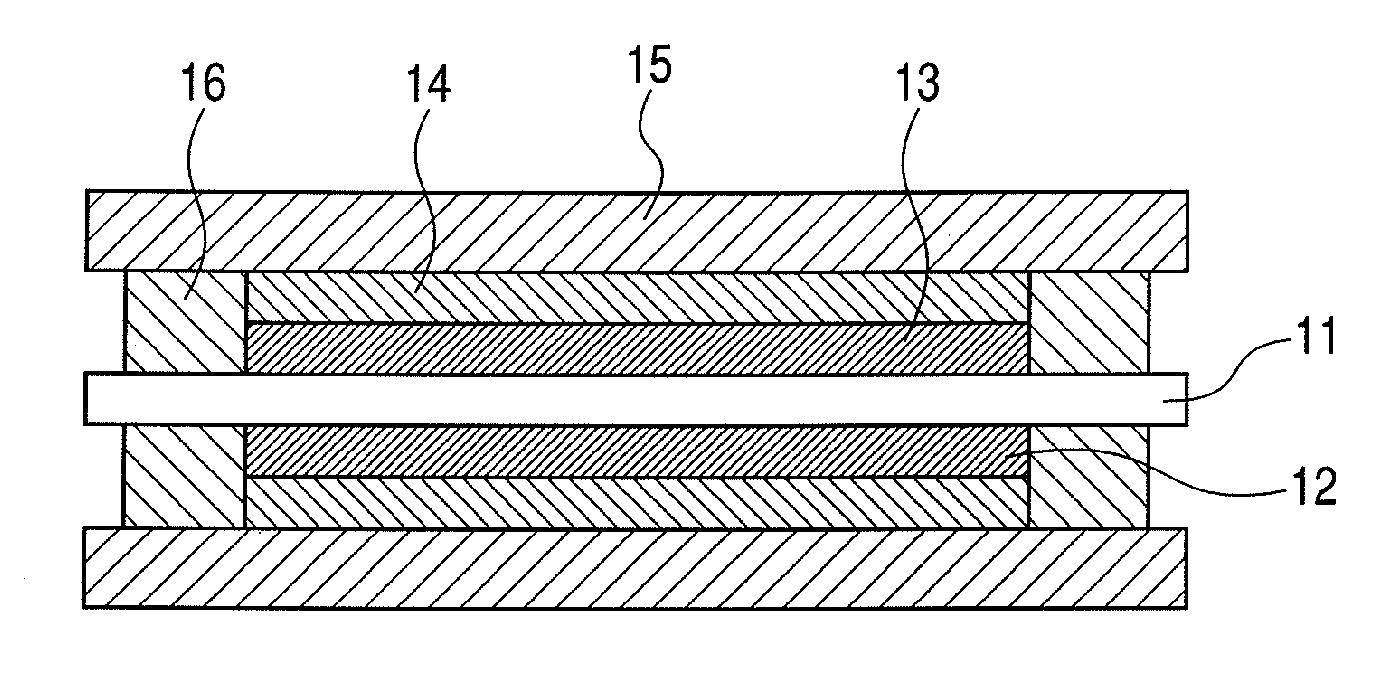
[0058]First, a membrane electrode assembly (MEA) obtained by bonding 2 cm squares of platinum black as the catalyst layers 12 and 13 to both sides of a Nafion (registered trademark of Du Pont Kabushiki Kaisha) as the electrolyte 11 by a hot press was prepared. Then, both sides of the MEA were sandwiched between carbon cloth pieces each as the gas diffusion layer 14, and further sandwiched the MEA from the outside between the collectors 15 obtained by plating SUS with gold and formed with the reaction gas flow paths so as to be fastened. In this manner, a fuel cell as illustrated in FIG. 1 was produced.
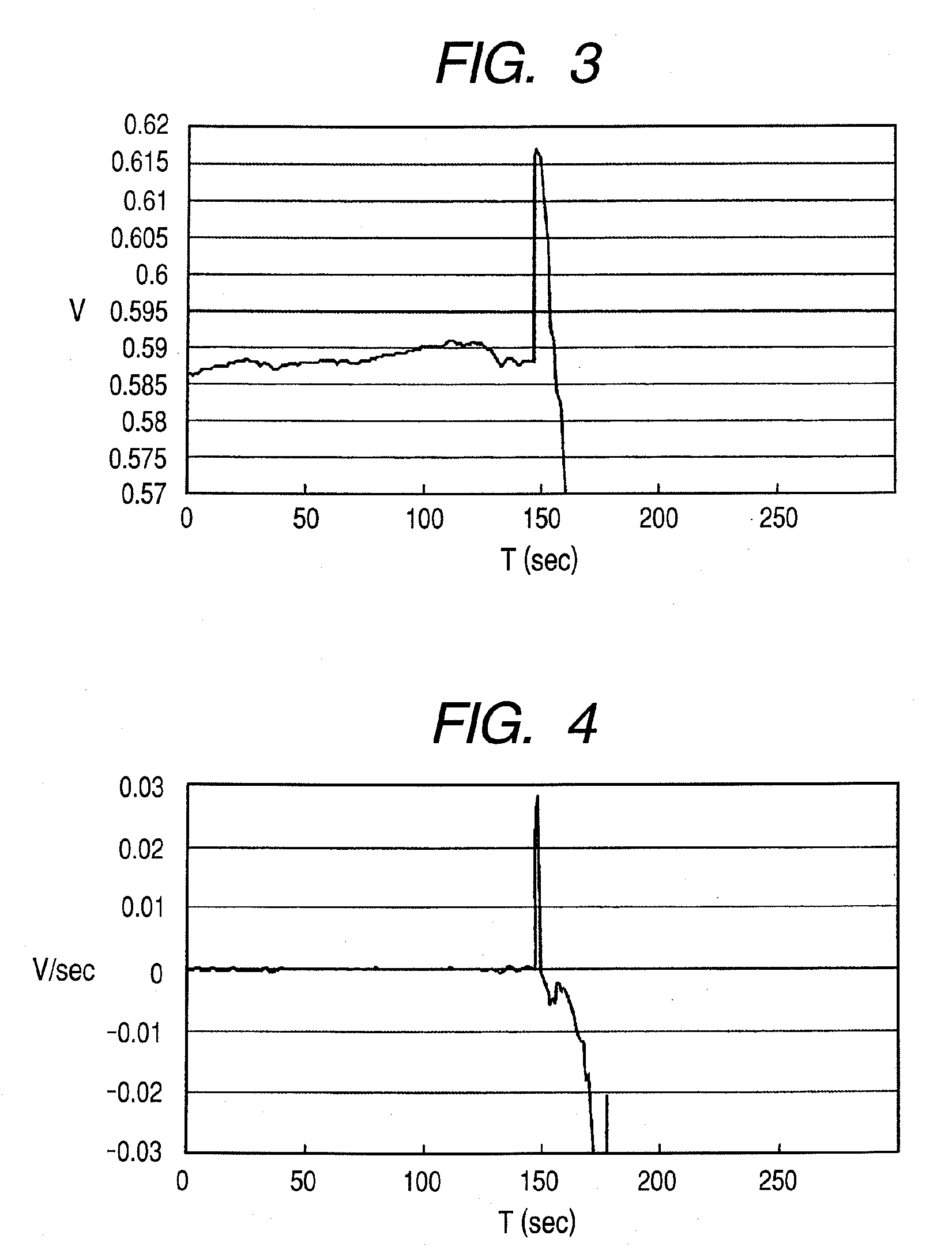
[0059]The fuel cell thus produced was placed in an environment tester, and held in a constant atmosphere at −15° C. for a period of one hour or more. Then, power generation was started with a constant current of 50 mA / cm2. After the power generation was continued for a while, a rise in voltage was observed at a certain time, as illustrated in FIG. 9. The change in voltage indicates tha...
example 2
[0060]Using the same fuel cell as used in Example 1, the same test as conducted in Example 1 was conducted except that freezing was detected using the secondary differential value of the output voltage instead of the differential value thereof. That is, at the time when the secondary differential value of the output voltage reached a value not more than −5 mV / sec2 (second step) after reaching the value not less than 5 mV / sec2 (first step), the fuel cell was heated using a heating unit. In this case also, after heating was performed, the output voltage that had temporarily dropped was gradually recovered to enable the power generation to be continued.
example 3
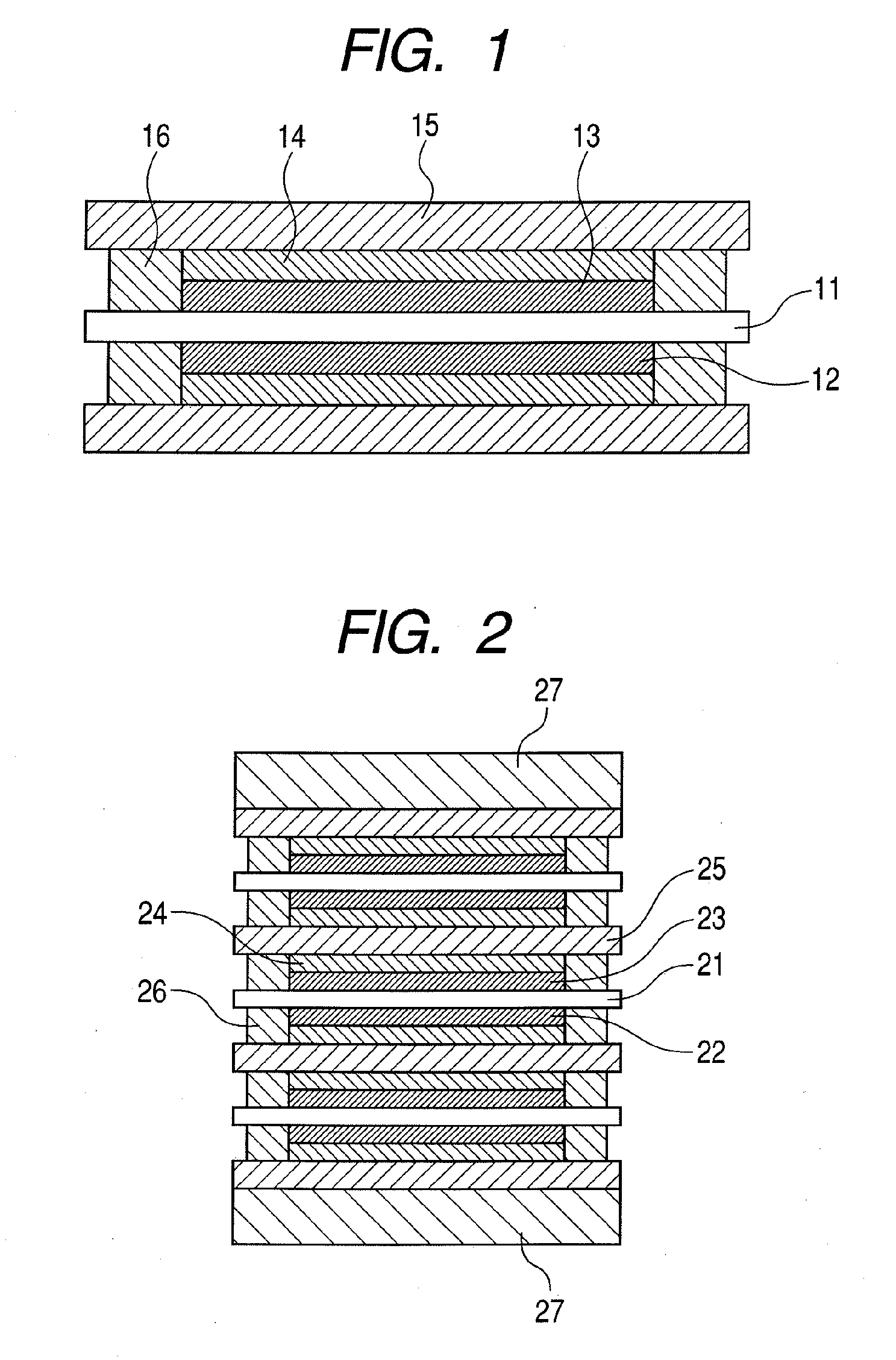
[0061]In Example 3, the fuel cells produced in Example 1 were stacked in a 3-cell series configuration to produce a fuel cell stack as shown in FIG. 2. Then, in the same manner as in Example 1, the fuel cell stack was placed in an environment tester, and allowed to stand in an atmosphere at −15° C. for a period of one hour or more. Thereafter, power generation was started with a constant voltage of 2.4 V. After the power generation was performed for a given period of time, a change in current indicating that freezing had started within the stack as illustrated in FIG. 10 appeared. At the time when the differential value of the output current changed to a value not more than −5 mA / sec after reaching the value not less than 5 mA / sec and when the secondary differential value of the output current reached a value not more than −5 mA / sec2 after reaching the value not less than 5 mA / sec2, the fuel cell was connected to a short circuit, and short-circuited. FIG. 11 represents the transitio...
PUM
| Property | Measurement | Unit |
|---|---|---|
| resistance | aaaaa | aaaaa |
| pressure | aaaaa | aaaaa |
| cell resistance | aaaaa | aaaaa |
Abstract
Description
Claims
Application Information
 Login to View More