Unlock instant, AI-driven research and patent intelligence for your innovation.

Multi-Stage Supply Chain Management System With Dynamic Order Placement

a supply chain management system and multi-stage technology, applied in the field of multi-stage supply chain management system with dynamic order placement, can solve the problems of shortening the product life cycle, increasing the complexity of the supply network, and affecting the market conditions,

Inactive Publication Date: 2009-10-15
E2OPEN
View PDF18 Cites 13 Cited by
  • Summary
  • Abstract
  • Description
  • Claims
  • Application Information

AI Technical Summary

Benefits of technology

The system ensures accurate and timely information exchange, reduces supply chain escalation, and enhances visibility, enabling efficient management of complex supply chains by standardizing data across fragmented systems, thus improving cost management and productivity.

Problems solved by technology

Supply chain management is affected, for example, by the globalization of businesses, the proliferation of product and service variety, the increasing complexity of supply networks, and the shortening of product life cycles.
Market conditions are susceptible to rapid demand fluctuation, inventory buildup, price competition, and frequent specification changes.
Outsourcing increasingly is involving more and more suppliers and supply chains are growing more complex.
When outsourcing is employed in the supply a chain, the visibility into the current status of the supply chain is more difficult and requires new and improved methods for insuring that complete, accurate and timely information is available.
In the absence of such current information, the ability to react in a timely way to exceptions, abnormal events and other matters may be lost or delayed.
When the time for taking action is not recognized or is delayed, supply chain management suffers and ultimately the cost of goods and services increases.
Although internet commerce simplifies many aspects of procurement, difficulties still exist and improvements are needed.
One difficulty results because large numbers of suppliers and buyers are attached to the market place and each participant, whether buyer or supplier, tends to use different parameters, terminology, terms, conditions and other information unique to the particular participant.
These differences among participants result in an information exchange problem.
The information exchange problem is particularly acute, for example, in the outsourcing semiconductor manufacturing industry because goods and services procured from one supplier are frequently further processed by other suppliers in subsequent downstream stages.
One difficulty that frustrates the good visibility necessary for supply chain management is the proliferation of different terminology and specifications used by each participant in the supply chain.
While any dominating buyer (and potentially any dominating supplier) can demand conformance with its way of doing business for its own business, the semiconductor C, manufacturing industry as a whole remains widely fragmented without much progress toward standardization.
Furthermore, this fragmentation is increasing rather than decreasing so that problems are bound to exist for many years to come.
Notwithstanding these attempts, the semiconductor manufacturing industry remains fragmented and neither the RosettaNet nor any other standard has become widely adopted.

Method used

the structure of the environmentally friendly knitted fabric provided by the present invention; figure 2 Flow chart of the yarn wrapping machine for environmentally friendly knitted fabrics and storage devices; image 3 Is the parameter map of the yarn covering machine
View more

Image

Smart Image Click on the blue labels to locate them in the text.
Viewing Examples
Smart Image
  • Multi-Stage Supply Chain Management System With Dynamic Order Placement
  • Multi-Stage Supply Chain Management System With Dynamic Order Placement
  • Multi-Stage Supply Chain Management System With Dynamic Order Placement

Examples

Experimental program
Comparison scheme
Effect test

Embodiment Construction

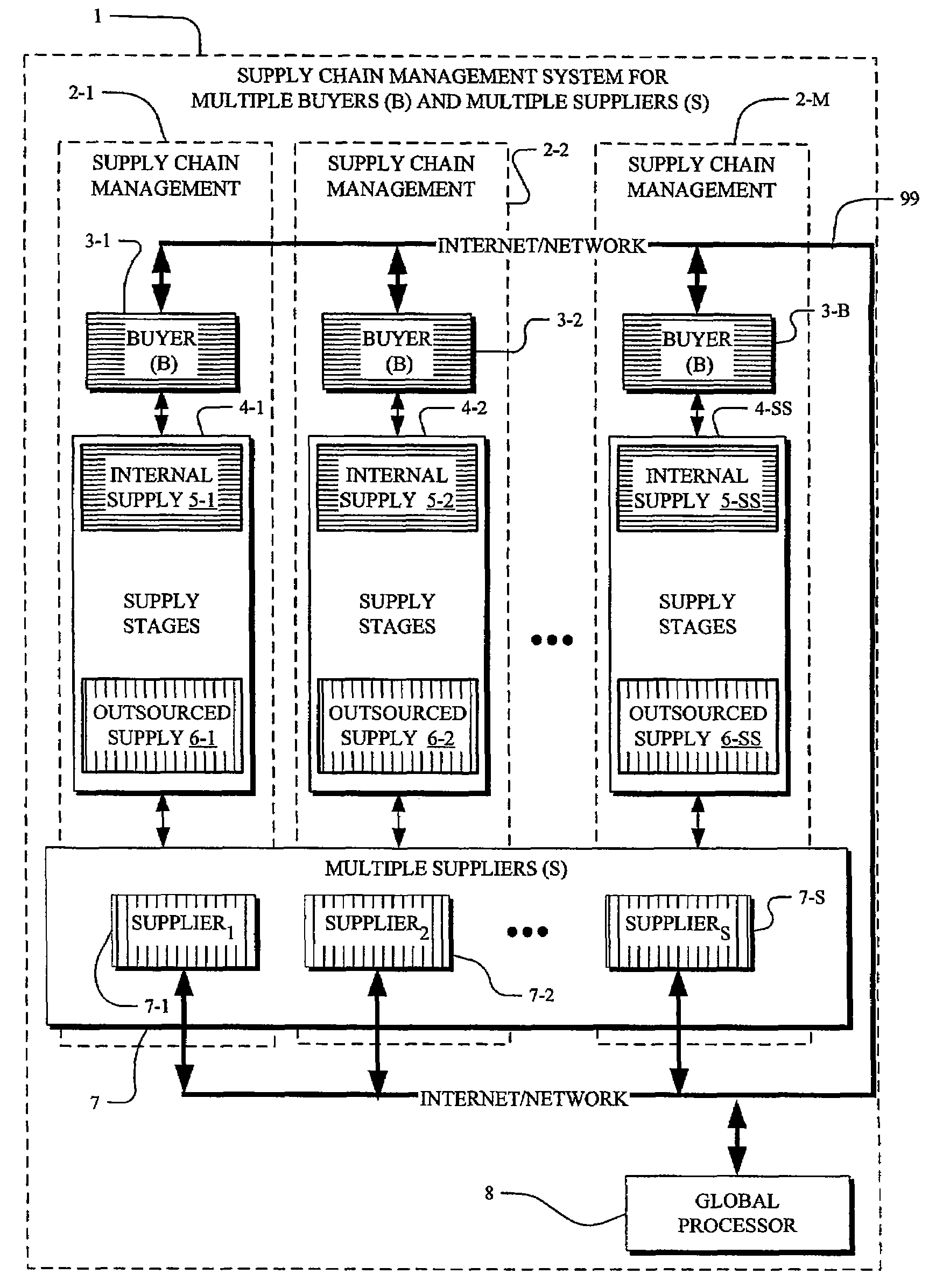
[0051]FIG. 1 depicts a plurality of supply chain management systems 2-1, 2-2, . . . , 2-M organized on an individual buyer (B) basis for the buyers 3-1, 3-2, . . . , 3-B in an environment also including multiple suppliers 7-1, 7-2, . . . , 7-S. FIG. 1 also depicts a supply chain management system 1 serving all the multiple buyers 3-1, 3-2, . . . , 3-B and multiple suppliers 7-1, 7-2, . . . , 7-S. The multiple buyers and multiple suppliers of FIG. 1 are connected over the internet and hence are able to exchange supply information rapidly and essentially in real time.

[0052]In FIG. 1, the local supply chain for each buyer includes supply stages 4 that typically include internal supply 5, that is, supply from the buyer's own organization, and outsourced supply 6, that is, supply from external suppliers 7-1, 7-2, . . . , 7-S. Specifically, the buyers 3-1, 3-2, . . . , 3-B have the supply stages 4-1, 4-2, . . . , 4-B, each in turn having the internal supply 5-1, 5-2, . . . , 5-SS and the ...

the structure of the environmentally friendly knitted fabric provided by the present invention; figure 2 Flow chart of the yarn wrapping machine for environmentally friendly knitted fabrics and storage devices; image 3 Is the parameter map of the yarn covering machine
Login to View More

PUM

No PUM Login to View More

Abstract

A global supply chain management system in an environment of multiple suppliers forming supply chains for one or more buyers connected over the Internet. The system includes a global processor with logic that maps “local” supply information for each buyer and each supplier, represented in one or more property tables having master information correlated to local information for each buyer and each supplier. The system manages processes from an input of lots to an output through supplier stages where clients each use fragmented different local information. A correlation means uses base lot indicators, one for each of the lots in common for all of said stages and executes supply chain management functions for tracking lots through the supplier stages and for dynamic creation of sets of purchase orders among groups of suppliers for processing the same lot through the supply chain.

Description

COPYRIGHT NOTICE[0001]A portion of the disclosure of this patent document contains material which is subject to copyright protection. The copyright owner has no objection to the facsimile reproduction by any one of the patent document or the patent disclosure, as it appears in the Patent and Trademark Office patent file or records, but otherwise reserves all copyright rights whatsoever.BACKGROUND OF THE INVENTION[0002]The present invention relates to internet commerce and particularly to methods and apparatus that enable efficient management of procurement transactions between buyers and suppliers in a supply chain that includes outsourcing with multiple suppliers.[0003]Today, buyers and suppliers operate in a fast changing global environment where quantities needed, pricing, technical specifications and other supply parameters are frequently changing. The supply chain for procurement of goods and services requires economies of scale, market pricing and rapid delivery. The managemen...

Claims

the structure of the environmentally friendly knitted fabric provided by the present invention; figure 2 Flow chart of the yarn wrapping machine for environmentally friendly knitted fabrics and storage devices; image 3 Is the parameter map of the yarn covering machine
Login to View More

Application Information

Patent Timeline
no application Login to View More
Patent Type & Authority Applications(United States)
IPC IPC(8): G06Q10/00G06Q30/00G06Q10/06G06Q10/08G06Q30/06
CPCG06Q10/06G06Q30/0601G06Q10/0875G06Q10/087
Inventor YANG, LOU PINGYIN, MINGTANG THOMASLAW, EDWINWEI, SIQINGLEE, JOHNSON C.
Owner E2OPEN