[0011]With the foregoing in view, it is an object of the present invention to provide an
intraocular lens insertion tool of novel construction adapted to minimize deformation of the intraocular lens, while effectively preventing the intraocular lens from rotating inside the insertion tube.Means for Solving the Problem
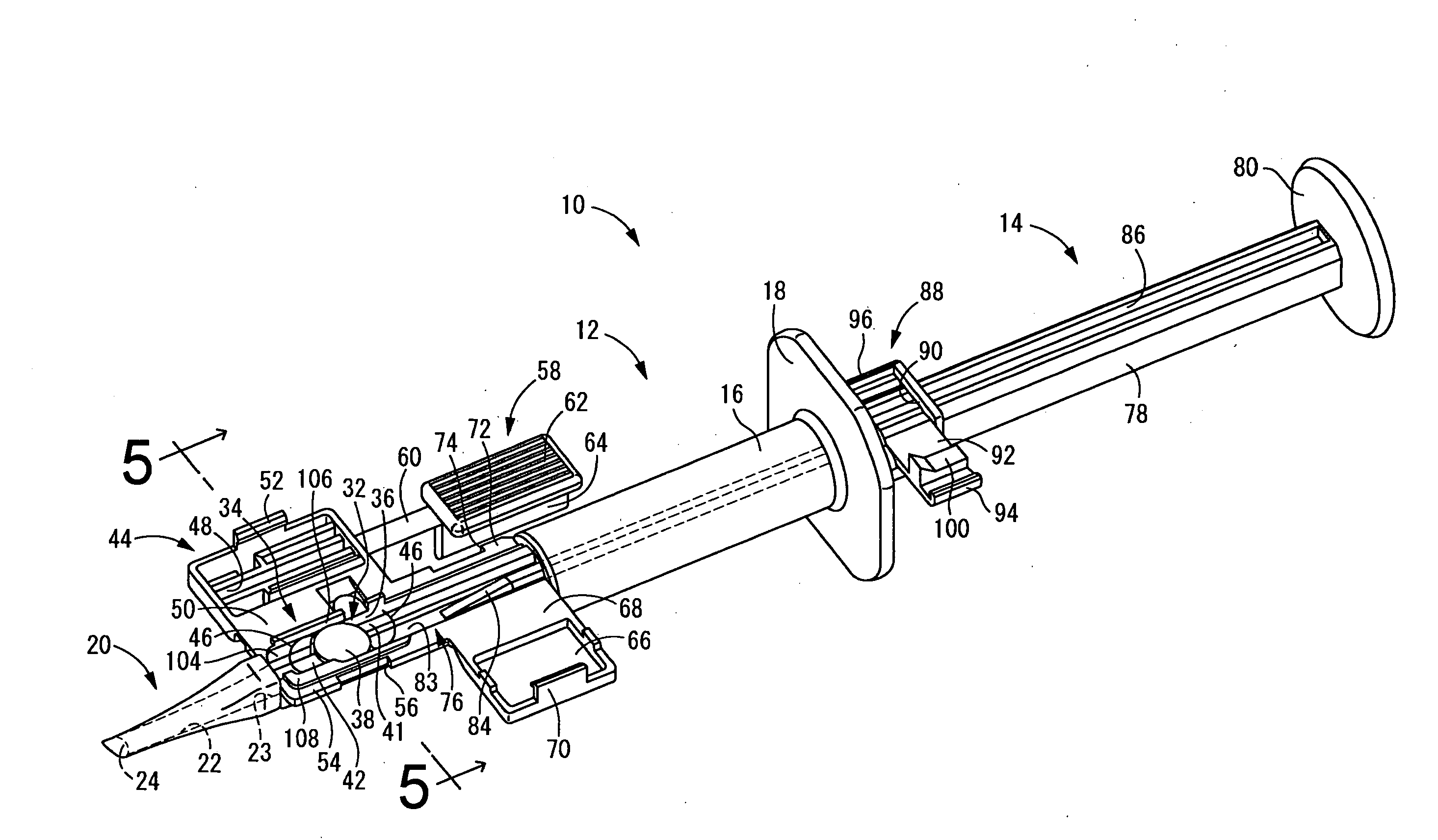
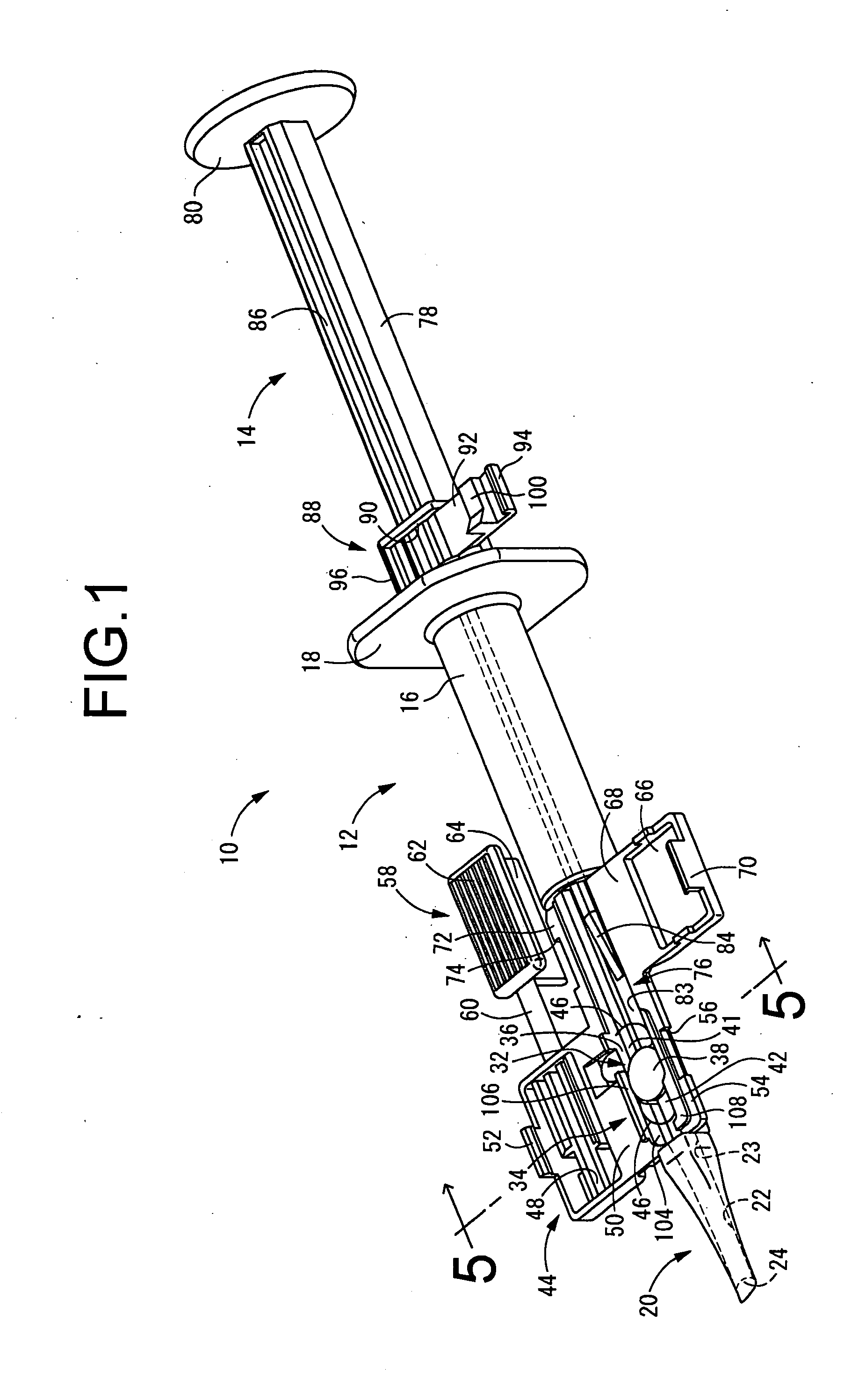
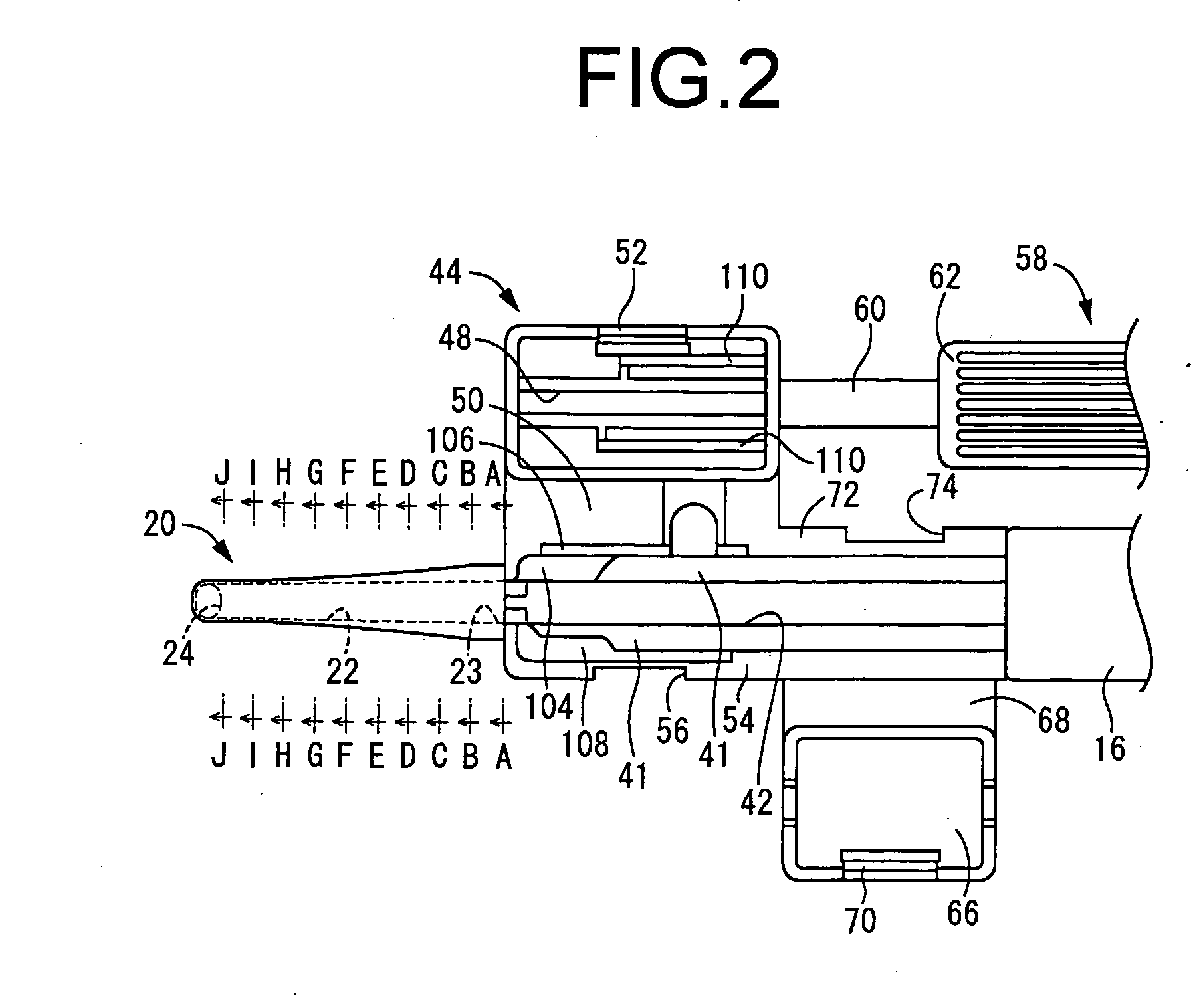
[0013]Specifically, the present invention resides in an intraocular lens insertion tool including a tool body having generally tubular shape for accommodating an intraocular lens, and a plunging member inserted into the tool body from a rear in an axial direction and moved forward for inserting into an eye the intraocular lens such that the intraocular lens undergoes compact deformation in association with forward displacement in the axial direction by the plunging member and is pushed out, characterized in that: an insertion tube disposed at a distal end section of the tool body and adapted for insertion into the eye, viewed perpendicular to a direction of extension thereof, has across an entire length from a proximal end opening to a distal end opening of the insertion tube a cross section wherein an upper and lower portions have
traverse linear portions that extend substantially parallel in a width direction, and left and right portions that connect smoothly with the upper and lower portions; that in at least one part of the insertion tube in the direction of extension towards the proximal end opening, the left and right portions have longitudinal linear portions that extend substantially parallel in a vertical direction; and that the upper and lower portions gradually approach one another due to a
radius of curvature that decreases gradually in an inwardly concave curved shape towards the distal end opening to form a tapered portion having a reduced cross-sectional area, thus producing the distal end opening of substantially oval shape.
[0015]According to the intraocular lens insertion tool of the present invention, the left and right planes inside the insertion tube connect to the upper and lower planes smoothly through common tangents with no inflection point. Thus, even if the intraocular lens should happen to experience displacement in the circumferential direction of the insertion tube, it will be possible to prevent localized excessive force from being exerted on the intraocular lens, and to prevent as much as possible deformation or damage to the intraocular lens.
[0017]Additionally, in a preferred mode of the intraocular lens insertion tool of the present invention, the cross section of the insertion tube viewed perpendicular to the direction of extension will become gradually smaller towards the tapered portion across the entire length from the proximal end opening to the distal end opening of the insertion to be, so that the tapered portion is formed across the entire length of the insertion tube. With this arrangement, the length dimension of the insertion tube can be used effectively to bring about deformation of the intraocular lens to smaller size.
[0018]In another preferred mode of the intraocular lens insertion tool of the present invention, wherein as viewed in cross section in a direction of extension, the lower portion of the tapered portion has a linear shape, whereas the upper portion has an inwardly convex, arcuate curved portion of substantially unchanging curvature which gradually approaches the lower portion towards the distal end opening. With this arrangement, the intraocular lens can be deformed more smoothly while being clamped stably against the lower plane.
[0020]With this arrangement, the intraocular lens can be rested easily in the tool body. Then, by compressing the intraocular lens resting on the stage from above with the clamping projection, the intraocular lens can be steadily deformed to upwardly concave shape while being clamped against the lower plane of the recessed groove. Thus, steady initial deformation of the intraocular lens when pushed into the insertion tube can be achieved with excellent control, making it possible for deformation of the intraocular lens inside the insertion tube to take place more steadily and smoothly.



 Login to View More
  Login to View More