

Lowering and raising a single wind turbine rotor blade from six-o'clock position
a technology of wind turbines and rotor blades, which is applied in the field of wind turbines, can solve the problems of significant expense in renting, procuring, operating and removing large cranes, and the rotor blades may require replacement, and achieve the effect of sufficient load capacity
- Summary
- Abstract
- Description
- Claims
- Application Information
AI Technical Summary
Benefits of technology
Problems solved by technology
Method used
Image

Examples
Embodiment Construction
[0018]The following embodiments of the present invention have many advantages, including allowing replacement of a wind turbine rotor blade without the need for a large expensive heavy-duty crane. The method further allows removal and replacement of the rotor blade with simple equipment in a manner that protects the blade from damage. A blade harness is provided that distributes the weight during the lift over a substantial length of the rotor blade and provides protection for the trailing edge against damage during the lift.
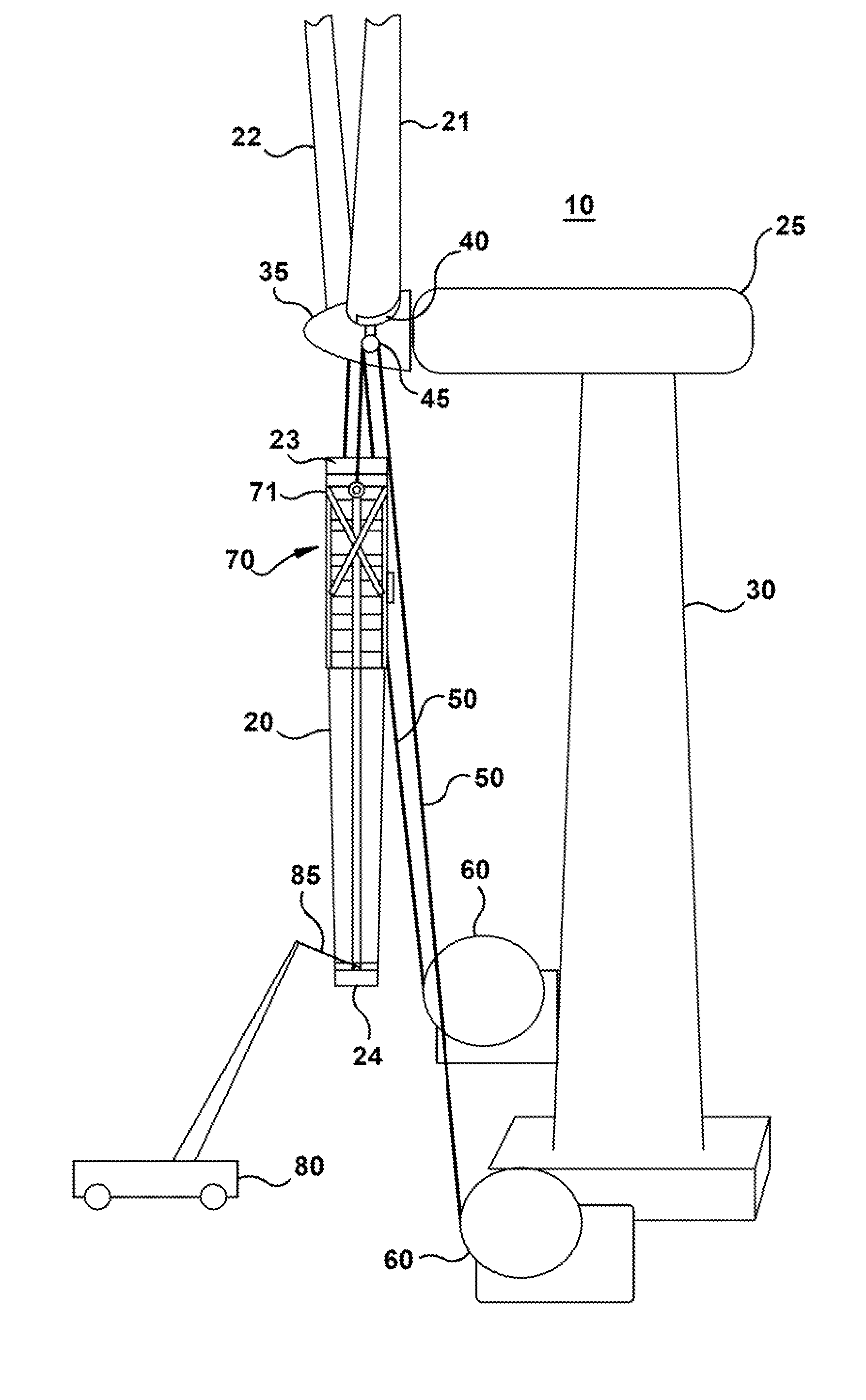
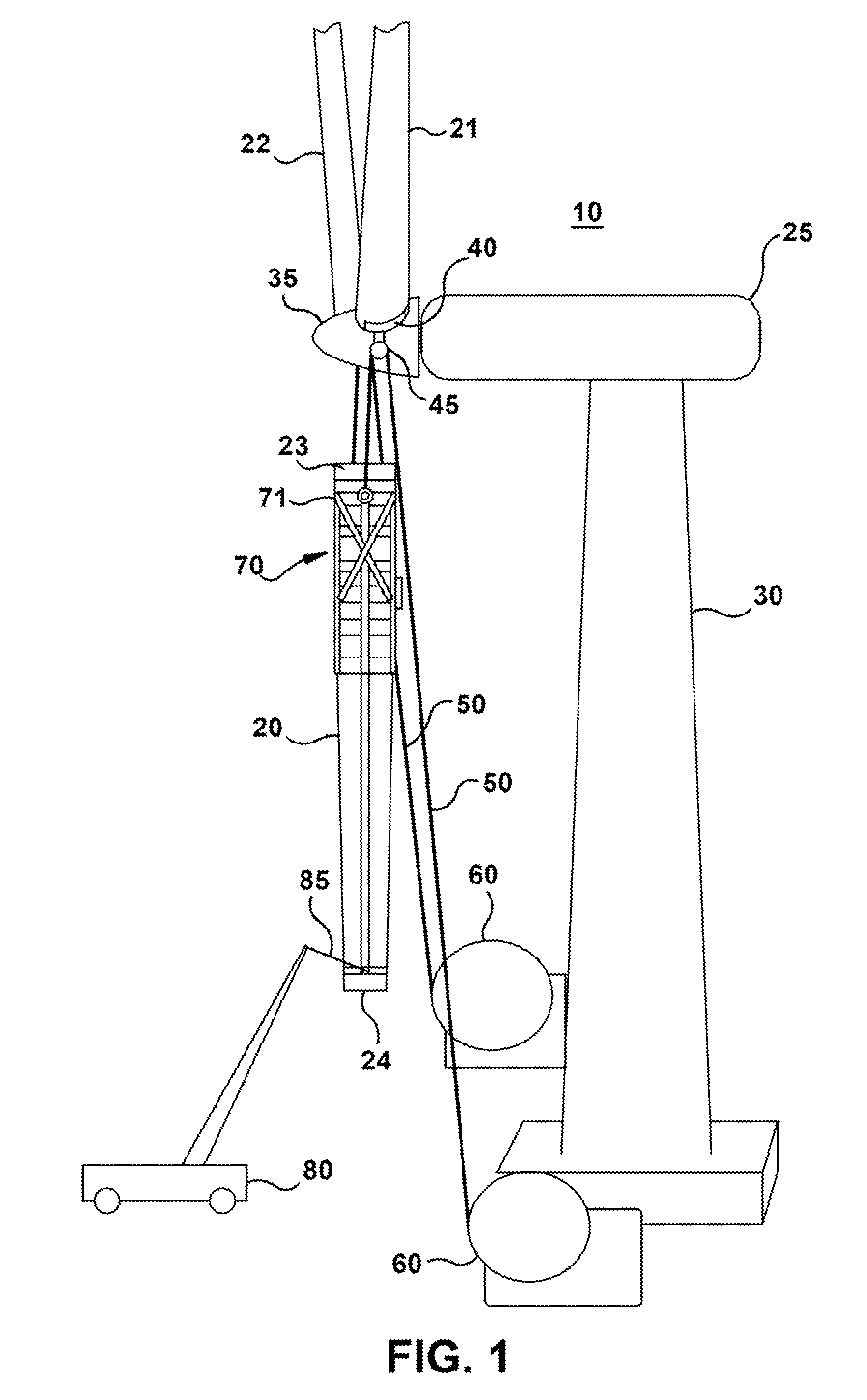
[0019]FIG. 1 illustrates a simplified representation of an embodiment of an arrangement for lifting and removal of a rotor blade from a six-o'clock position on a rotor hub of a wind turbine tower. The lifting arrangement 10 is provided for lifting of a rotor blade 20 mounted in a six-o'clock (vertical-hanging) position. A nacelle 25 is positioned atop the wind turbine tower 30 and houses wind turbine power generating equipment (not shown) connected to a rotor hu...
PUM
| Property | Measurement | Unit |
|---|---|---|
| length | aaaaa | aaaaa |
| pressure | aaaaa | aaaaa |
| flexible | aaaaa | aaaaa |
Abstract
Description
Claims
Application Information
 Login to View More